
From the NJ Department of Labor and Workforce Development:
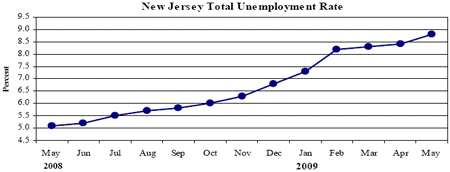
Job losses slowed in May as New Jersey employers reduced employment by 6,200 over the month, the smallest monthly drop since September 2008. The state’s unemployment rate moved to 8.8 percent while remaining lower than the national rate of 9.4 percent.
According to preliminary estimates from the New Jersey Department of Labor and Workforce Development’s monthly survey of employers, nonfarm wage and salary employment in the Garden State decreased by 6,200 jobs in May, to a total of 3,935,100. The loss was less than half the average monthly drop over the most recent six-month period (-16,000) and mirrors the employment pattern nationally. The previously released April estimate was revised lower by -4,300 for a revised March-to- April loss of 18,700.
“In May, New Jersey’s employment losses somewhat moderated from those of previous months,” said New Jersey Labor Commissioner David J. Socolow. “Through Governor Corzine’s leadership New Jersey is investing state and federal resources in needed infrastructure upgrades. These important projects will help generate jobs for our citizens and help the economy rebound from the global economic recession.”
Over the month, six of ten private industry sectors realized losses while four recorded gains. Public sector employment was higher by 400. The largest losses occurred in trade, transportation and utilities (-5,800), construction (-4,900) and information (-1,100). Increasing jobs in heavy and civil engineering construction, mainly due to infrastructure projects getting underway, were not enough to offset contractions in commercial and residential construction. In trade, transportation and utilities the majority of the loss was in retail trade.
Job gains were concentrated in leisure and hospitality (+5,200) and other services (+1,300). Hiring was evident in both the accommodation and food services, and arts, recreation, and amusements components of leisure and hospitality as businesses ramp up for the summer season. The gain in other services was due to higher payrolls at businesses such as automotive repair services, personal care services and business/professional organizations.
first!
second
Tax news of the day:
I am not touching this one. I will simply report it and let the assembled have their say.
“Bill Offers Tax Incentives to Foster Breastfeeding
Rep. Carolyn Maloney (D-N.Y.) June 11 introduced legislation (H.R. 2819) that would offer employers a 50 percent tax credit for the costs of encouraging breastfeeding by new mothers in the workplace, up to $10,000 per year for “qualified breast-feeding promotion and support expenditures.”
Under the bill, which would amend the Fair Labor Standards Act, those expenditures would include breast pumps and other equipment specially designed to assist mothers who are employees to breastfeed or express milk for their children, and for consultation services relating to breastfeeding. The equipment would have to remain at the workplace. The bill would require employers of 50 or more employees to provide breastfeeding employees with “reasonable break time” to express breast milk during the workday for one year after the birth of a child, but would not require that they be paid for that time.
H.R. 2819 was referred to the House Committee on Ways and Means, the House Energy and Commerce Committee, and the House Labor and Education Committee.”
This one is for you, Stu. I used to live next to this rink, and I think I would prefer these guys to the yahoos that hung out in the parking lot and drank after games.
http://www.cnn.com/2009/LIVING/wayoflife/06/17/hockey.seniors/index.html
The previously released April estimate was revised lower by -4,300 for a revised March-to- April loss of 18,700.
Oops!
#5 grim: frank here is the recession?
“Job gains were concentrated in leisure and hospitality (+5,200)”
– WTF??!!? Are people taking vacations and going to fancy dinners after losing their jobs?
I heard it’s contained to subprime. A real estate professional told me. ;)
#7 – Is this seasonal spring hiring (think shore)?
#7 – Those are most likely summer jobs and stuff on the shore.
Grim (9) –
Is there a way we can compare this number to last year’s?
i guess we can talk about everything including mens bikini’s but the post below is in actually regards to real estate so pay no attention to it.
—————————
“In the New York metropolitan area they may drop 40.6 percent from the first quarter to the bottom, the report said, less than Deutsche Bank’s March estimate of 47.4 percent.”
So whats the deal? Is DB predicting that ny prices will fall another 40% from current prices?
The way it is written is confusing because they start out by saying “many metro areas will see another 16.5% decline from today” but then they say that NY will decline another 40%. There is obviously a huge difference between another 16% drop and another 40% drop in NY, depending on how you read it. Can someone please weigh in here.
Ruehl no mas
from businessweek;
Abercrombie & Fitch to shut its 29 Ruehl stores
Abercrombie & Fitch Co. said Wednesday that it will shut all of its Ruehl stores by the end of the fiscal year, as the recession has proved too much for the brand to bear.
The retailer said the pullback in consumer spending that was prompted by the economic downturn weighed on its 29 Ruehl stores and the brand’s direct-to-consumer operations. The stores were aimed at older shoppers than its namesake teen apparel chain.
“Given the current economic environment, we believe it is in the best interests of the Company to focus its efforts and resources on the growth opportunities afforded by our other brands, particularly internationally,” Chief Executive and Chairman Mike Jeffries said in a statement.
http://www.businessweek.com/ap/financialnews/D98SG5T00.htm
More tax news of the day:
“Shulman, Geithner Seek Modernization
Of Tax Law on Employer-Provided Cell Phone
Internal Revenue Service Commissioner Douglas Shulman and Treasury Secretary Timothy Geithner, in a June 16 statement, called on Congress to clarify that no tax consequences will be levied upon employers or employees for personal use of cellular phones provided by employers.
In Notice 2009-46 released June 8, IRS asked for comments on ways it could simplify compliance with rules pertaining to employer-provided electronic devices, such as cell phones.
Shulman called current law on employer-provided cell phones “burdensome,” and said it would still confuse businesses and their employees even if it were modified to include some of the proposed clarifications, he said.
“The passage of time, advances in technology, and the nature of communication in the modern workplace have rendered this law obsolete,” Shulman said in the statement. . . .”
Love the spin. Shulman issues notice to suggest that this long-extant law is gonna be enforced; people go nuts; and administration decides to “modernize” law by killing it.
Thanks Nom,
I know what you are talking about when you mention those kids who drink in the parking lot after the games. I swear, those discussions could last longer than the game. Maybe I will play for the bald eagles one day.
[12] Veto,
I read the 16% number as pertaining to the whole country. The 40.6% number is the Q12009 to trough estimate for NYC.
In need of free advice:
My ex employer had a Dependant Child account.
When I left I had to get the money for 2008 tax year within a certain time frame, which I did.
I was still owed $769 for 2009 tax year.
I was just told by ADP that the money was forfeit as I did not apply for it within 60 days of being laid off.
I am pi$$ed to say the least. I wasn’t informed of this on leaving. They kept changing the forms around the same time which meant that claims were getting kicked back and most importantly IT IS MY FREAKING MONEY!!!!!
Those %$#%^^ are holding MY hard earned money.
Recourse?
How long before out of state internet purchases become a Corzine or federal target for taxation?
Layoffs at one of the big NY law firms today. Green shoots/recession is over indeed.
18 stu,
I thought that you were alread supossed to “report” internet purchases to state tax authorities…..
Veto
I read it the same way that goonsquad did
I read the 16% number as pertaining to the whole country. The 40.6% number is the Q12009 to trough estimate for NYC.
#11 – Vic – The press release (pdf warning) shows that the ‘Leisure and Hospitality’ sector lost 9.4% YOY from `08 – `09. So we’re seeing a month on month bump in seasonal employment which is down YOY. There was a MOM jump from 330k to 345k in the sector last year; with a MOM jump of 323k to 343k this year.
#21 – Hospitality’ sector lost 9.4% YOY from
Hang on, I mis-read that. The sector lost 9400 jobs not 9.4%, duh on my part.
“[12] veto, the 40.6% number is the Q12009 to trough estimate for NYC.”
goonsquad,
if that is indeed what it says, i wonder if everyone realizes that this is one of the more extreme predictions that this board has ever witnessed? and its coming from the mouth of a global bank.
i think i just shat myself.
[23] veto,
“if that is indeed what it says, i wonder if everyone realizes that this is one of the more extreme predictions that this board has ever witnessed?”
I did indeed notice this. Interestingly, their March estimate of 47.4% peak-to-trough I must have missed. They revised their estimate downward to the 40.6% number.
TM-
Hospitality lost because AC has been crushed. Anybody see that TROP sale price last week?
The company that laid me off in Apri was chopped last Friday. They let go about 60% of their reduced workforce. Very sad indeed. I feel awful for my former friends that did not see it coming?
kettle, side note.
another 40% decline to trough lines up almost exactly with our monthly cs predicted chart, through 2016.
Yeah, the boys at Deutsche are making me look like Mr. Sunshine with my 30% off peak prediction.
30% looks downright optimistic at this point.
My my, how times have changed.
http://blogs.wsj.com/developments/2009/06/16/deutsche-bank-predicts-40-drop-in-new-york-home-prices/
…specifically says “How much further could home prices tumble in the New York City metro area? Deutsche Bank predicts a decline of 40.6% from the first quarter of 2009” so yeah, its a showstopper of a forecast.
I think the reason people are glossing it over is because there are so many numbers thrown around today, we have dumped billions and billions into the economy at taxpayer expense without people burning down D.C., and 90% of any forecasts out there are going to be VERY wrong.
So, even though I think this 40% decline from March 2009 is very possible, I think it will very much vary from town to town, block to block. The places I am looking to move, I don’t think will see 40% drops from today but I am sure many would argue with me. Another 15% would not surprise me.
Veto,
when do we start our own consultant group to the banks?
#25 – That’s a good point. I keep thinking of the sector as made up of minimum wage summer jobs and forgetting AC.
Wouldn’t a 40% decline just put the NYC area in line with the other bubble areas that have already fallen harder?
Basically, it sounds to me like DB is saying NYC is not immune, just a step behind
Why bother, just start a hedge fund.
Even better, join the NJVF.
BC, 3b
want to start a hedge fund with Veto and I????
ket,
The NJ Vulture Fund concept has been floated here on a number of occasions.
JPMorgan’s Lee sees S&P 500 retest of ’07 record
REUTERS — 59 MINUTES AGO
By Ellis Mnyandu
NEW YORK (Reuters) – The benchmark S&P 500 index should surge back to its October 2007 record above 1,500 by the end of 2012, provided the U.S. economy sees a V-shaped recovery, JPMorgan Chase Chief U.S. Equity Strategist Thomas Lee said on Wednesday.
“The global economy is in the midst of a synchronized recovery,” Lee said at the Reuters Investment Outlook Summit. “If we end up with a V-shaped recovery, we could go back to our record high of 1,500 in 2011-2012,” he added, referring to the S&P 500.
The S&P 500 fell 0.4 percent to 908 on Wednesday.
Lee also reiterated his year-end 2009 target of 1,100 for the S&P 500, saying the United States will likely come out of its recession some time this summer, followed by the rest of the developed world.
Can I create an ETF that shorts this said hedge fund with 4X leverage?
#13 – Reuhl
Lots of talk today about the Eddie Bauer bankruptcy as well.
Grim,
you are correct, i am behind the curve apparently :(
stu,
Wouldnt you want to go long said hedge fund? or are you taking over pretorious’ investment portfolio?
#28 seneca:Another 15% would not surprise me.
At a minimum, we are finally just really getting started here with the declines. As far as differencnes from town to town and block to block, yes less desireable areas will fall more, but so will the so called desireable areas. For your typical surburban town you wont see block to blok differences unless it is a busy street vs one that is not.
3b,
Clifford Chance?
From the WSJ:
Eddie Bauer is expected to file for Chapter 11 and announce a deal to acquired by private-equity firm CCMP.
Kettle1:
Just trying to be funny and failing miserably.
#35 John:The global economy is in the midst of a synchronized recovery,”
What in God’s name does that mean? And the guys making predictions 3 years out?
Ans with the S&P at 913 now, it is going to rise almost 200 points betweeen the now and the end of the year, just as we are “coming out of the recession”, but than it is going to take another 2 to 3 years to rise another 400 points?
This chief can go back to sleep now.
Grim,
you have mail
#41 grim; Fulbright.
40% from today?
Nooooooooooooooooooooooooooooooooooooo!
NJ Bond of day, trading at 72% higher than same maturity treasury yet completely tax free. Good college fund stuffer.
NEW JERSEY ST TRANSN TR FD AUTH TRANSN 00.00000% 12/15/2029 SYS BDS SER. 2006C
Price (Ask) 29.210
Yield to Worst (Ask) 6.100%
CUSIP 646136ES6
Spread to Treasuries 1.724
#33 I would be honored!!
#48 John: There you go, that is how you price/value a muni. It must be at least 70% above a comprable high grade taxable.
3b BC
what paper work do we file for PiPP / TARP/ XYZ funds??
3b,
we could probably pick up the old Lehman offices on the cheap ;)
This won’t end well
President Obama plans to expand the powers of the Federal Reserve and the Treasury Department.
http://money.cnn.com/2009/06/17/news/economy/regulatory_reform/index.htm?postversion=2009061712
#52 kettle: Just up in that area yesterday. Beautiful building, and they would probably throw in the furniture.
3b,
now we just need a few 10’s of million in seed money. maybe Shoregy can make a few calls for us ;)
lisoosh says:
June 17, 2009 at 12:09 pm
In need of free advice:
My ex employer had a Dependant Child account.
When I left I had to get the money for 2008 tax year within a certain time frame, which I did.
I was still owed $769 for 2009 tax year.
I was just told by ADP that the money was forfeit as I did not apply for it within 60 days of being laid off.
I am pi$$ed to say the least. I wasn’t informed of this on leaving. They kept changing the forms around the same time which meant that claims were getting kicked back and most importantly IT IS MY FREAKING MONEY!!!!!
Those %$#%^^ are holding MY hard earned money.Recourse?
lisoosh: I would say that Pat is likely the best person here to answer the question (if at all). You probably know this fact, but when dealing with employee benefits that are derived from IRC, chances are that despite the completely reasonable and defendable “my dog at my homework” excuses, ADP is likely bound by strictly enforced IRS guidelines. I would assume that regardless of fault, you are in an absolute sense screwed.
That said, it would be interesting to know where the forfeitures are remitted. If they serve to net future contributions by your former employer top the plan, then go back to them.
Personally, I would act 10x more desperate, upset etc. than you are. Don’t be angry…..come off as more suicidal. That last thing your ex-employee wants is to be tied to bad publicity from a laid off worker.
I had to be Machiavellian, but you were rooked, so alls fair….
I had to be Machiavellian…HATE
[18] stu
internet purchases are reportable to state.
No fed sales tax (yet, which is why I am slowly stocking up on durable and nonperishable items)
40% from 1Q was the prediction, no? Does that mean end of March or beginning of January.
I’ll be anxious to see where this month’s case schiller numbers land for NY metro…Still ~10 days away.
former employer top the plan = TO THE PLAN
“Basically, it sounds to me like DB is saying NYC is not immune, just a step behind.”
skep-tic,
Sounds the same to me. I guess that would blow my theory out of the water that we are smarter, more stable and more educated, etc in NJ compared to Cali.
[59] to myself…
Nevermind, the estimate looks at end of march.
[56] chi
Note that the fed guidelines (notably Treas. Reg. 1.125 et seq.] set the outside parameters on how a cafeteria plan/FSA can operate. There is no obligation to adopt the standards in the regs, and companies can make FSAs and cafeteria plans more restrictive if they choose.
Lisoosh should refer to the summary plan description, and if all else fails, file an action since it costs less to pay it out than defend the action.
“40% from 1Q was the prediction, no? Does that mean end of March or beginning of January.”
goon, details in light of the overall predication but end of Mar is my interpretation, or else they would have just said from ‘q4’ or ‘beginning of the year.’
New listing in my town bank owned, asking 424K (too high), decent looking house, really busy, busy stree. Last sold in October of 2003 for 435K
http://www.njmls.com/cf/details.cfm?mls_number=2927422&id=999999
3b, thats realistic at least you get 3 baths.
#55 kettle:Shoregy can make a few calls for us ;)
he can get it done.
veto– I would not be surprised if the rate of decline for the first half of this year is similar to the rate of decline of CA, NV, FL for the same period a year ago.
holy sh!tballs, another 40% leg down from these levels in nj.
i’ll take it. where do i sign?
In all seriousness, i’m sensing the third leg is upon us right here and now. I wont believe it until i see the data but I have the same happy feeling in my stomach just like in Nov of last year when i saw local listings getting slashed 5-10% off asking price accross the board in the same month. I’m currently tracking about 20 different houses in three towns near me in mercer county and just recently in the last two weeks, they all took about $30k off asking prices in tandem like all the realtors attended the same seminar hosted by nouriel roubini. Some houses are nice and priced right but still, they are just sitting and chasing the market down with their 5k slashes every 4 months except the market is falling faster than that and now even though they lowered their asking price 4 times, they are more overpriced then ever.
grim at 27,
The DB analyst is actually a woman, Karen Weaver.
veto at 12,
I looked but couldn’t find anything on the web more than what was posted here, i.e. I was unable to locate the actual report itself. Only Fox Business reported on it so you have to rely on the fact that their one-paragraph synopsis is an accurate reflection of the actual report.
Veto,
if my thesis of a bottom being supported primarily by the price/household income ratio or HPI/household income ratio reaching a stable point in historical terms then both NJ and Cali have about another 40 – 50% to fall depending on if the overshoot is about the same as the 90’s bubble or proportionally larger.
note that a 40% fall in the ratio cannot be directly translated to a 40% drop in prices as the ratio also depends on income. if real household income falls then housing could fall more then the 40% drop likely in the ratio.
A 10% decrease in median household income would suggest we could see a 50% drop in median home prices based on the target for HPI/household income ratio
Note that a 50% drop in home prices and 10% drop in income would put us at the same bottom we were at in the 80’s/90’s bubble burst. if we overshoot that bottom………
In this case yes, this muni is triple AAA just like the USD benchmark. It is 72% more than a taxable treasury, when you add the tax benefits it is more like 100% higher. Believe it or not, pre 2007 munis often traded at 72% of a treasury to account for the tax savings. Any instate NJ Muni with an A or higher rating yielding more than 6% is pure gravy.
Back in 2000 GM bonds were trading at par, yet if GM went bankrupt you would get 15-20 cents on a dollar around an 80% loss. Yet when GM bonds were trading for 5 cents on a dollar and worse case was you would get 15% in bankruptcy or par, meaing anywhere from a 300% return to 20 times your original investment it was “risky”, sometimes higher yield more than offsets the additional risk turn the higher yielding bond into the lower risk bond.
3b says:
June 17, 2009 at 12:56 pm
#48 John: There you go, that is how you price/value a muni. It must be at least 70% above a comprable high grade taxable.
chi / nom –
Thanks for the answers. So is the ultimate decider here ADP or my former employer?
They gave me a claims address – is it worth following formal procedure or just letting things get messy now?
I’m actually stunned. I can see forfeiting the tax benefits and fair enough but to actually take my money is beyond belief.
Chi – will look into where it goes and who gets it. An interesting question.
#65 3b:
How do you know that house is bank owned?
“veto– I would not be surprised if the rate of decline for the first half of this year is similar to the rate of decline of CA, NV, FL for the same period a year ago.”
Easy skep-tic, I already deficated myself today. Are you trying to give me a heart attack too? Actually, me and kettle have begun researching the different regions fundamentals, trying to figure out why there is such a disparity between the various cities price drops. I initially thought it was obvious that cali and Nevada had weaker economic fundamentals but after a few people in here challenged that notion yesterday, im beginning to second guess my whole assumption.
Although i still think ny/nj wont drop as much as some of those weaker states and regions, i cant seem to find any compelling data that suggests it cant.
Actually it is required by law. ADP offers the Flex program to employers for free, they fund it by the ability to keep unclaimed funds. Also the use it or lose it feature is critical to meet the IRS requirements to be tax free. ADP by paying you back may result in ADP asking for the firm to make up the funds or jepordize the tax break to all your old employees, good luck.
lisoosh says:
June 17, 2009 at 1:30 pm
chi / nom –
Thanks for the answers. So is the ultimate decider here ADP or my former employer?
They gave me a claims address – is it worth following formal procedure or just letting things get messy now?
I’m actually stunned. I can see forfeiting the tax benefits and fair enough but to actually take my money is beyond belief.
Chi – will look into where it goes and who gets it. An interesting question.
“A 10% decrease in median household income would suggest we could see a 50% drop in median home prices”
Ket, I guess thats not so extreme, a 50% drop from peak is May 2000 price levels.
#74 Dink: Bergen Co tax records sold on June 12 back to Wells Fargo. Prior sale price 435K October of 2003. The internet is a beautiful thing.
Veto 77
NO…… 40-50% from Mar 09
Thats assuming my thesis on the price/income ratio holds
[17] lisoosh
Call the company and ask for copies of the summary plan description and the plan document. By law, a cafeteria plan must be in writing, and there has to be an SPD (these can be merged into one doc).
You are entitled to see these upon request, so don’t take any b.s. about it.
Notwithstanding ADPs rep, they don’t always get things right, so don’t assume that they know exactly what the plan says.
You can also try this: advise them that Treas. Reg. 1.125-5(c)(1) provides in pertinent part that “Unused benefits or contributions remaining at the end of the plan year . . . are forfeited” and that the plan year has not ended yet. If they don’t redefine plan year in the SPD or plan doc for terminations, that may help. Also, if you front-loaded the FSA, they can’t forfeit the amount. Treas. Reg. 1.125-5(d)(3).
#75
“Although i still think ny/nj wont drop as much as some of those weaker states and regions, i cant seem to find any compelling data that suggests it cant.”
veto– I just question whether the other bubble states have fundamentally weaker economies than the northeast.
population has been shifting south and west for years now. new industry is not locating in the northeast. the northeastern states have disproportionately large deficits, both short and long term and accompanying tax problems.
now that high wage jobs are being shed in the northeast, it may be revealing how fundamentally weak/overpriced it is here.
[76] john
If they pay a disputed claim outside of the plan, it doesn’t jepoardize the tax status.
Veto ()-
“they all took about $30k off asking prices in tandem like all the realtors attended the same seminar hosted by nouriel roubini.”
LOL! Thanks for that.
#72 John: not alot of high grade corporates left, so only Treas left to do comparisons.
I used to love when I found munis out there 100% of comprable treas (at the time), and even better when I found munis that were escowed or pre-refunded, of course with no prior calls.
[76] lisoosh
the claims procedure section of the spd/doc will specify who decides. Likely the employer as ADP typically doesn’t want to handle this.
Veto
http://www.scribd.com/full/16522851?access_key=key-u46wra9zl69ajthqjll
i also misread you post. this would put us at about 1997 in the cost ratio terms
this chart also suggests that Cali NJ and FL, 3 major bubble areas that have the potential for similar drops from here on out, but that cali would have fallen much more in the end
Balance in an FSA
Flexible spending accounts are “use-it-or-lose-it” plans. This means that amounts in the account at the end of the plan year cannot be carried over to the next year. However,the plan can provide for a grace period of up to 21/2 months after the end of the plan year. If there is a grace period, any qualified medical expenses incurred in that period can be paid from any amounts left in the account at the end of the previous year. Your employer is not permited to refund any part of the balance to you.
http://www.irs.gov/pub/irs-pdf/p969.pdf
[76] lisoosh
and you have to follow the procedure, otherwise they can claim you did not exhaust remedies, and boot you out of court.
Soc Gen: “Expect New Equity Lows In H2”, China Is The Global Achilles Heel
Posted by Tyler Durden at 1:35 PM
Just released, a new and highly relevant Weekly Strategy report out from Albert Edwards of Societe Generale. Not only does Edwards, who was previously vilified then praised for calling the 1997 Asian Bubble, see a significant drop in equities before the end of the year, his main concern is every optimist’s greatest green shoot: China.
Most areas in the markets have now discounted a V-shaped recovery. Any doubt will trigger a rapid reversal in prices. I continue to be extremely sceptical and see recent events as part of a 1930s-like, long march to revulsion. Talking about long marches, nowhere in the world fills me with more scepticism than the Chinese economic recovery. The continued enthusiasm for all things China reminds me so much of the way investors were almost totally blind to the fact the US growth miracle was built on sand. China could be the biggest disappointment yet.
http://zerohedge.blogspot.com/2009/06/soc-gen-expect-new-equity-lows-in-h2.html
Lee also reiterated his year-end 2009 target of 1,100 for the S&P 500, saying the United States will likely come out of its recession some time this summer, followed by the rest of the developed world.
Amazing that the USA being Bankrupt, has no effect?
“40-50% from Mar 09”
Kettle, 50% off todays NY CS prices is may 1998 dude.
wow. Nice.
You guys do realize that back in 2007 Deutsche Bank had the highest amount of REOs owned of any bank on Long Island, yet Deutsche Bank doesn’t make mortgages, those dopes bought tons of bad paper from the various shady mortgage brokers of the time and did not understand what they were getting in to. Yet in 2009 you are quoting these same dopes as if they are mortgage gurus.
“I just question whether the other bubble states have fundamentally weaker economies than the northeast.”
skeptic, Ket has the same argument. i guess two smart people cant be wrong and i should re-consider my assumptions more seriously.
I’m looking at census data from 2000 to compare some states and cities but that would not be accurate if alot of people have moved west and south since then. good point.
downtown is for OGs and midtown is for Studio Gs
“Yet in 2009 you are quoting these same dopes as if they are mortgage gurus.”
John, Cmon buddy you are kindof missing the point. its ground breaking that they would make such prediction. You cant ignore them totally because they didnt call the mortgage bubble and global collapse. The whole system fell apart while they were making wads of money. i guarantee you they made way more money then they lost in the mortgage backed business when all was said and done. So are they really as dumb as you say?
Home price are falling right now, so by your logic, every home owner is an idiot, even if they bought in 1997.
some people here should ante up
who wants to meet the hot rebecca jarvis
http://cgi.ebay.com/Play-Golf-with-CNBCs-Bill-Griffeth-Rebecca-Jarvis_W0QQitemZ250445843531QQcmdZViewItemQQptZLH_DefaultDomain_0?hash=item3a4fbc4c4b&_trksid=p3286.c0.m14&_trkparms=65%3A12|66%3A2|39%3A1|72%3A1205|240%3A1307|301%3A1|293%3A1|294%3A50
that got all messed up, but basically, you can play golf with her. bidding is up to $910.
Actually, Time magazine did a more explicit blurb on DB’s prediction:
http://www.time.com/time/business/article/0,8599,1905085,00.html?cnn=yes
And yes, DB is predicting a 40% drop in the NY region from Q109 based on unaffordability.
June 17 (Bloomberg) — Almost two years into the worst financial calamity since the 1930s, companies are doing everything they can to reduce their indebtedness, selling record amounts of equity to pay back bonds and loans.
Companies Signal High Anxiety With Share Sales to Retire Debts
“Stock buybacks are a thing of the past: It’s reducing debt and bond buybacks that are in vogue,” said Kathleen Gaffney, co-manager of the Loomis Sayles Bond Fund in Boston. “Stocks aren’t going to move and earnings aren’t going to move without a healthier balance sheet,” said Gaffney, whose firm manages $98 billion in fixed-income assets.
http://www.bloomberg.com/apps/news?pid=20601109&sid=akugWPwhe9DQ
If you’re buying when they are selling a cardboard box will be your dwelling:)
Veto,
While many on this blog understand the dependence in the drop on BOTH factors in the ratio, Such a factor would be easily misunderstood by many who just looked at the number casually.
Hope you dont mind me sharing an early projection of ours…
A preliminary projection of the Case-Shiller NY metro Index
http://www.scribd.com/full/16523604?access_key=key-1gv28mjz15lramg6p9ai
hey john, field day was the best, man. i still have the ribbons to prove it. you must not have been an athlete in your time. were you the anchor for tug-o-war? oh well.
“I just question whether the other bubble states have fundamentally weaker economies than the northeast.”
How does one measure the strength of a region’s economy.
I would think that our local economy is much more government service oriented and Wall Street dependent than other parts of the country. Where say Cali has a lot of industry and farming and film and television production, we might take a much bigger hit than they would. Though, I think you may struggle trying to come up with data to support your thesis on this one. Hate to sound like a pompous *ss (couldn’t help it), but it almost appears that you have formed your conclusion without any proof except that you think your area is better than theirs for no other reason than it is YOUR backyard.
Ket, ha. that one was more like your prediction but its turning out to be more true than the one i had in mind, although i guess we were never really as far off as i make it sound anyway.
My only problem with predicting income to price ratio instead of price levels is that you can get to the same exact ratio in twenty different ways.
Its like saying i think PEs of the S&P 500 will go to 9 in the next year. Well ok, but i still havent said if S&P 500 will go up or down because we can get to a 5 PE if earnings make a big enough change.
Stu,
You sir, are a POMPUS A$$!
joking
Veto,
we will have to debate that off line, could be productive.
Ket/Vet
According to your latest chart, my house value should return back to my original purchase price right about the time our 30 year mortgage is paid off.
Yay!
Hear that recent purchasers? I suppose, we can pray that DB and you two are wrong. :P
Comrade nom deplume says:
June 17, 2009 at 1:43 pm
[76] john If they pay a disputed claim outside of the plan, it doesn’t jepoardize the tax status.
nom: my thought about netting out the forfeitures; although if John is correct then her haggling is with ADP;
“it almost appears that you have formed your conclusion without any proof except that you think your area is better than theirs for no other reason than it is YOUR backyard.”
Stu, valid points but actually, it was only my position that Nj has a stronger economy but Kettle takes the exact opposite stance so our final decision is far from conclusive. My presumptive notion has been shot to hell in the last 24 hrs thanks to this blog and i am completely open minded about it. In the end we will let the census data or some other generic source paint the picture.
Also, i grew up in nj, but spent a good three years living in san diego so you can call me unbiased.
;^)
For what it’s worth, mortgage rates are starting to drop a bit again. Wells 30 w/ 1 point is now 5.375/5.571. That’s down about 3/8ths from the recent peak.
John: Any opinion on these new issue Dow Chem 14’s & 16’s with 6.7/7.65% handles?
The have a 2010 par call & basically they got killed with the Rohm & Haas takeover….
Veto, I lived on Melrose place for 20 months in a past life. Wow is culture different out there. Think people have issues with me driving an old Civic out here? Out there is was new and still frowned upon.
“According to your latest chart, my house value should return back to my original purchase price right about the time our 30 year mortgage is paid off.”
Stu, that was a dark period in kettle’s life, he was living in a motel off 78, mixing downers with cutty sark, playing 70s music backwards. he got carried away with his laptop one night while smoking a carton of filterless camels. i can assure you, he will be much more optimistic going forward.
Kettle, you’re going to get me jumped. I told you. i only want my name on that one if turns out to be true. lol.
“Wow is culture different out there.”
Stu, you could say that again. priorities are definately reverse from west to east coast. People think nothing of buying an $80k mercedez but cant afford to furnish their living room.
amazing.
Bye the way, i love that you drive that little piece. i drove my 10 yr old gti into the ground. recently traded it in for a 2007 Si but hated it so now i drive an 2008 ex like old lady.
My advice is dont ever give that car up until it shoots a rod through the hood.
Most people dont have the confidence to drive a practical car into the ground. too afraid of what other will think. look where that got us. All the people with that mentality are being foreclosed now, some are just victims but most have been living beyond their means for tehir whole life.
As if driving a $35K shiny car makes you a better, smarter more responsible person anyway.
I heard a theory at work that just like with people, cars are most expensive in their last year of life as owners spend money on one repair after another trying to keep it alive. The theory goes, get rid of it before you hit that year.
[108] chifi,
ADP will punt. They want no part of dealing with that and it will fall to the employer.
Fact is, there is a lot we don’t know. I am assuming that Lisoosh was let go this year, but if not, then game over.
The Fed will raise its benchmark lending rate “no sooner than 2011,” and any speculation officials will raise interest rates this year is “simply silly,” McCulley wrote in a commentary on Pimco’s Web site.
“As if driving a $35K shiny car makes you a better, smarter more responsible person anyway.”
I drive a Prius, that shows I’m, better, smarter, more responsible, smug etc.
/tongue_in_cheek
Veto, Stu
The SpecialK might not have helped when i mixed it with the Jack.
Is this better Stu?
http://www.scribd.com/full/16524784?access_key=key-29porm9ri2cokwkxbcnj
No offense meant, but I perceive Prius drivers no differently than the way I view people who feel the need to put a Jesus fish on their rear bumper. If it works for you, great.
PGC, you forgot g@y…
ha j/k.
unless of course its pink.
[99]
OK, now I know you people are just skipping over my posts. Check #28
Quoting from the quote I quoted:
“Deutsche Bank predicts a decline of 40.6% from the first quarter of 2009”
“first quarter of 2009” = Q109 = Jan/Feb/Mar 2009 = 1Q 2009. Geez, this was clarified at 12:30!
I tried to get the DB report for the board but Karen Weaver does not produce any hits on my platform. Maybe she’s a co-writer?
Kettle1:
I think that’s how John sees it.
Would have been better if you had a stickman with Sue Adler’s head on it climbing the slope.
ha. thats good stuff kettle.
And John was right, you really are making up numbers.
I intend to run my commuter car into the ground. That will be some time from now. It only has 110k on it and is a manual transmission.
Actually, there was no such thing as field day when I was in school, I actually never really saw the point of sports, back in the day when I was 18 I was 6:2 195 and could run fast. I got offered a full sports scholership to one school for Lacrosse even though I never played a single game in my life. Coach said I was perfect size for being a midfieldman and since I ran track two years in HS I won’t tire out. Next question from me was what does this job require, basically other team runs downfield, I try to block them, people hit me with sticks and while I tie people up the real scorers can score, next question was since I am on full financial aid and don’t pay for school anyhow why would I want to spend 20 hours a week in practice getting hit by sticks to play in a game where more people hit me with sticks? I could be working a part time job or drinking beer, well coach did not have an answer for me. It amazes me that kids are jammed in sports from the age of 3 to 18 with dreams of a free ride in college, face it myron unless you are over six feet two inch tall, over 190pds and are in shape and can run fast it ain’t happening. You can take that little field day ribbon and put it in your hair like a good little nancy boy!!
yikes says:
June 17, 2009 at 2:15 pm
hey john, field day was the best, man. i still have the ribbons to prove it. you must not have been an athlete in your time. were you the anchor for tug-o-war? oh well.
tbw, the red death (my Civic) is a stick too. I test drove the automatic and did not feel safe merging into traffic getting out of the dealership parking lot. The stick adds a ton of acceleration to my snail mobile.
ChiFi, Dow bonds were like 9 or 10% two months ago, now you like them at 7%? What’s the cusips?
chicagofinance says:
June 17, 2009 at 2:28 pm
John: Any opinion on these new issue Dow Chem 14’s & 16’s with 6.7/7.65% handles?
The have a 2010 par call & basically they got killed with the Rohm & Haas takeover….
Now this is a staple your balls to the side of your leg type bond!
GENWORTH FINL INC NT 6.50000% 06/15/2034
Basic Analytics
Price (Ask) 59.150
Yield to Worst (Ask) 11.506%
37247DAB2
#120 Stu
I picture you as Michal Bolton in Office Space, driving to work with the Geto Boys blasting in the manual Civic ….. :*)
question for the Indian contingent.
you seem like a friendly bunch. is there something in the Indian culture that says you have to stare at people in the face, no smile, no greeting when working in customer service?
I just got back from the grocery store. The indian lady at the counter pretty much ignored me, which is fine but its a different approach than i am used to when frequenting a business. I purposely didn’t say a word just to experiment and see how far it would go. Finally, she hands me the receipt. no talk.
I’ve experienced that quite a bit since ive moved to central nj. Especially in DnD.
I realize this happens with people of all backgrounds, not only indian, but i notice it more so with indian. whats the deal with customer service back east?
I also experience this in london too. I spent some time there and the overqualified english ladies at the register at starbucks would look at me like they were going to spit in my coffee any minute.
Or is it me? maybe my drakar is lathered on too thick. help me out. thanks,
#121
Having lived in Jersey City, that label wouldn’t stick.
ChiFi, if you believe in stress testing and two big to fail than GMAC would be a good bond buy.
GENERAL MTRS ACCEP CPSMARTNBE 7.00000% 03/15/2018 CALL
Basic Analytics
Price (Ask) 55.500
Yield to Worst (Ask) 16.932%
Old Media WSJ and the Wall St Brain trust cannot figure out Credit Default Swaps.
http://www.huffingtonpost.com/david-fiderer/emthe-wall-street-journal_b_216759.html
It’s all-out warfare’ between the banks and Amherst, said a senior banker at one firm that lost money…When the bonds got paid off, the swaps became worthless, meaning the banks effectively forfeited what they had paid for the insurance. J.P. Morgan lost millions, while RBS and BofA suffered minimal losses, said people familiar with the matter.
Stu,
My apologies, must be left overs form the 78 motel days… this better?
http://www.scribd.com/full/16524784?access_key=key-29porm9ri2cokwkxbcnj
John,
The lacroisse groupies would have been the correct answer. easy action without the effort.
Veto #132…
I notice that too with many Indians that haven’t come into contact with diverse cultures. In fact, I was asked by a close friend from India for a work related assignment (first time visit): “Why do you have to suck up to the waitress [at Olive Garden]”? I waited for the waitress to notice me (just a little lifting of finger like people do in a meeting) and asked “Could you please get us some bread? [with a smile]”. It was hard for me to explain [may be he thought that I was groveling at white women?]
I don’t have a psych or sociology degree… and we cannot extrapolate from few data points, but I’d say some college education in the US usually is one reasonable separator…
Or, may be you were staring at her b..bs? :)
S
Kettle1:
Now that’s a chart with some REAL value. I think you should email it to her.
Pretty funny stuff. I like the keys, but what is going on in the other hand?
I think that’s a steaming pile of crap.
Indian Culture shock.
When I was training some U.S. jobs away 16 months ago in Chennai (Madras to you old-timers), there was this one particular trait that slayed me. As I’m teaching the lesson plan, half the men in the room are nodding there heads side to side. Of course this prompts me to repeatedly ask if they understand what it is that I am teaching them. Apparently it is similar to us nodding our heads up and down. It drove me up a wall for about two days until I learned to ignore it.
Stu
GREEN SHOOTS
KEt: “GREEN SHOOTS”
Hilarious!
Ket,
“Green shoots, steaming pile of crap, whatsa’ difference!”
Nom/chi/John
Thanks for all the additional input, all useful, some of which I discovered while googling the plans.
I was laid off end of Feb and this is for 2009, their plan year ends 12/31 so it is current. I claimed for expenses in Jan and Feb,so that is all by the rules. The issue is the cut-off date.
HOWEVER, I did initially enter the claim well before the cut-off date but around the same time they were changing their paperwork and procedures. I had to refile. Because I was home with a faulty printer and only had one new form I re-filed the one for 2008, as it was more urgent. I already received those funds.
I think I have 2 avenues –
1. They have a”grace period” for regular end of year claims, which I am still within.
2. The claim was originally filed before the cut-off date, this is a refiling with adapted paperwork. I might be able to argue that the file on those expenses was already opened well within the timeframe.
The turtle back zoo was crowded today. Lots of trophy wives wandering around with their noses up in the air. Plus tons of school trips.
“Or, may be you were staring at her b..bs?”
sastry, she was 60.
and yes i was.
Veto:
You dirty dog!
stu -when hitchhiking in Arab areas, always point to the road, don’t raise your thumb. The raised thumb is an insult.
Just sayin.
safe. Hate trophy wives.
The kids museum in Paramus was swamped with them when I took my kids up there once.
Will never go back again.
The 90 second guide to Indian Cultural Idiosyncrasies –
http://www.youtube.com/watch?v=a2lPniSsFxs&feature=related
safe/lisooh,
Thats a little bit harsh. A SAHM may not necessarily a trophy wife. If they are at the zoo or the kids museum at least they are showing some sort of interest in their kids. As opposed to the kids getting dragged round the mall or on the local coffee and cosmo circuit.
OT, Turtle Back Zoo:
We’ve lived less than two miles away from Turtle Back Zoo for the last two years. May be we will try to visit it before we move out in two weeks…
S
Re: Indian Population in Central NJ
Where do they all live? I occasionally take the 611p (last stop Jersey Ave) out of Penn Station and I get off in Secaucus to transfer. It might as well be the 611p to New Delhi. The other day I looked around in the car, and it had to be 90% Indian.
I’ve never seen anything like it.
#152 PGC: My wife was a SAHM for years, and she did all those wonderful things with my kids when they were young.
Her and I would not trade that for the world.
“The other day I looked around in the car, and it had to be 90% Indian.”
Doyle, yep.
the train is where thy colonize.
Doyle #154
We’re everywhere, booga booga booga!
Doyle,
And they carpool lane. I see four of them climbing out of a kia rio in the work parking lot.
John (127)-
I’d love to host a GTG for the purpose of watching my daughter cross-check you into next week.
As an extra handicap, you can gear up. Girls lax players don’t wear pads.
Doyle,
Come on down to Mercer County, you ain’t seen nothing yet.
Mercer, what a joke. Middlesex is where the action is at.
Sync,
I see your Edison and raise you a West Windsor.
chicks dig my sticks, actually no problem beating your daughter in lacross, what really scares me is womens field hockey, we played the girls team once and they just kept beating us with those sticks across the shins and knees, they were quick and low to the ground we got beat to all hell.
If I don’t make it to your daughters game at least invite me to the wedding I know a bake shop in village that does a lovely two butch cake.
Clotpoll says:
June 17, 2009 at 4:20 pm
John (127)-
I’d love to host a GTG for the purpose of watching my daughter cross-check you into next week.
As an extra handicap, you can gear up. Girls lax players don’t wear pads.
#157 – We’re everywhere, booga booga booga!
I LOL’d.
To add to the count in the many categories being currently discussed on this forum, this lurker is female, Indian and a sahm.
Consider yourself warned! :)
I asked my indian friend why so many indians live in jersey, it turns out that Jersey smells even worse then they do so it is a great place to mask their smell.
#164
Me too… and yes you are!!!
you guys so funny I almost spit up my slurpee!!
Julia,
From 2004 – 2008, I owned a home in Westfield on North Ave. Brigadoon is a great town but North Ave. is a busy road with train tracks running behind many houses. It was our first home and we got hoodwinked by all the hype in 2004. We spent a bomb on major renovations yet afterwards it was still uncomfortable holding any family events. We had a good sized backyard but the trains were so loud and frequent that it caused some people to hold their ears. There was also slight window rattling in our home. Our bedroom windows faced North Ave and the truck/motorcycle/car honking noises woke me up each morning. We adjusted but I would never make that mistake again. Luckily, late last year my wife wanted a divorce and also wanted the house (no idea what she was thinking). She bought me out without an appraisal based on 3% appreciation from 2004 – 2008. She currently rents it out for $500 monthly loss. I still snicker everyday about that one. My advice – RUN AWAY FROM THAT HOUSE! It will eat away at your life and marriage. Think about hearing those noises everyday for eternity. Think about family events. Don’t sacrifice peace and quiet.
West Windsor doesn’t match up to the Indian concentration from Woodbridge to P’way, down into the Brunswicks. This here is way beyond critical mass, baby.
sorry:
have a hard time believing that there will be an additional 40% drop in NY metro area housing prices.
I can believe a total of 40% off of peak, but I am really having difficulty grasping the possibility of an additional 40% off of the reductions we have already seen.
And i thought I was wise in bidding 40% off of 2007 peak or a 2007 list price on a particular property
have a hard time believing that there will be an additional 40% drop in NY metro area housing prices.
Me too, but only because an additional 40% drop would bring my place down to my current mortgage balance. Not my idea of a desired outcome.
That said – unlike me, veto and kettle know what they’re talking about. I fear they are closer to right than I am.
Sync,
I have no idea what i am talking about. I get this stuff off the back of a cereal box ;)
it just happens to make some pretty charts!
syncmaster says:
June 17, 2009 at 4:34 pm
“West Windsor doesn’t match up to the Indian concentration from Woodbridge to P’way, down into the Brunswicks. This here is way beyond critical mass, baby.”
Agreed. I’m in Somerset, on the border of North and South Brunswick. I’d say we are now at least 35% South Asian. As I like a good curry and the schools are improving I’m not actually complaining.
The area has changed dramatically over the past 10 years.
Kett- we called em lax-titutes
Stan,
i always wondered why those yummy chocolates made me go so often!
I am illiterate!!!!!!!!
Stan ignore 175, reading quickly on the PDA is dangerous.
And yes i that was the term i was looking for in regards to LAX
That train full of Indians must have been headed down to Metropak.
I kid, I kid.
Put electric barbed wire around Franklin’s apartment complexes (esp the ones near NB) and have armed guards pat down everyone going in and out… and Franklin will actually be a nice place to live. They screw it up for everyone.
#171 morpheus: I have a hard time believing that there will be an additional 40% drop in NY metro area housing prices.
If you think about all that has transpired, it really is not that difficult to imagine at all.
Escape #162
Sync is right. Edison region has a very high percentage of Indian population — and is an appealing place for Indians.
West Windsor/Plainsboro is no match. If you think WW is way too much Indian, you’d be OD’ed with “Indian” in Edison On a weekend afternoon drive on Oak Tree Road from the intersection of Rt 27 towards Edison (i.e. away from Rt 1). You’ll forfeit the match with Sync.
Regarding the appeal of Edison for Indians, our first preference for buying a house was Green Brook, and second preference was North Edison. Some friends complained about our choice of not putting Edison at the top! On the other hand, the new place has quite a few Indian families there too — way more diverse than Edison.
S
“unlike me, veto and kettle know what they’re talking about”
sync, the only difference between you and me is that you dont try to act like you know what you are talking about. just because we spread data in excel doesn’t tell the future.
But meaningful research can help narrow down certain outcomes about the future. the trick is getting the research right, and i can never promise you that so make sure you draw your own conclusions too.
PGC says:
June 17, 2009 at 4:03 pm
safe/lisooh,
“Thats a little bit harsh. A SAHM may not necessarily a trophy wife. If they are at the zoo or the kids museum at least they are showing some sort of interest in their kids. As opposed to the kids getting dragged round the mall or on the local coffee and cosmo circuit.”
Don’t forget that outside of my all to brief return to work, I am/was a SAHM.
Plastic b00bs, plastic nails, plastic hair, injected lips, botoxed brows, over-priced bags/shoes/clothes. Plastic tans.
Yup. Bored aging trophy wives.
Plus they were all in huddle talking about their hair appointments while their 8-10 year olds were running wild and trying to beat up the younger kids.
syncmaster says:
June 17, 2009 at 4:49 pm
“Put electric barbed wire around Franklin’s apartment complexes (esp the ones near NB) and have armed guards pat down everyone going in and out… and Franklin will actually be a nice place to live. They screw it up for everyone.”
Actually look at Somerset Mews apartment complex on Route 27 – all Indian.
veto, you’re humble, that’s good:-)
lisoosh #184,
I knew there was a reason our teachers told us not to stereotype. Doh!
“Plastic b00bs, plastic nails, plastic hair, injected lips, botoxed brows, over-priced bags/shoes/clothes. Plastic tans.
Yup. Bored aging trophy wives.”
Lisoosh, you are just mad they werent wearing head scarf.
Doyle [154]
You should stay on the 6:11 one day all the way through. At Newark, every Indian backoffice IT worker who took the PATH from WTC boards so in addition to filling the seats, its standing room only with the overwhelming majority being South Asian.
On the commute in, van-loads board as synch mentioned all the way through Metropark and Rahway. Literally. Many live in apartment complexes that offer shuttle buses to the train stations so you never see ’em arrive one at a time, its more like 20-30 at a time. If Bergen and Pascack Valley lines are the “cracker” lines for NJT, the NorthEast Corridor is solidly the “pampadam” line.
#152 pgc
The trophy wives were wandering around in packs yapping to each other while ignoring their kids. they were too busy trying to impress each other, like the fist pumpers at DJ’s in Belmar.
#155 3b,
A SAHM takes interest in her kids and interacts with them. Trophy wives seem disinterested unless they are trying to impress the other trophy wives with something little Madison or Chatham has done.
Seneca:
I think those shuttle buses are know as jutneys?
[191] stu
how about “chutneys”? (instead of jitneys).
[190] safe,
But what about little Summit or Millburn? Didn’t they do cute things too?
I was sort of expecting this:
http://money.cnn.com/2009/06/17/news/overhaul.arrows.fortune/index.htm?cnn=yes
OTS is truly about the regulated running the regulators. In the banking world (hell, in the real world), the OTS is well known for being a pushover agency that promotes and protects, rather than regulates, the banks. I have read transcripts from analyst conference calls where bank ceos have said as much. Just astonishing.
OTOH, the small banks did have their own regulator, and are loathe to be lumped in with the big boys, so they have a point.
Nom,
the Jutney instead of jitney was my attempt at Chutney.
Lisoosh, sounds like you have an argument with your original submission. That is your strongest point. Go thru the appeal process and make me proud.
[195] stu
I got it after the fact. Slow on the uptake. Not enough sleep. Mmmmm, sleep.
#193…
Little Edison will beats them all! Of course, we’ll not talk about little Clinton, NJ.
S
Clot,
Seems the little nom has taken a liking to lacrosse. A neighbor gave her two old toy fiddlestix, and she seems to like the concept, even taking them out to play with her friends.
In fact, judging by the way she was hacking at me, midfielder or defense is something she can do quite well.
Seneca,
I’m just glad I get off in Secaucus, they pack ’em in like sardines. I stand in between cars and jump out for air when the door opens.
What????
Of the top ten road rage cities, Minneapolis ranked 5th??? Boston didn’t even make the list??? What gives?
In Minneapolis, a dirty look is road rage, so maybe that accounts for it.
Lisoosh..didn’t read the entire thread, so you may have already received your answer.
Salary reduction agreements (like the one you signed during last year’s open enrollment) impact monies you would have otherwise earned in tax year 2009 and the W-2 that you will receive next January.
You’ll need to go through the employer contact responsible for the plan. Only they can submit a payroll adjustment to ADP that will adjust your pending W-2.
Write directly to the “Plan Administrator.” Use snail mail, and specifically ask the person for the appeal procedures in writing. State that you did not receive at the time you enrolled (i.e., when you signed the reduction agreement) a document that informed you of a 60-day window at term.) Ask for a copy of whatever document you signed during the open enrollment that included such a 60-day window.
It’s possible that the rules you’ve been given are specified in ADP’s payroll contract with your former employer, but the benefits person failed to communicate this to you. ADP wants to close the books on terminated employees and shuffle the record off to the W-2 pre-file.
I would also ask the Administrator what the rule is for re-hires during the same tax year. “What would happen to my payroll account if I were to be rehired during 2009?” Would they re-instate your funds?
If the Administrator produces your signature on a document that notifies you of the 60-day window, then you need to go to Plan B, harship and negotiation.
Remember, they didn’t take your money.
You never earned it. You agreed to earn less money (a salary reduction) in order to obtain a tax benefit.
More tax news:
BOHICA!
“House Democrats Introduce Statutory Pay-Go Legislation
Posted June 17, 2009, 5:01 P.M. ET
The House Democratic leadership June 17 formally introduced a White House-written statutory pay-as-you-go plan that would require most entitlement spending and tax cuts to be fully offset, but lawmakers made it clear that a number of changes are in store for the measure.
“There are some differences between the way the president’s proposal would work and our House rules that we will need to resolve and we will be working with the administration on those issues,” said House Majority Leader Steny Hoyer (D-Md.), who introduced the measure with 153 co-sponsors.
The legislation, as outlined June 9 by President Obama, would require that most increases in mandatory spending or decreases in revenues be offset elsewhere with comparable savings or revenue increases.
“Pay-go legislation was a core part of the system in the 1990s that contributed to the shift from deficits to surpluses,” said Peter Orszag, director of the Office of Management and Budget in support of the measure. The House Budget Committee will hold a hearing June 18 on the legislation.
Text of the legislation is available at http://op.bna.com/dt.nsf/id/egrr-7t4sm9/$File/hoyerpaygobill617.pdf“
Did anybody get a broker notice this week regarding FDIC coverage on cash and sweep accounts?
Anyone have any idea what the interest rates are going to be?
#69 (coincidence?):
“In all seriousness, i’m sensing the third leg is upon us right here and now.”
That would be a mighty big third leg.
#193 comrade,
How could I ever forget those 2?
My wife met some of my friends from Long Branch last week. She couldn’t believe how nice and down to earth they were. I keep telling her I would rather have our kids grow up in a place like Long Branch than Madison.
If anyone want to see the Muslims taking
over come on up to Passaic county.
unbelievable ,
#113
“Stu, that was a dark period in kettle’s life, he was living in a motel off 78, mixing downers with cutty sark, playing 70s music backwards. he got carried away with his laptop one night while smoking a carton of filterless camels.”
sounds like the beginning of a Murakami novel
Sastry and Syncmaster,
Any truth that Edison, NJ is as well, if not more, known as other major US cities in India?
Went to headquarters in Chicago and had lunch with a co-worker….knowing I was from NJ, she asked if I lived near Edison. Then she promptly mentioned my comment above.
[Re] 141: Stu, thanks for the laugh….thought I was the only person who felt that way when I was mentoring Wipro folks!
Veto #187 –
Ah. Got me.
Pat says:
June 17, 2009 at 5:26 pm
Pat – thanks very much for the info and advice. The Plan Admin is really nice, so that may help.
This comment was a real eye opener though. Didn’t think of it that way. Live and learn.:
“Remember, they didn’t take your money.
You never earned it. You agreed to earn less money (a salary reduction) in order to obtain a tax benefit.”
safe #206:
When I was working in Whippany and dealt with people from all over Morris and Essex counties, the difference in attitude when I got home was palpable.
Just so much more practical and down to earth.
“As if driving a $35K shiny car makes you a better, smarter more responsible person anyway”
$35,000? No way. One needs to spend at least $50,000 in order to show greater smarts, or responsibility. $35m, ph-lee-ze!
plume (199)-
One could find a worse sport.
Everything about lacrosse is a refreshing change from baseball, football, basketball. The attitude isn’t about college/full ride/AAU teams, etc, since there are virtually no full rides in lacrosse. Even the top players only get partials.
Players play because they want to. Your last game in college will most likely be your last game ever.
Clot-
The aau phenomena has ruined many sports. Soccer included. I fear lax will eventually follow as its popularity explodes.
When there were only three main regions, cuse(upstate), LI, and MD
I was always amazed how you could tell where a kid came from by his playing style….glad to see its growth in NJ and beyond however.
the only fight I had after that involved the same guy, four of his friends, and the usual assortment of pipes, bottles and nunchucks. Looked bad for me until a senior known for beign a tough guy drove by, stopped his vintage mustang, and intervened. Seemed my dad (a cop) cut him a major break years before, and it was payback time.
whoa. how long were u in the hospital.
never been in a real fight. odd, since i tend to get mouthy.
Grim:
check your mail. merry Xmas from Deutsche Bank
i am getting laid off of work, 15 months. i know i will get unemployemnt. am i able to take thereal estate course 3+ weeks & still get unemployemtn?