
NJ jobs growth bleak

From the Record:

New Jersey lost 5,600 jobs in October

In what several experts said showed a loss of momentum in the state’s economy, New Jersey lost 5,600 jobs in October, as its unemployment rate dipped to 5.2 percent, according to preliminary estimates by the U.S. Bureau of Labor Statistics.

New Jersey private employers shed 4,600 jobs and 1,000 public jobs were lost.

“What I really see looking at the broader trends is there’s not a lot of vigor in the state economy,” said Charles Steindel, who was state economist under Governor Christie and is now a resident scholar at the Anisfield School of Business at Ramapo College of New Jersey. “I would view this as a pretty lackluster report.”

Sectors that experienced contraction were trade, transportation and utilities (5,700), manufacturing (1,900), leisure and hospitality (1,200), financial activities (700), information (500) and construction (200). The public sector recorded a loss of 1,000 jobs.

Industries that had employment gains in October included professional and business services (4,400), other services (1,000) and education and health services (plus 200).

Based on more complete reporting from employers, September preliminary estimates were revised up by 2,200 jobs, including 1,800 in the private sector to show an over-the-month private-sector employment gain of 5,100 jobs instead of the 3,300 initially reported.

“The results of this preliminary BLS report may be mixed, but the overall labor market picture remains unchanged with continued growth in payroll employment in 2016,” James Wooster, chief economist for the New Jersey Department of Treasury, said in a statement.

“The New Jersey economic recovery is expected to continue into the near future fueled by further gains in both the labor market and the housing market,” he said. “Private-sector payroll employment has fully recovered from the last recession, with 28,100 more people employed than during the pre-recession peak.”

Steindel and Joel Naroff, president and chief economist of Naroff Economic Advisors Inc. of Holland, Pa., said the numbers, particularly the trend now for the past 12 months, paint the state’s employment picture as rather stagnant.

“It’s not as if the state’s economy is weak,” Naroff said. “It’s just that it’s not strong. Every once in awhile you get teased into thinking that it’s starting to pick up steam, and then the acceleration fizzles out. And then it picks up steam again. It’s what the state is … When you average it out it’s mediocre.”
Posted in Economics, New Jersey Real Estate | 136 Comments

The elusive millennial buyer

From the Record:

Millennials boost numbers of first-time homebuyers

After two years of renting an $1,800-a-month studio apartment in Harlem, Sarah and Micaiah Fitzgerald decided it was time to buy a home.

“We just felt we were throwing money away by renting,” said Sarah Fitzgerald, a 35-year-old psychiatrist. “It became very clear that the way to keep a lot of that money in your pocket was owning your own space.” After just a few weeks of looking, she and her husband, a 44-year-old software engineer, recently bought a three-bedroom house in Teaneck for $380,000.

The Fitzgeralds are among a growing number of first-time buyers venturing into the housing market, as the more than 75 million members of the millennial generation — the most populous in U.S. history —start families and find brighter job prospects than in the years following the recession. East Brunswick appraiser Jeffrey Otteau, who tracks the housing market statewide, has estimated that 325,000 millennial buyers — those born starting in the early 1980s — will enter New Jersey’s housing market over the next decade.

Many young households delayed buying homes after the 2007-09 recession, which sent unemployment skyrocketing to 10 percent. Moreover, the accompanying housing crash dragged down home values, making houses seem like a risky investment.

Other people held off buying homes as they completed their educations and struggled to save for down payments in the face of student debt and high rents. Those delays may be one reason the median age of first-time buyers surveyed this year by the NAR rose to 32, up from 31 in the past five years.

Andrew and Kerribeth McKenna, who now live in Hoboken, love the easy commute to their financial-services jobs in New York City, but their two-bedroom rental is starting to feel a little crowded now that they are parents of a 1-year-old. So they’ve been looking for a house – first in the lake communities of Wayne, and more recently in Ridgewood.

“It’s a matter of space, and the cost of that space” in different places, said Andrew McKenna. “We could get a 1½- or 2-bedroom apartment in Hoboken for the cost of a whole house in Ridgewood.”

Posted in Demographics, New Jersey Real Estate | 91 Comments

The Trump Housing Market – Up or Down?

From Forbes:

How President Trump Could Affect The Value Of Your Home

In July the U.S. Census Bureau announced that the homeownership rate in this country had hit its lowest level since the government began measuring the stat in 1965. Then candidate Donald Trump jumped on the news with a tweet suggesting the figure proved his most consistent message: the economy is failing you.

In a nation in which homeownership is largely seen as synonymous with the American dream, it’s easy to see why a change candidate would highlight the record low rate. But at the time economists urged Americans–and candidates–to look beyond the eye-popping headline number. It turned out the decline in the rate had not been due to fewer people owning homes, but to more people forming households in rental properties. In other words, the dip may actually be a (good) sign that more young people are striking out on their own. Trump, a billionaire by way of real estate development, should understand this.

Demand: There are numerous ways Trump’s election could shake up Americans’ desire for housing. In the short term consumer confidence could track political party lines, which–probably not coincidentally–may mean a home sales slowdown in economically healthy blue-states and a sales pick up in red-states where growth has been slow. Notes Ralph McLaughlin, chief economist at real estate listing site Trulia: “These geographically polarized effects may help housing markets converge between the Costly Coasts and the Bargain Belt. The net effect on U.S. consumer demand for homes will remain unclear.”

Other Trump priorities could further complicate the picture long term. Trump’s tax plan, for example, would give the most substantial cuts to high earners. Oren Jacobson, an analyst at New Home Star, which works with builders to manage home sales, notes the extra cash should increase upper income spending but it may not lead to greater consumption of housing nationwide since the wealthy tend to live in areas where home prices are already bolstered by scarcity.

If the president-elect’s $550 billion transportation and infrastructure plan creates jobs and boosts wages it should lead to greater housing demand and prices. Meanwhile, Trump’s controversial immigration stance could limit foreign investment in U.S. real estate, as well as the number of people who move here (legally or not), limiting price growth and household formation. This could boost the homeownership rate, since immigrants tend to rent rather than buy, but not for the reasons economists like to see.

Supply: A lack of inventory is widely considered the biggest current drag on the housing market. In an August speech to the National Association of Home Builders, Trump suggested he will encourage builders to build. He called the home building industry one of the most regulated in the country and estimated that 25% of the cost of a home is due to regulation. “I think we should get that down to about 2%,” he said. Further emphasizing his support for the industry, he added: “There is no greater thing you can do. If you can build a home, you can build anything.”

Mortgage rates: Mortgage rates have already begun rising post-election. Investors are responding to new uncertainty by pulling their money out of U.S. Treasury Bonds, which serve as a benchmark for mortgage rates, in favor of Japanese and European bonds. As a result the interest rate on a 30-year fixed mortgage has soared to 4% from as low as 3.34% in the past 12 months, according to MortgageNewsDaily.com. Expect a rocky rate road at least until inauguration day.

Credit availability: The Trump transition team has made it clear they plan to undo many banking regulations put in place following the financial crisis via Dodd-Frank Act. The sweeping law both created the Consumer Financial Protection Bureau and imposed limits on how much money big banks could lend out. “The Dodd-Frank economy does not work for working people,” notes the transition website. “The Financial Services Policy Implementation team will be working to dismantle the Dodd-Frank Act and replace it with new policies to encourage economic growth and job creation.” If this dismantling makes it easier for banks to lend to average Americans this could increase the buyer pool and increase home prices. The danger, notes Jacobson, is that regulations are loosened too far and lead to another housing bubble.

Posted in National Real Estate, Politics | 71 Comments

Will ending HAMP shorten the foreclosure timeline?

From HousingWire:

Saying goodbye to HAMP isn’t the end for struggling homeowners

Dec. 31, 2016 marks the end of a seven-year government program designed to save struggling homeowners who are behind on their mortgage, or in danger of imminent default due to financial hardship.

The government’s Home Affordable Modification Program also came with incentives for servicers and investor, which worked to help unify the industry after the financial crisis.

HAMP’s sibling, the Home Affordable Refinance Program, which was created at the same time, was extended in August until Sept. 30, 2017 in order to create a smoother transition period for a new refinance product. HAMP, on the other hand, is still slated to end at the end of this year.

Borrowers aren’t out of luck though. A new report from Fitch Ratings explains that 2017 brings the start of a new system that can still be beneficial for all parties involved. There are just a few wrinkles that the system would need to be ironed out.

Up until this point, Fitch stated that HAMP loan modifications have accounted for approximately 50% of all loan modifications completed this year, and this number is dropping. HAMP monthly applications are now approximately 70% below the monthly average at the start of the program.

The main benefit Fitch outlines is that modification decision timelines will shorten.

“Currently servicers first perform full reviews of applications for acceptability to HAMP guidelines; ineligible candidates are usually subsequently screened for acceptability under proprietary modification programs,” the report stated.

With HAMP ending, this initial step is removed and servicers will likely be able to make faster modification decisions.

This is likely to then translate into shorter liquidation timelines for the portion of loans that do not qualify for proprietary modifications.

Posted in Foreclosures, National Real Estate | 86 Comments

Who said NYC was immune?

From the NY Post:

New Yorkers see drastic spike in home foreclosures

October brought an ugly surprise to hundreds of New Yorkers, as new foreclosure cases spiked dramatically.

More than 1,100 NYC households fell into foreclosure in October, a 32 percent increase from September, and a 37 percent increase from last year. Queens, which has been hard-hit since the foreclosure crisis began in 2007, had 400 new cases last month, nearly double the number of a year ago.

Brooklyn also took it on the chin, with 365 new cases, a 20 percent increase. Statewide, the number of new cases jumped 15 percent, according to real estate research firm Attom Data Solutions.

“We’re definitely seeing a spike,” said Westchester-based attorney Linda Tirelli.

There’s been a spike in foreclosures on reverse mortgages, a crisis The Post highlighted in July, as well as on mortgages of homeowners shut out of the economic rebound, attorneys said.

“People think the foreclosure crisis is toward the end, and it really isn’t,” said Rose Marie Cantanno, supervising attorney of the Foreclosure Prevention Project at the New York Legal Assistance Group. “There are still a lot of people stuck in the middle, trying to do something, but having trouble [negotiating with their lender].”

hile last month’s results are well below the city’s October 2007 peak of 3,200 new foreclosures, experts fear the October 2016 uptick will continue.

The market for residential mortgages has shifted from big banks to specialized servicers and private equity owners.

After the federal Home Affordable Mortgage Program, or HAMP, ends on Dec. 31, lenders are unlikely to continue offering HAMP-style income-based modifications with interest rates as low as 2 percent.

Posted in Foreclosures, NYC | 70 Comments

FHA/VA cause new bump in foreclosures?

From CNBC:

What’s behind a sudden foreclosure spike

Foreclosures had been falling steadily to the lowest levels in nine years, but a curious spike in October may be the first sign of a crack in the recovery.

The number of properties with a foreclosure filing, which includes default notices, scheduled auctions and bank repossessions, jumped 27 percent in October compared with September, according to a new report from Attom Data Solutions. The volume is still down 8 percent from a year ago, but annual drops had been in the double digits all year, until now. Government-insured FHA loans are fueling much of the jump.

“While some states are still slogging through the remnants of the last housing crisis, the foreclosure activity increases in states such as Arizona, Colorado and Georgia are more heavily tied to loans originated since 2009 — after most of the risky lending fueling the last housing boom had stopped,” said Daren Blomquist, senior vice president at Attom Data Solutions.

“The increase in October isn’t enough evidence to indicate a new foreclosure crisis emerging in these states, but it certainly demonstrates that this housing recovery is not completely devoid of risk.”
The spike, the biggest monthly jump since August 2007, may be due to a dynamic in the recovery itself: When the mortgage market crashed, and private capital fled entirely, the government stepped in. Government-insured FHA loans jumped from about 3 percent of mortgage originations in 2005 to as high as 18 percent in 2010, according to Inside Mortgage Finance.

These loans, which require just a 3.5 percent down payment, are by definition more risky. Not only do borrowers have far less of a cushion in prices, but the credit score minimum is lower. Borrowers who use FHA loans, which require mortgage insurance, are likely doing so because don’t have the income to afford a higher down payment.
“In digging into the numbers among loans that were originated in the seven years from 2009 to 2015, FHA and VA loans account for 49 percent of all active loans in foreclosure. By comparison, among loans in that were originated in the previous seven years from 2002 to 2008, FHA and VA loans account for just 12 percent of all active loans in foreclosure. Most of the risk during that time was subprime, which were exotic loan products outside of the FHA and VA credit box,” said Blomquist.

Posted in Foreclosures, Housing Bubble, National Real Estate | 38 Comments

Open your wallets, someone needs to bail out Atlantic City

From the Morning Call:

Will demise of North Jersey casinos bring $100 million in new building at Bethlehem Sands?

While the rest of the country was transfixed by the presidential race, Sands Casino Resort Bethlehem officials kept one eye on another race just across border as New Jersey asked voters whether to expand gambling into the heart of Sands’ lucrative market.

Now that voters soundly crushed that effort, will it trigger $100 million or more of new building at Sands casino? The short answer is, well, probably.

Two sources with knowledge of Sands’ master plan but not authorized to speak for the casino say the world’s largest gambling company elected to wait until Garden State voters decided whether to build two $1 billion casinos in northern New Jersey.

And now that voters defeated the question 78 percent to 22 percent, Sands can forge ahead with plans that could include a $40 million project to build a new poker room and restaurants, and a second hotel and convention center that could cost more than $60 million.

From Casino News Daily:

New York Casino Commission Approves Table Game Regulations for Upstate Casinos

The New York State Gaming Commission approved on Tuesday the necessary regulations that would govern the operation of table games at the four Upstate casinos that are set to open doors in the next several years.

The regulations adopted included rules and official terminology for popular table games like blackjack, roulette, poker, and craps, among others, and covered important operational details about how cards should be dealt and shuffled. The rules will come into force once published in the New York State Register.

Late in 2014, the state Gaming Facility Location Board recommended the construction of three hotel and casino resorts in the Schenectady, Catskills, and Finger Lakes regions in Upstate New York. As a result, the New York State Gaming Commission granted licenses to the developers that stood behind the projects for the above-mentioned three areas.

Montreign Resort Casino in Catskills, Rivers Casino & Resort in Schenectady, and del Lago Resort & Casino in the Finger Lakes are the other three casino complexes to have been approved for Upstate New York. They will also feature Las Vegas-style casino gaming and numerous other non-gaming options to attract visitors from around the state and other parts of the nation.

Posted in Politics, South Jersey Real Estate | 142 Comments

So close!

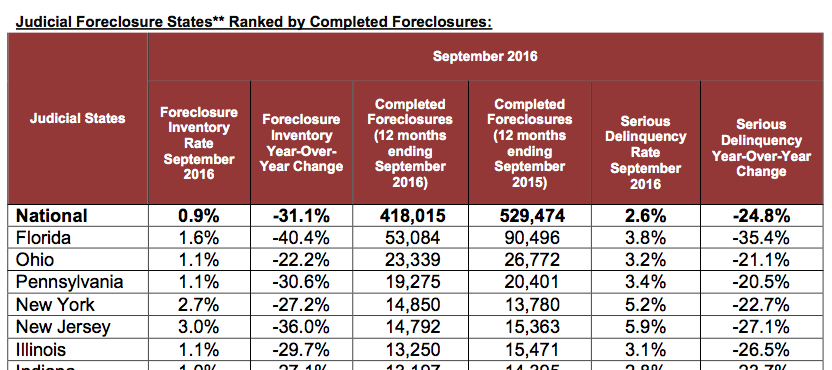
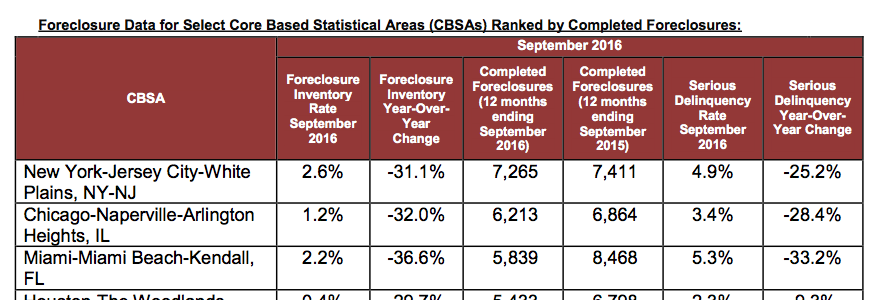
NJ on the cusp of moving to the #2 position for foreclosure inventory. NY looks poised to take the #1 slot any month now. NY Metro Area continues to resolve.

From CoreLogic:

screen-shot-2016-11-10-at-6-24-37-am

screen-shot-2016-11-10-at-6-27-06-am

Posted in Foreclosures, New Jersey Real Estate, NYC | 144 Comments

NJ Votes!

From the Star Ledger:

N.J. votes to dedicate gas tax revenue to transportation projects

New Jersey voters on Tuesday approved a constitutional amendment dedicating gas tax proceeds to transportation projects, locking in more than $1 billion a year in new revenue from the recently enacted 23 cent gas tax.

The referendum passed despite a late revolt against the once-virtually uncontested question that passed the Legislature with just one “no” vote and had the support of Gov. Chris Christie.

On its face, ballot question 2 asked voters to protect the new revenue from future raids, ensuring it goes to road, bridge and mass transit projects. It also protects some existing revenues not already constitutionally dedicated. Less obvious is that it also allows the state to finance $12 billion for transportation.

The state expects to collect $1.16 billion a year from the new gasoline tax, $31.1 million a year from increased taxes on non-motor fuels, and $39.6 million a year from a diesel surcharge.

That dedication will prevent governors or legislatures from diverting the revenues each year, and instead provide a steady stream of revenue to finance an eight-year, $16 billion transportation program that includes $12 billion in borrowing and $500 million a year in pay-as-you-go spending.

From the Star Ledger:

N.J. voters overwhelmingly reject North Jersey casino proposal

New Jersey voters Tuesday overwhelmingly rejected a proposal to expand casino gambling to the northern part of the state, meaning Atlantic City will retain its four-decade monopoly on gaming.

The ballot question appears on pace to fail by more than 1.5 million votes, according to projections by the Associated Press — which would make it the largest margin of defeat for any referendum the state has ever seen.

It would shatter the mark set in 1987 when a plan to build a professional baseball stadium at the Meadowlands fell by nearly 500,000 votes.

With 93 precincts reporting early Wednesday morning, the casino question was failing nearly 78 percent to 22 percent.

The referendum, which asked voters to amend the state constitution to allow two casinos to be built at least 72 miles north of Atlantic City, was one of the more unusual ones in New Jersey history.

Posted in Economics, New Jersey Real Estate, Politics | 249 Comments

Election Day!

Please be sure to vote YES today to both Public Questions on today’s ballot:

STATE QUESTION NO. 1 – CONSTITUTIONAL AMENDMENT TO PERMIT CASINO GAMBLING IN TWO COUNTIES OTHER THAN ATLANTIC COUNTY

Do you approve amending the Constitution to permit casino gambling in two additional counties in this State? At present, casino gambling is allowed only in Atlantic City in Atlantic County.

Only one casino in each of the two counties would be permitted. Each casino is to be located in a town that is at least 72 miles from Atlantic City. The amendment would allow certain persons to apply first for a casino license.

STATE QUESTION NO. 2 – CONSTITUTIONAL AMENDMENT TO DEDICATE ADDITIONAL REVENUES TO STATE TRANSPORTATION SYSTEM

Do you approve amending the Constitution to dedicate all revenue from the State motor fuels tax and petroleum products gross receipts tax to the Transportation Trust Fund?

This amendment would provide that an additional three cents of the current motor fuels tax on diesel fuel, which is not dedicated for transportation purposes, be dedicated to the Transportation Trust Fund. In doing so, the entire State tax on diesel fuel would be used for transportation purposes. The entire State tax on gasoline is currently dedicated to the Transportation Trust Fund and used for transportation
purposes.

The amendment would also provide that all of the revenue from the current State tax on petroleum products gross receipts be dedicated to the Transportation Trust Fund. In doing so, the entire State tax on petroleum products gross receipts would be used for transportation purposes.

This amendment does not change the current tax on motor fuels or petroleum products gross receipts.

Posted in Price Reduced | 204 Comments

2017- Turning point or much of the same?

From HousingWire:

What’s in store for housing in 2017?

For the majority of this year, the housing market could not get past low inventory levels, which were continuously cited as the main road block to a fully healthy housing market. Next year should be better, according to the newly release forecast from the National Association of Realtors, but it’s going to take time.

During the residential housing and economic forecast session at the 2016 Realtors Conference & Expo, Lawrence Yun, chief economist of the National Association of Realtors, and Dennis Lockhart, president and CEO of the Federal Reserve Bank of Atlanta, discussed the 2017 housing and economic forecast, along with the economic conditions that support the housing sector.

“It’s evident that demand and sales slightly weakened over the summer as stubbornly low supply limited buyers’ choices, accelerated price growth and hindered some consumers’ belief that now is a good time to buy a home,” Yun said.

Looking to next year, Yun stated that he think the tight supply and affordability issues affecting buyers in many markets will very slowly but surely start to abate.

Yun predicts that housing starts will jump 5.3% next year to 1.22 million.

However, this is still under the 1.5 million new homes needed to make up for the shortfall in recent years and keep up with the growing demand.

The report added that new single-family home sales are likely to total 570,000 this year and rise to around 620,000 in 2017.

And ready to step into those new homes are Millennials. Both Yun and Lockhart stated that they are optimistic that housing demand will include leading-edge millennial households finally dipping their toes into the market at a growing rate.

“NAR surveys from both current renters and recent buyers prove that there’s an overwhelmingly strong desire among the younger generation to own a home of their own,” said Yun. “The housing market over the next couple of years should get a big lift in demand from these new buyers. The one caveat is it’s essential that there’s enough new and existing supply at entry-level prices for them to reach the market.”

According to Yun’s forecasts for next year, existing-home sales are projected to grow roughly 2% to around 5.46 million, and then experience a more prominent jump of 4% in 2018 (5.68 million).

The national median existing-home price is expected to rise to around 4% both this year and in 2017, and by the end 2017, Yun said he expects rates to be around 4.5%.

As for the rest of 2016, Yun added that he expects existing-home sales to finish at a pace of about 5.36 million – the best year since 2006 (6.47 million).

Posted in Demographics, Economics, National Real Estate | 85 Comments

Time to increase loan limits? (Haven’t we heard this somewhere before?)

From the WSJ:

Home Builders Say Federal Loan Limits Shut Out Many Buyers

At the New Haven housing development in Ontario, Calif., Brookfield Residential is building 189 townhomes priced below $378,000.

So far, the moderately priced homes have sold at nearly twice the rate of others listed above the $378,000 mark.

That isn’t an arbitrary price. It marks the upper limit for a buyer to qualify for a low-down-payment, federally insured mortgage in Southern California’s Inland Empire, the suburban expanse east of Los Angeles.

Such mortgages, known as Federal Housing Administration loans, have become a primary vehicle for first-time buyers and those rebounding from the housing crash who have less-than-stellar credit and lack the 10% to 20% down payment required for most conventional mortgages.

Builders and developers in many higher-cost housing markets still recovering from the bust—including the Inland Empire, Las Vegas, Sacramento, Calif., and Phoenix—say the price limits set by the federal government make it nearly impossible to deliver homes that cater to buyers looking to purchase with FHA loans.

“It’s basically put a lid on the market,” said Michael Maples, co-founder of Trumark Cos., a California builder and developer. “For builders, if you’re above that FHA limit your buyer pool is significantly lower.”

The challenge is particularly acute in California, which has the nation’s highest upfront fees for new construction, according to housing-research firm Zelman & Associates. Fees to pay for roads, sewers, schools and other infrastructure in California markets average between $40,000 and $72,000 per home, according to the firm’s research, compared with an average of $2,600 in Houston.

“If you have a million-dollar house it’s easy, you can just pass the cost along to the consumer,” said Ivy Zelman, chief executive of Zelman & Associates. But for entry-level homes, “with all the fees they’ve been asked to pay, it’s almost impossible for them to make money,” she said.

After 2013, the FHA also changed its loan limit formula to reflect home values after the downturn, causing the loan limits to fall in 44% of metropolitan U.S. counties, according to an analysis by the Urban Institute in 2014.

Loan limits in California’s Riverside and San Bernardino counties dropped from $500,000 in 2013 to about $355,000—a nearly 30% decline overnight. In Clark County, Nev., home to Las Vegas, loan limits fell from $400,000 to $287,000.

New home sales in the Inland Empire plummeted by more than 30% in the first half of 2014 from the same period a year earlier, according to housing data firm Meyers Research, while sales in the Las Vegas area fell by more than 45%.

Officials at HUD argue that pegging loan limits to median home values is the fairest way to ensure buyers can afford the loans. But critics say limits imposed across an entire metropolitan area fail to account for vast differences within a market.

Posted in Mortgages, National Real Estate, New Development, Risky Lending | 194 Comments

What bubble?

From HousingWire:

Median home prices finally pass housing boom levels, hit all-time high

Home prices hit a new all-time high, finally surpassing the pre-recession peak, according to the Q3 2016 U.S. Home Sales Report from ATTOM Data Solutions, a source for comprehensive housing data and the new parent company of RealtyTrac.

In fact, the median home price increased 6% monthly to $230,000 in the third quarter, and is up 10% from last year. This is 1% above the pre-recession peak of $227,000 in 2005 and an all-time high in home prices.

“We are seeing the average seller home price gain since purchase start to wane in some of the highest-priced markets where appreciation is beginning to cool, indicating those markets are past their prime as sellers’ markets,” said Daren Blomquist, ATTOM Data Solutions senior vice president.

“Meanwhile there are still a number of buyers’ markets across the country where a high level of lingering distress and relatively weak demand from owner-occupant buyers provides investors with plenty of bargain-buying opportunities,” Blomquist added.

Posted in Housing Bubble, National Real Estate | 138 Comments

We’re in the money!

From CNBC:

Homeowners twice as house rich as five years ago

America’s housing market is heating up again, fortifying the finances of current homeowners and frustrating potential first-time buyers.

After hitting bottom in 2012, home prices took off dramatically before leveling off a bit in mid-2014. In the last two months, though, they turned higher again. The amount of equity homeowners now have — the value outside their mortgage debt — has doubled in the last five years, according to CoreLogic.

The latest read on September home prices showed a 6.3 percent annual gain, a touch bigger than August and a clear sign that prices are heating up again after cooling through much of spring and summer.

“Home-equity wealth has doubled during the last five years to $13 trillion, largely because of the recovery in home prices,” said Frank Nothaft, chief economist for CoreLogic. “Nationwide during the past year, the average gain in housing wealth was about $11,000 per homeowner, but with wide geographic variation.”

All real estate is local, and while most states show gains in home values, the variance is wide. Connecticut and Alaska are the only states seeing annual price declines. For Connecticut, it is jobs plain and simple. The loss of major employers there, like General Electric’s decision to move its headquarters to Boston, have hit the housing market hard.

Other states, like Arkansas, New Jersey, North Dakota, Oklahoma, Wyoming, Maine and Maryland, are barely in the black. On the flip side, as tech companies flee California, nearby states like Washington and Oregon are seeing double-digit home price gains, with Colorado and Utah not far behind.
Homeowners today show more wealth on paper, but they are not extracting it at nearly the rate they did during the last housing boom. Near-record-low mortgage rates have certainly prompted thousands of borrowers to refinance and lower their monthly payments, but a very small share have extracted cash in these refinances and home equity lines of credit (HELOC).

Posted in Economics, National Real Estate | 142 Comments

Market strong, but what about prices?

From the Otteau Group:

MarketNEWS October 31, 2016 Edition

NJ Purchase Contracts in September Strongest in over 11 Years

In September, the number of contract purchases by homebuyers exceeded the same month in the prior year for the 25th consecutive month, reflecting a 12% increase over September 2015. Considering the 15% increase (y-o-y) in September of 2015, home sales have increased by 28% over the past 2 years. This latest gain was the highest number of purchase contracts recorded in the month of September of the past 11 years.

On a year-to-date basis (January-September) home purchase demand in New Jersey increased by 14%. This increase has however been largely concentrated in lower priced homes as first-time ‘Millennial’ buyers begin to transition from rentership to homeownership. By comparison, the number of luxury home sales priced at $2,500,000 and above declined by 4% this year. Reasons for this trend include a greater number of younger-age first home buyers, trade-down purchases by older-age empty-nesters, and relaxed mortgage lending standards which have reduced minimum down-payment amounts.

Shifting to the supply side of the equation, the supply of homes being offered for sale remains constricted, which is limiting choices for home buyers. The number of homes being offered for sale today in New Jersey has declined by nearly 6,000 (-11%) compared to one year ago. This is also about 25,000 (-34%) fewer homes on the market compared to the cyclical high in 2011. Today’s unsold inventory equates to 5.4 months of sales (non-seasonally adjusted), which is lower than one year ago when it was 6.7 months.

Currently, the majority (81%) of New Jersey’s 21 counties have less than 8.0 months of supply, which is a balance point for home prices. Hudson County is presently experiencing the strongest market conditions in the state with just 3.2 months of supply, followed by Union, Essex, Morris, Middlesex and Somerset Counties, which all have fewer than 4.5 months of supply. None of the counties have an unsold inventory level equivalent to a supply of 12 months or greater, however those with the largest amount of unsold inventory are concentrated in the southern portion of the state including Cape May (9.2), Salem (10.1), Cumberland (10.3) and Atlantic (10.5).

Posted in New Jersey Real Estate | 128 Comments