
Foreclosures Jump in October

From HousingWire:

RealtyTrac: Foreclosure starts post highest jump in more than four years

Foreclosure filings — default notices, scheduled auctions and bank repossessions — were reported on 115,134 U.S. properties in October, up 6% from the previous month. This is still down 6% from a year ago, the latest RealtyTrac Foreclosure Market Report for October 2015 showed.

The rise was caused primarily by a 12% monthly jump in foreclosure starts, with 48,605 properties starting the foreclosure process for the first time in October.

This increase marks the largest month-over-month increase since August 2011, when there was a 24% month-over-month increase. Despite the month-over-month increase, foreclosure starts in October were still down 14% from a year ago.

While this increase isn’t a giant surprise, it did exceed expectations.

“We’ve seen a seasonal increase in foreclosure starts in October for the past five consecutive years, so it’s not too surprising to see the monthly increase this October,” said Daren Blomquist, vice president at RealtyTrac.

“However, the 12% increase this October is more than double the average 5% monthly increase in the past five Octobers, and the even more dramatic monthly increases in some states is certainly a concern. The upward trend in foreclosure starts in those states in some cases could be an indication of fissures in economic fundamentals driving more distress and in other cases is more likely an indication of long-term delinquencies finally entering the foreclosure pipeline,” he added.

Broken up, October foreclosure starts increased from the previous month in 34 states, including California (up 21%), Florida (up 13%), New Jersey (up 15%), Illinois (up 20%), Maryland (up 300%), Washington (up 34%), and Michigan (up 37%).

New Jersey accounted for 7,559 properties receiving a foreclosure filing in October, a foreclosure rate of one in every 471 housing units. While the state’s foreclosure activity is down 4% from the previous month, it is still up 87% from a year ago.

Recently, Sens. Cory Booker, D-NJ, and Robert Menendez, D-NJ, sent a letter to the heads of the Department of Housing and Urban Development, the Federal Reserve Board, the Consumer Financial Protection Bureau, the Federal Housing Finance Agency and others, saying that the prevalence of zombie foreclosures in the state is seriously impacting the state’s residents and its economy, and they want to know what the federal regulators are going to do about it.
Posted in Economics, Foreclosures, Housing Recovery, New Jersey Real Estate | 91 Comments

Warm up the bulldozers!

From the WSJ:

Hudson River Rail Tunnel Project Takes Another Step Forward

An emerging plan to dig two new Hudson River rail tunnels came into sharper focus on Wednesday as state and congressional leaders outlined a plan to fund and manage the project.

Under an agreement announced late Wednesday, the project would be managed by a subsidiary of the Port Authority of New York and New Jersey. That development corporation would be overseen by a four-member board including two representatives of the bistate agency and one each from Amtrak and the U.S. Department of Transportation.

New York Gov. Andrew Cuomo and New Jersey Gov. Chris Christie, who announced the deal with two U.S. senators, jointly control the authority.

“Our shovels are ready,” Mr. Cuomo said in an interview. “Literally, if you don’t build this tunnel, you would greatly imperil train service.”

Anthony Coscia, Amtrak’s chairman, said the agreement among state and federal leaders marked an encouraging step for Amtrak’s broader Gateway project. “It’s going to be a real turning point,” he said.

The national passenger railroad has struggled to fund big projects, and has warned of a transportation crisis if it must shut down one of its aging two current tunnels between New York and New Jersey.

It remains unclear how the local, state and federal governments will fund the tunnel project in an era of tight budgets. The project is part of the Gateway plan, which early estimates suggest could cost $15 billion to $20 billion.

But the state and congressional officials said the agreement included a commitment by U.S. transportation officials to secure financing for at least half the tunnel project’s costs. In September, the two governors agreed to foot half of the project’s costs if the federal government picked up the rest.

The national passenger railroad has struggled to fund big projects, and has warned of a transportation crisis if it must shut down one of its aging two current tunnels between New York and New Jersey.

It remains unclear how the local, state and federal governments will fund the tunnel project in an era of tight budgets. The project is part of the Gateway plan, which early estimates suggest could cost $15 billion to $20 billion.

But the state and congressional officials said the agreement included a commitment by U.S. transportation officials to secure financing for at least half the tunnel project’s costs. In September, the two governors agreed to foot half of the project’s costs if the federal government picked up the rest.

Posted in Economics, Employment, North Jersey Real Estate | 64 Comments

Christie wants to raise taxes on NJ

From the Star Ledger:

Christie’s new tax plan would cost 40% of N.J. taxpayers an average $16,682 deduction

Gov. Chris Christie wants to do away with a tax break that his state’s residents use more than almost anyone else.

During Tuesday’s Republican presidential debate, Christie talked about his plan to reduce income taxes, including for the top bracket for the richest taxpayers, and keep only the tax breaks for home mortgage interest and charitable deductions.

Gone under Christie’s plan would be the federal deduction for state and local taxes, which New Jersey taxpayers use more than residents of almost any other state.

“That will put more pressure on governors and on local officials not to keep raising those taxes, saying we can deduct them,” Christie said in Milwaukee, where he participated in the preliminary debate after his poll average was too low to qualify for the main stage.

According to Internal Revenue Service statistics, 41.4 percent of New Jersey taxpayers took the state and local tax deduction, which lowered their federal income taxes, in 2013, the last year for which figures were available. Only Maryland and Connecticut had a higher percentage.

Posted in New Jersey Real Estate, Politics | 118 Comments

Housing confidence dips in October

From HousingWire:

Fannie Mae: Consumer confidence in housing market fell in October

Consumers’ feelings towards the housing market were weaker in the month of October than they were in September, as some consumers displayed hesitancy to commit to the long-term financial obligation of buying a home, a new survey from Fannie Mae showed.

Released Monday, Fannie Mae’s Home Purchase Sentiment Index for October 2015 decreased slightly to 83.2 in October as consumers’ volatile outlook on both household income improvement and mortgage interest rates kept housing sentiment relatively flat.

In October, the HPSI Household Income component fell 4 points on net this month and the Good Time to Buy and Good Time to Sell components fell 2 and 6 points, respectively, after picking up in September.

While those number fell in October, signifying weakening confidence in the housing market, the survey results showed that consumers appeared to be less worried about job loss, with the net figure nearing the most favorable reading in the five-year history of Fannie Mae’s National Housing Survey.

Additionally, the share of consumers who think mortgage interest rates will go down increased by 4 points on net in October.

“The income growth necessary for renewed momentum in housing market sentiment remains elusive, even though consumers’ confidence in their job security continues to strengthen,” said Doug Duncan, senior vice president and chief economist at Fannie Mae.

“Consumers’ net view on whether their household income has improved over the last year is down once again this month,” Duncan continued.

“Some consumers may be hesitant or unwilling to commit to buying or selling a home without seeing meaningful improvement in their wages and salaries,” Duncan added. “Still, the HPSI remains close to its near all-time high level of the past four years and, given the strong October jobs report, suggests that any cooling in near-term activity, if it occurs, should be moderate.”

Overall, Fannie Mae’s October 2015 Home Purchase Sentiment Index decreased 0.6 percentage points to 83.2 in October following a 3-point increase last month to near its peak level.

The net share of respondents who say they are not concerned with losing their job rose 2 percentage points to 71%, and has risen each month since July. The percent of respondents who are not concerned about losing their job reached an all-time high of 85%.

Posted in Demographics, Economics, Employment, Housing Recovery | 82 Comments

Where’s the money? Here.

From MarketWatch:

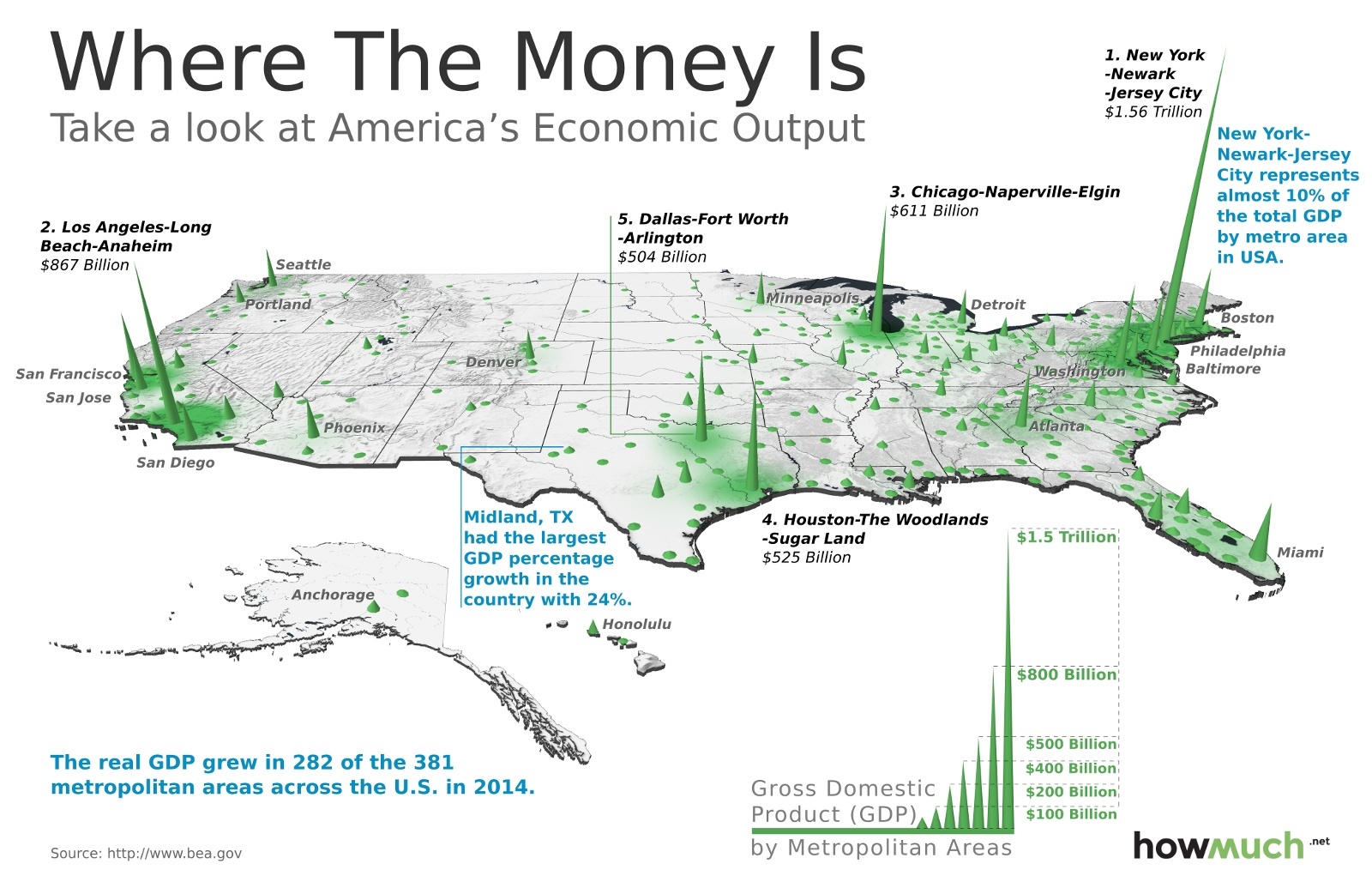
Where’s the money in America? This 3D map will show you

The hardest working states and regions in America? Sorry flyover states, better luck next time. The kings of production remain in the most obvious spots: California, Texas and New York.

The Bureau of Economic Analysis and the U.S. Department of Commerce recently pushed out some statistics on gross domestic product in 2014 for the U.S. based on metropolitan areas. The folks at HowMuch.net took that data and turned it into a map that demonstrates just where the growth in the U.S. is coming from. As shown below, the higher the cone rising from the map, the bigger the GDP in that region.

“In analyzing the data, we found that the top 20 metropolitan areas represent over 52% of the total GDP in the U.S.,” said Raul Amoros, director of content development at HowMuch.net.

Spiking right out of the map, was the New York region, which includes Newark and Jersey City., with a whopping contribution of $1.56 trillion in GDP and growth of 2.4% in 2014. That region provided nearly 10% of the total GDP for the whole of the U.S.

Just behind it, the Greater Los Angeles area was second with $866 billion in GDP, with a 2.3% rise over 2013. Third and fourth, respectively, was the Chicago metro area, with $610 billion and growth of 1.8%, and the Houston metro area with $525 billion. Dallas stole the fifth spot with $504 billion.

Posted in Demographics, Economics, Employment | 125 Comments

Hope you locked in your refi

From the Washington Post:

After stellar month for U.S. jobs market, Federal Reserve increasingly likely to raise interest rates

The U.S. job market has almost fully healed from the deep wounds of the Great Recession, raising expectations that the Federal Reserve will begin withdrawing its support for the recovery by the end of the year.

Government data released Friday showed the economy added a blockbuster 271,000 jobs in October — the highest amount so far this year and beyond analysts’ most optimistic forecasts. The unemployment rate dipped to 5 percent, and wages rose at the fastest pace since 2009.

The stellar performance provided reassurance that the American economy can withstand powerful global headwinds, from the slowdown in China to the threat of deflation in Europe. A healthy labor market could also give policymakers at the nation’s central bank the confidence to raise its key interest rate target for the first time in nearly a decade.

“The economy’s course is steady and true,” said Chris Rupkey, chief financial economist at MUFG Union Bank. “The reasons for Fed caution and delay are falling to the wayside as this economic expansion is the real deal.”

The probability that the central bank will move at its next meeting in December jumped to nearly 75 percent on Friday, according to futures markets, up from roughly even odds a week ago. Barclays reined in its forecast from March 2016 to December. Famed investor Bill Gross of Janus Capital was unequivocal, telling Bloomberg TV he believes the chances are “almost 100 percent that the yellow light changes in December to bright green.”

The move would mark the beginning of the end of an unprecedented era of easy money that cushioned the American economy during the downturn but has not produced robust growth in the recovery.

Posted in Economics, Employment, Housing Recovery, Mortgages | 71 Comments

GSEs failing again?

From HousingWire:

Compass Point: Fannie Mae, Freddie Mac will need another bailout

The disappointing third quarter results for Fannie Mae, which saw its net income cut in half, and Freddie Mac, which took a comprehensive loss of $501 million, have many already questioning whether the current financial status of the government-sponsored enterprises is stable.

Richard Bove, vice president of equity research at Rafferty Capital Markets told clients earlier this week that Freddie Mac is “insolvent” and “playing financial games that are not acceptable.”

Others, including the two prominent groups of community lenders and several major civil rights groups are calling for the recapitalization of Fannie and Freddie because the GSEs are in danger of needing another bailout from the government.

New analysis from Compass Point Research & Trading suggests that it’s no longer a question of if the GSEs will need another bailout. Now, it’s simply of a question of when.

In the new Compass Point report, analyst Issac Boltansky writes that Freddie’s loss in the third quarter reduced its total equity from $1.8 billion to $1.3 billion, adding that due to the 3rd Preferred Stock Purchase Agreement requires each GSE to reduce its capital buffer by $600 million a year until hitting $0 in 2018.

“To that end, the potential for the GSEs to take another draw from the U.S. Treasury increases each year as the capital buffers steadily decline to $0 while accounting-related earnings variability persists,” Boltansky writes.” Our view remains that under the current terms of the bailout agreement it is a matter of when, not if, the GSEs will be forced to take another draw.”

Freddie Mac CEO Donald Layton, for his part, told HousingWire earlier this week that he was not concerned about the loss, referring to the loss as “accounting noise.”

“[The loss] is not the real economics going on,” Layton said in a telephone conversation with HousingWire, where he dismissed any accusation of inappropriate risk management. The GSE did grow its single-family guarantee business 50% annually in the third quarter.

In a statement Layton added: “This $0.5 billion loss was caused mainly by the accounting associated with our use of derivatives, whereby the derivatives are marked to market but many of the assets and liabilities being hedged are not.”

Posted in Economics, Foreclosures, Mortgages, Politics | 108 Comments

Best September Since 2005

From the Otteau Group:

MarketNEWS October 30, 2015

Home purchase demand in New Jersey increased for the 13th consecutive month in September with more than 8,000 home-purchase contracts. This was the highest number of purchase contracts recorded in the month of September since 2005, reflecting a 15% increase compared to the same month one year ago.

While we have some concern about a developing slowdown in secondary markets like Camden and Sussex counties, the Fed’s decision to keep interest rates low should act as an accelerant for home sales heading into 2016. Also encouraging, is a 17% increase for homes purchased by first-time buyers this year which will provide broad support for continuing home sales activity for the next year or so.

While home purchase demand continues to rise, the inventory of available homes remains constrained in New Jersey. The number of homes being offered for sale in the month of September declined by more than 1,400 homes (-3%) compared to one year ago. This is about 19,000 (-26%) fewer homes on the market compared to the cyclical high in 2011. Today’s unsold inventory equates to 6.7 months of sales (non-seasonally adjusted), which is less than one year ago when it was 7.9 months.

Currently, 67% of New Jersey’s 21 counties have less than 8.0 months of supply, which is a balance point for home prices. Hudson, Union, Essex, Somerset, Ocean, and Morris Counties are presently experiencing the strongest market conditions in the state with fewer than 6 months of supply. All of the counties with an unsold inventory level equivalent to a supply of 12 months or greater are concentrated in the southern portion of the state including Salem (14.3) and Atlantic (14.6).

Posted in Economics, Housing Recovery, New Jersey Real Estate | 180 Comments

Bend Over NJ

From the Star Ledger:

N.J. taxes second-worst in U.S., Forbes says

New Jerseyans already know it to be true, but a Forbes analysis of state-by-state tax burdens places the Garden State near the top of its “Worst States for Taxes” list.

New Jersey lands in second place, behind New York, in the comparison of state and local taxes.

Connecticut, California, Wisconsin, Minnesota, Maryland, Rhode Island, Vermont and Pennsylvania round out the top 10, according to the Forbes report.

The analysis compares local taxes and the effective tax rate for single people with $50,000 in reportable income, a figure Forbes said it based on the $53,046 median U.S. Household income from 2009 to 2013.

In New Jersey, which has one of the most progressive tax structures in the country, that income tax rate is 2.54 percent, which Forbes combined with local taxes to establish a 12.3 percent state and local tax burden.

While the report doesn’t specify which local taxes are included (some states have local income taxes or local sales taxes), presumably New Jersey’s steep property taxes had a hand in the state’s ranking. Last year, the average property tax bill here was $8,161, while nationally only 0.2 percent of U.S. homeowners paid more than $8,000.

New Jersey’s income taxes start at 1.4 percent on earnings less than $20,000 and the top marginal tax rate hits 8.97 percent on income over $500,000.

Posted in New Jersey Real Estate, Politics, Property Taxes | 93 Comments

Bye Bye Bungalow

From the Record:

Three years later, shore’s housing market feels effects of Sandy

Maureen and Bill Craft put “backbreaking” work and thousands of dollars into fixing their Little Egg Harbor Shore home after it was flooded during Superstorm Sandy, but Maureen now says if she had to do it over again, she’d walk away.

Meg Huber spent thousands of dollars to repair her tiny Ocean Beach cottage after the storm, but now fears she and her husband will have to sell the home because they can’t afford to elevate it.

Rick Guglielmo despaired after the storm, but it allowed him to buy a beachfront property at a reduced price in Ortley Beach.

The three are among the thousands of property owners whose lives changed when Sandy sent floodwaters surging across the Jersey Shore. Three years after Sandy hit, the storm is just a memory along most of the coast. But in Ortley Beach, Mantoloking, Manahawkin and other hard-hit areas, the effects of the storm are still obvious in the mix of new homes, derelict cottages and empty lots.

Amid the buzz of construction, the Shore is coming back, but it’s going to take a few years to return fully — and it will be a different Shore. Many of the small, affordable cottages that squatted on the sand have been elevated or replaced by new, taller buildings, constructed to withstand hurricane waters and winds.

“The old beach bungalow is basically gone. The Shore has changed,” said Lee Childers of Childers Sotheby’s International Realty in Normandy Beach, which has six offices at the Shore.

The people at the Shore also have changed. Faced with the financial or emotional cost of repairs, many longtime homeowners are selling their properties..

“There are a lot of people out there who can’t afford to rebuild,” said Ed Walters of the ReBuild division of Barnegat-based Walters Group, which has constructed more than 200 houses to replace those destroyed in the storm. “A lot of those properties are coming on the market and people are buying them. There’s going to be a changeover of people selling and new people coming in to all these areas.”

“These quaint little bungalows — they’re cute, but people want to bring friends and family to the beach,” Walters said. “That’s one of the biggest gripes. Everybody was sleeping in sleeping bags. … It’s just not practical to have a home one foot off the ground. It’s inevitable that it’s going to flood.”

Posted in New Development, Shore Real Estate | 107 Comments

Cheap rates might get easier … or maybe not

From the NYT:

A Focus on Credit History for Mortgage Approvals

Fannie Mae announced on Monday that it would soon start taking a longer view of consumer credit histories when evaluating mortgage applications, a change that could help some borrowers and hurt others.

Beginning in mid-2016, Fannie Mae will require lenders to use what is known as “trended credit data” when submitting loan applications through the agency’s proprietary automated underwriting system, Desktop Underwriter. This widely used automated system can quickly tell lenders whether a borrower is eligible for a conforming loan and under what conditions.

Fannie Mae now requires a “tri-merge” credit report reflecting data from the three major credit bureaus — TransUnion, Equifax and Experian — for all mortgage applications, said Chris Cartwright, the president of information services nationally for TransUnion. That data, he said, is really a point-in-time “snapshot” of the borrower’s open credit balances and any delinquencies at the time the credit was pulled.

The trended data product developed by TransUnion and to be used by Fannie Mae (along with trended data from Equifax) will provide more of a credit chronology. It will go back 30 months, showing whether payments were made on time, and more important, whether borrowers tend to carry balances from month to month, pay more than the minimum or pay off balances in full.

Studies by TransUnion have found that consumers’ paying habits are key indicators of risk. Consumers who carry revolving credit balances, for example, have been found to be considerably higher credit risks than those who pay off their balances every month. Using this richer, longer-term data “allows the credit reporting agencies to score more consumers and to score them more accurately,” Mr. Cartwright said.

TransUnion’s research estimates that the widespread use of trended data could increase the share of consumers in the “Super Prime” risk tier — those who have access to the lowest-priced credit products — to nearly 21 percent of the population from 12 percent. It is already a popular tool for evaluating auto loan and credit card applicants, according to Steve Chaouki, TransUnion’s executive vice president at the financial services business unit.

John Ulzheimer, a credit expert who has previously worked for the credit-scoring companies FICO and Equifax, said the use of trended data will lead to “smarter” mortgage lending, because it will help lenders more precisely link pricing to risk. But, he noted, it won’t work to all borrowers’ benefit. “Trended data could also mean you’re going to do worse,” he said.

Posted in Mortgages, National Real Estate | 19 Comments

So much for the boom?

From CNBC:

Pending home sales down 2.3% in September

Signed contracts to buy existing homes dropped 2.3 percent in September from August and were just 3 percent higher than one year ago, according to the National Association of Realtors.

The August read of the Realtors’ Pending Home Sales Index was revised down slightly. Analysts had expected a slight gain for the month. This is the second-straight monthly drop and is the second-lowest reading of the year. Pending sales are a forward-looking indicator of closed sales for the next two months.

“There continues to be a dearth of available listings in the lower end of the market for first-time buyers, and Realtors in many areas are reporting stronger competition than what’s normal this time of year because of stubbornly-low inventory conditions,” Realtors’ chief economist Lawrence Yun said in a statement. “Additionally, the rockiness in the financial markets at the end of the summer and signs of a slowing U.S. economy may be causing some prospective buyers to take a wait-and-see approach.”

Sales dropped across the nation, with the weakest reading in the Northeast. Sales there fell 4.0 percent in September from August. In the Midwest, pending home sales declined 2.5 percent and were 2.6 percent lower in the South. The West was nearly flat, with sales down just 0.2.

Posted in Housing Recovery, National Real Estate | 123 Comments

Scratchin’ and Surviving, Good Times!

From the Record:

N.J. home sales activity at highest level since 2005

The number of home sales in New Jersey is up 17 percent from last year and is on track to hit the highest level since the housing-boom days of 2005, an East Brunswick real estate expert said Wednesday.

But home prices haven’t been pulled upward as fast, rising about 3 percent this year, according to Jeffrey Otteau, an appraiser and consultant whose forecasts are followed by many in the real estate industry. Prices remain about 16 percent below their peaks in mid-2006, leaving many homeowners owing more on their mortgages than their properties are worth.

“Housing prices aren’t higher because incomes aren’t higher,” Otteau told about 100 real estate agents at a seminar in Hasbrouck Heights.

Otteau predicted that home prices will increase about 4 percent next year, as sales activity remains strong. Low mortgage rates, an improving employment market and pent-up demand are increasing the buyer pool, he said.

“Young people who have been stuck in rental housing for a while are beginning to make the move into home-buying,” Otteau said.

Because of New York City’s strong job recovery, demand for housing is strongest in areas closest to the city, especially in towns with commuter train lines. Bergen and Passaic counties, for example, both have less than a six-month supply of housing inventory for sale, a level that generally points to rising prices as buyers compete for properties. Several of the most in-demand towns in the state are in Bergen County, including Lyndhurst, Glen Rock, Waldwick and Ridgewood, Otteau said.

Posted in Demographics, Economics, Employment, New Jersey Real Estate | 87 Comments

Home prices up 5.1% in August

From the WSJ:

U.S. Home Price Growth Gains Strength in August, Case-Shiller Says

Home prices rose in August, according to a report released Tuesday, suggesting the market has momentum heading into the final months of the year.

The S&P/Case-Shiller Home Price Index increased 4.7% in the 12 months ended in August, slightly better than the 4.6% gain recorded in July.

“The last three, four, five months, we’ve been on this very steady pace. I think that’s a good sign,” said Svenja Gudell, chief economist at home-tracker Zillow.

The S&P/Case-Shiller 20-city index jumped 5.1% year-over-year through August, after July’s 4.9% increase. Economists surveyed by The Wall Street Journal expected a 5.1% increase in the 20-city index.

The S&P/Case-Shiller 10-city index increased 4.7% from a year earlier, compared with a 4.5% increase in July.

Economists caution that home prices, which are rising about twice as quickly as incomes, represent one of the market’s biggest long-term challenges. A lack of new construction has created a supply shortage, magnifying the problem.

“People slowly but surely get priced out of the housing market,” said David Blitzer, managing director and chairman of the Index Committee for S&P Dow Jones Indices.

Posted in Economics, Housing Recovery, National Real Estate | 119 Comments

New Home Sales Tank

From CNBC:

US new home sales drop to near one-year low

New U.S. single-family home sales fell to near a one-year low in September after two straight months of gains, suggesting a temporary cooling in the market for new houses.

The Commerce Department said on Monday sales dropped 11.5 percent to a seasonally adjusted annual rate of 468,000 units, the lowest level since November 2014. August’s sales pace was revised down to 529,000 units from the previously reported 552,000 units.

Economists polled by Reuters had forecast new home sales, which account for 7.8 percent of the market, slipping to a rate of 550,000 units. Sales were up 2.0 percent compared to September of last year.

The moderation in new home sales is likely to be temporary as other housing reports have painted an upbeat picture of the sector. In addition, new home sales tend to be volatile month to month because they are drawn from a small sample.

New home sales tumbled 61.8 percent in the Northeast to the lowest level since April. Sales declined 6.7 percent in the West and were down 8.7 percent in the populous South. In the Midwest, sales fell 8.3 percent.

With sales weak, the stock of new houses for sale increased 4.2 percent to 225,000 last month, the highest level since March 2010. Still, supply remains less than half of what it was at the height of the housing boom.

At September’s sales pace it would take 5.8 months to clear the supply of houses on the market, up from 4.9 months in August. The median price of a new home rose 13.5 percent from a year ago to $296,900.

Posted in Economics, Housing Recovery, National Real Estate, New Development | 43 Comments