Cost of regulation holding back new home sales/construction?

From Seeking Alpha:

Trumponomics In The Housing Market

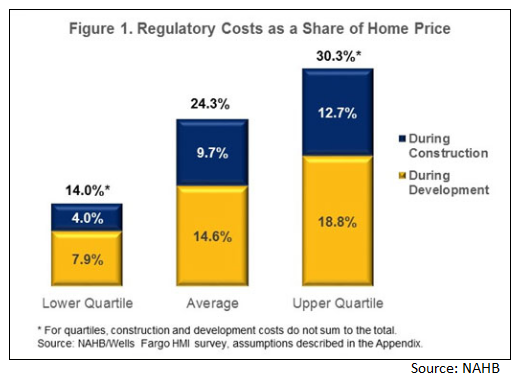
With the market soaring high on Trumponomics (the belief that Trump’s business experience will fix the country), we should take a look at some of the “unnecessary regulation” that might seem ripe for elimination. Before getting into this, it is important to stress that this is not a political article. This article is going to focus strictly on the impacts regulation has on housing prices and the impact housing prices have on the economy.

Posted in National Real Estate, New Development, Politics | 17 Comments

Time to lube the mortgage market

From Business Insider:

It hasn’t been this hard to buy a house in America since the financial crisis

Housing affordability in the US is at an eight-year low, according to Attom Data Solutions.

The parent company of RealtyTrac released its fourth-quarter affordability index on Thursday, which dropped to the lowest level since the same period in 2008.

And now mortgage rates are rising again. According to Freddie Mac, the average rate for a 30-year fixed mortgage hit a two-year high of 4.3% this week. That was up from 4.16% last week, when the Federal Reserve raised its benchmark interest rate and signaled that it expected to hike in the new year more times than it previously thought.

Mortgage rates are still near historic lows, so the housing market is not seeing much of an effect yet. Some prospective buyers could rush to lock in the lowest rates possible in the next few months, according to the National Association of Realtors.

“The prospect of further interest rate hikes in 2017 will likely cause further deterioration of home affordability next year,” Daren Blomquist, senior vice president at Attom, said in a statement. “Absent a strong resurgence in wage growth, that will put downward pressure on home price appreciation in many local markets.”

Two other reports on Thursday showed that housing affordability could become an even bigger issue in 2017. The Home Price Index from the Federal Housing Finance Agency showed that year-over-year, home prices rose by 6.2% in the third quarter, a record high. And home values rose 6.5% in the year through November, the fastest pace since 2006, according to Zillow.

As with the prior housing crisis, strong buyer demand is fueling this price rally. This time, however, a shortage of inventory is also pumping up values.

Posted in Mortgages, National Real Estate, Risky Lending | 102 Comments

Home sales strong in November

From HousingWire:

Existing home sales continue to climb at highest pace since 2007

Existing home sales increased for the third consecutive month in November to the highest pace in almost 10 years, according to the most recent report from the National Association of Realtors.

Existing home sales, which are completed transactions that include single-family homes, townhomes, condominiums and co-ops, increased 0.7% to a seasonally adjusted rate of 5.61 million in November. This is up from a downwardly revised 5.57 million in October, up 15.4% from last year’s 4.86 million and the highest since February 2007.

The median existing-home price rose once again in November to $234,900, up 6.8% from last year’s $220,000. This marks the 57th consecutive month of year-over-year gains.

Inventory, on the other hand, dropped 8% from October to 1.85 million existing homes available for sale. This is now 9.3% below last year’s 2.04 million, and the 18th consecutive month of annual decreases.

“Existing housing supply at the beginning of the year was inadequate and is now even worse heading into 2017,” Yun said. “Rental units are also seeing this shortage. As a result, both home prices and rents continue to far outstrip incomes in much of the country.”

However, home builders reported a significant boost in confidence after President-elect Donald Trump won the election, according to the National Association of Home Builders/Wells Fargo Housing Market Index, leading some to believe that it could push new home builds up in 2017.

Properties are now staying on the market slightly longer than before at 43 days, up from 41 days in October, but down significantly from last year’s 54 days. Short sales were on the market the longest at a median of 110 days in November, while foreclosures sold in 55 days and non-distressed homes took 41 days. Overall, 42% of homes sold in November were on the market for less than a month.

Posted in Demographics, Economics, National Real Estate | 52 Comments

NJ Grows, NY/PA Shrink

From the Star Ledger:

N.J.’s population rises, but New York and Pennsylvania lost residents

New Jersey’s population has risen slightly as the Garden State is hanging on to its ranking as the 11th most populous state in the nation, according to estimates released Wednesday by the U.S. Census Bureau.

New Jersey had 8,944,460 people as of July 1, up just 9,000 from the 2015 estimate of 8,935,421. New Jersey counted 8.7 million residents in the 2010 census.

New York and Pennsylvania, on the other hand, were among eight states with a decline from 2015 to 2016. New York lost almost 2,000 people, bringing its estimated total to 19,745,289, while Pennsylvania’s population stood at 12,784,227, a decline of almost 7,700. Both remain in the top 10 in population.

New Jersey remained the 11th most populous state, but with a narrowing gap over Virginia.

Viirginia gained almost five times as many people as the Garden State, bringing its total to 8,411,808 in 2016 from 8,367,587 in 2015 and lowering the population gap with New Jersey to slightly more than 530,000. The 2010 census gave Virginia 8 million residents.

The fastest growing state by percentage was Utah, whose population increased 2 percent over the past year to 3.1 million people. Next was Nevada (2 percent) and Florida, Idaho and Washington (all with 1.8 percent).

Texas reported the biggest overall increase in population with 432,957 new residents from 2015 to 2016, followed by Florida with 367,525, and California with 256,077.

“States in the south and west continued to lead in population growth,” said Ben Bolender, chief of the Census Bureau’s Population Estimates Branch.

Posted in Demographics, Economics, New Jersey Real Estate | 87 Comments

Corelogic: Rates won’t stop appreciation

From HousingWire:

CoreLogic predicts housing market growth in 2017

Economic growth will be the theme of the housing market in 2017, according to the forecast from Frank Nothaft, CoreLogic senior vice president and chief economist.

1. Increase in mortgage rates

Interest rates will average just over 4% next year, about 0.5% higher than in 2016, according to the forecast. Many expect the Federal Reserve to raise the federal funds target several times in 2017. This increase could affect the cost of loans tied to short-term rates, such as home equity lines of credit.

2. Vacancy rates remain low

Vacancy rates will remain low in the rental market and even decrease in the housing market, according to CoreLogic. The low level of new homes built will keep for-sale inventories low in many markets.

3. Home appreciation will continue

While home prices will continue to increase, Nothaft stated that it could continue at a slower pace. In 2017, expect to see an increase of about 5% in home prices, however some neighborhoods could even see double-digit growth while others may decline. Rent price growth is also projected to moderate at 3% in 2017.

4. Reducing incentives to refinance

With higher mortgage rates, refinance originations will drop in 2017, the forecast shows. However, this decrease will be at least partially offset by higher purchase-money volume and second liens.

5. Credit risk to stay low

New loan originations will continue to show relatively low credit risk, Nothaft stated. CoreLogic’s Housing Credit Index shows that new single-family originations during the first half of 2016 show lower risk attributes than those made 15 years ago. Next year could see heightened fraud risks, however, credit risks still look favorable overall.

Posted in Economics, Mortgages, National Real Estate | 60 Comments

A Trump Housing Market

From the WSJ:

Trump Win Makes It Tricky to Foresee Path of Housing Market

Before the presidential election, economists anticipated the housing market would continue its steady recovery in 2017. Growth in home prices and sales likely would slow after a four-year run-up, but new construction likely would pick up, bringing relief to those struggling to find affordable homes.

Most economists still hold to those predictions, but they now say Donald Trump’s victory could upend the market. As investors bet on faster growth—tied to tax cuts and higher infrastructure spending—mortgage rates have risen to 4.16% from 3.54% before the election, figures from mortgage giant Freddie Mac show.

If rates continue to rise quickly, it could make it more difficult for new buyers to afford homes and create a disincentive for current owners to sell their homes and give up ultra-low-rate loans.

Changes to immigration policies under a Trump administration also could put a damper on the market by exacerbating a shortage of workers to build new homes and by reducing the number of new households being formed. “If you pull back on immigration, you pull back on housing,” said Mark Zandi, chief economist for Moody’s Analytics.

On the other hand, economists said paring financial regulations—along with a stronger economy overall—could also give the housing market a lift.

Lawrence Yun, chief economist at the National Association of Realtors, expects mortgage rates to rise to about 4.5% next year, which he said won’t be enough to dampen demand. He expects the volume of existing home sales to increase slightly, by 1% to 2%, but said the pace could accelerate or turn negative depending on various policy changes.

“Under a Trump presidency, he relishes unpredictability so there is a wide variance in the forecast outlook,” he said.

Mr. Zandi expects housing starts to rise to 1.4 million from about 1.2 million this year, an important boost to a market starved for new supply.

Posted in Economics, Housing Recovery, National Real Estate, Politics | 39 Comments

Now lending standards go the other way

From the WSJ:

U.S. Home Prices Soar, But Minorities and Young People Miss Out

U.S. home values have jumped to records over the past four years, but some demographic groups have participated more in the rally than others.

A study by the Pew Research Center released Thursday found that homeownership rates since the peak in 2004 are down across the board. But while the rate among white households has fallen 5%, it has fallen 16% for African-American households.

The rate among households age 65 and up has fallen just 3%, compared with 18% for those younger than 35.

Nationally, the homeownership rate hit a more-than 50-year low in July, although it has since edged higher. That number reflects a growing population of senior citizens who continue to own homes in much greater numbers than their younger counterparts.

“Today’s homeownership rate is being propped up by an aging society,” said Richard Fry, a senior economist at the Pew Research Center.

Home prices jumped 5.5% in September compared with a year earlier, according to the S&P CoreLogic Case-Shiller U.S. National Home Price Index. That was good news for homeowners, many of whom are nearing retirement age and ready to cash out on the appreciation of the past few years.

But as prices rise, homes are slipping further out of reach for younger and minority buyers.

Pew found that 72% of renters said they would like to buy in the future, but mortgage applications are down significantly. The falloff has been greatest among African-American and Hispanic borrowers, according to Pew.

Applications for home loans among whites tumbled 45% from 2004 to 2015, but plunged 77% among blacks and 76% for Hispanics, according to Pew. At the same time, the share of loan applications that were approved rose to 71% from 64%, likely reflecting stronger applicant pools.

Deterred by the lack of down-payment money or less-than-pristine credit, it appears many of these households assume they won’t be able to get a loan and don’t bother applying, according to Pew.

The tightening of credit to reduce default risk has had the unintended consequence of excluding more minorities from homeownership. In 2004, 32% of loans to African-American borrowers were subprime, while in 2015 only 7% of them were, according to Pew.

“That’s not to say that returning to the standards of 2003 [or] 2006 is appropriate,” Mr. Fry said. “It may be that banks can make successful loans to buyers with less-than-stellar credit histories.”

Posted in Demographics, Economics, National Real Estate, Risky Lending | 28 Comments

HAMP v2

From Bloomberg:

Fannie and Freddie Outline New Respite for Troubled Borrowers

Distressed mortgage borrowers will get a new lifeline from Fannie Mae and Freddie Mac after a critical foreclosure-prevention program expires this month.

The mortgage-finance giants on Wednesday outlined a plan to replace the Home Affordable Modification Program, one of the first responses to the financial crisis by President Barack Obama’s administration.

The new program aims to cut troubled borrowers’ mortgage payments by 20 percent, through a combination of tools such as interest-rate reductions, extensions of loan terms and mortgage principal forbearance. The program, called “Flex Modification,” begins in October 2017.

Fannie Mae and Freddie Mac, which are regulated by the Federal Housing Finance Agency, don’t make loans. They buy them from lenders, wrap them into securities and make guarantees to investors in case of default. Their role in guaranteeing the repayment of mortgages gives them ultimate authority in setting the terms for modifications of borrowers’ loans.

The program closes another chapter on HAMP, which launched in 2009 and struggled in its early days to meet the ambitious goals of the Obama administration to help as many as 4 million borrowers avoid foreclosure.

Fannie and Freddie’s new program, which is similar to a September proposal from the Mortgage Bankers Association, will let borrowers get a streamlined modification with no required documentation after being 90 days late on payments. When the MBA made its proposal, lenders said such a move would ensure borrowers get help quickly, which they say is key to avoiding foreclosure.

Fannie and Freddie said a high percentage of borrowers who are at least 60 days late would be eligible.

Posted in Foreclosures, Mortgages, National Real Estate | 90 Comments

Foreclosures rise in Bergen, fall in Passaic

From the Record:

New Jersey leads nation in foreclosures

New Jersey leads the nation in foreclosure activity, as the state continues to unwind the mortgages that went bad in the worst housing crash in decades.

One in every 598 Garden State households with a mortgage had some type of foreclosure filing in November, according to Attom Data Solutions, a real estate research company that is the parent company of RealtyTrac, which tracks foreclosures. That’s down about 7 percent from a year ago – a sign that the worst of the foreclosure crisis may be in the past.

Nationally, foreclosure activity declined by about 17 percent in November, compared with a year earlier.

New Jersey has been slower to deal with foreclosures than other states, in part because the state is one of about two dozen where foreclosures go through the courts, which tends to slow the process. In addition, mortgage servicers are still catching up after a period where New Jersey foreclosure activity was almost frozen while the industry faced accusations of abusing homeowners’ rights.

According to Attom, New Jersey has two of the metropolitan areas with the highest rates of foreclosure in the nation, Atlantic City and Trenton.

In Bergen County, foreclosure filings rose 5.3 percent in November, compared with the previous year. One in every 987 Bergen households with a mortgage had some type of foreclosure activity during the month. In Passaic, foreclosure activity was down 14.7 percent from a year earlier, but the rate of housing distress is still higher than in Bergen. One in every 554 Passaic County households with a mortgage had a foreclosure filing during November, according to Attom.

Posted in Foreclosures, New Jersey Real Estate, North Jersey Real Estate | 63 Comments

Foreclosures continue five year decline

From 24/7 Wall Street:

October Foreclosure Inventories Highest New York, New Jersey, Hawaii

In the month of October, 30,000 U.S. home foreclosures were completed, down 3.6% month over month and down 24.9% from a total of 40,000 in October 2015, according to CoreLogic. The research firm notes that the current foreclosure inventory totals 0.8% of all homes with a mortgage in the United States, down 0.4 points compared with October of last year.

The number of U.S. homes currently in some stage of foreclosure totals approximately 328,000, compared with 479,000 in October 2015. That represents a decline in the national foreclosure inventory of 31.5% compared with October a year ago.

The four states and the District of Columbia with the largest foreclosed inventory as a percentage of mortgaged properties are New Jersey (2.8%), New York (2.7%), Hawaii (1.7%), Maine (1.7%) and D.C. (1.6%). The five states with the lowest inventories of foreclosed properties are Arizona (0.3%), Colorado (0.3%), Michigan (0.3%), Minnesota (0.3%) and Utah (0.3%).

The five states with the highest number of completed foreclosures in the past 12 months were Florida (51,000), Michigan (29,000), Texas (26,000), Ohio (23,000) and Georgia (20,000). The five states with the fewest foreclosures in the prior 12 months through October were District of Columbia (212), North Dakota (278), West Virginia (407), Alaska (622) and Montana (660).

Of the 10 largest U.S. metro areas, the foreclosure inventory was highest in the New York area, at 2.5%. The Miami metro area’s foreclosure inventory totaled 2.1%, with the Las Vegas metro and Chicago at 1.2%. The lowest totals were posted in the San Francisco (0.1%) area and in Denver (0.2%).

A total of 21 states posted year-over-year declines of more than 30% in foreclosure inventory for the month of October. Florida’s foreclosure inventory has fallen 41.4% in the past 12 months and Washington’s has dropped by 40.3%.

According to CoreLogic, the current foreclosure rate of 0.8% is the same as the June 2007 rate, and the foreclosure inventory has declined every month for the past 60 months. Before the collapse in the housing market in 2007, the average number of foreclosures completed in a month was 21,000.

Posted in Foreclosures, National Real Estate | 77 Comments

Has the refi window finally closed?

From HousingWire:

Refinance well drying up? Rising interest rates shrink pool of eligible borrowers, again

Recent reports from various analysts, including this one from Kroll Bond Rating Agency, suggest that 2017 will see smaller mortgage origination volume than 2016, thanks to the impact of rising interest rates on borrowers seeking to refinance their mortgage.

A report from Black Knight Financial Services last week showed that the pool of borrowers who had incentive to refinance shrank over the last several weeks as interest rates rose above 4%.

Now, thanks to another increase in interest rates last week, the pool of borrowers with incentive to refinance is now even smaller.

As Freddie Mac noted in its most recent report, the average interest rate for a 30-year, fixed-rate mortgage increased to 4.13% for the week ending Dec. 8, 2016. That’s up from 4.08% during the previous week.

Black Knight’s report last week showed that the number of potential refinance candidates dropped by more than 50% recent, as roughly 4.3 million borrowers were removed from the pool of potential refinance candidates.

That left just approximately 4 million borrowers who both benefit from and likely qualify for a refinance.

Now, according to Black Knight’s newest report, another 700,000 borrowers lost the incentive to refinance with the latest interest rate increase.

Per Black Knight’s data, there are now 3.3 million borrowers in the eligible to refinance pool, which means that 5 million borrowers lost the incentive to refinance since the beginning of November when interest rates began to increase.

According to Black Knight’s report, the refinance population has only been this low on two occasions in recent history: December 2013 and January 2014.

Interest rates at that time were above 4.4%.

Consequently, refinance mortgage origination volume in the first quarter of 2014 was the lowest in any quarter in the last 10 years, and 60% below the refinance mortgage origination volume in the third quarter of 2016, Black Knight’s report showed.

Posted in Mortgages, National Real Estate | 108 Comments

Lock them in their parents basement

from NJ101.5:

How can NJ stop young adults from fleeing the state?

As we wind down the end of 2016 and get set to ring in a brand new year, New Jersey faces a number of significant challenges.

The state’s leading business group is setting its sights on stopping the out-migration of millennials — young adults under age 35 — as a top priority in 2017.

Michele Siekerka, president of the New Jersey Business and Industry Association, points out Garden State taxpayers spend a small fortune on K-12 education, and yet many of our best and brightest students leave New Jersey to go to college and never return.

“When we’re making significant investment in our great K-12 education here in the state of New Jersey — [on average] $19,000 per year per pupil times 13 years — to let those students walk out of the state, we’re losing our pipeline, we can’t let that happen anymore,” she said.

To change things, Siekerka said, we have to look at issues of affordability.

“Housing costs for millennials are in the $1,600 a month range, which is simply too high. A student graduating from college can’t afford that off the bat. Energy costs, costs of insurance in the state of New Jersey, they’re simply too high,” she said.

Siekerka pointed out another huge problem is the cost of higher education.

“We have gotten expensive. We’re the 4th most expensive in the country on state tuition when you include fees and room and board, so that’s a challenge. Students aren’t choosing our own state schools,” she said.

To address the issue, she said we must look for ways to increase financial assistance.

“If we do that, the $25,000 tuition is now only $15,000. But we don’t have the stream of funds in New Jersey to cover that gap, and that’s another reason why higher ed is expensive,” she said.

Siekerka believes all of these issues are connected.

“We must do something in the state of New Jersey about how we fund our education, because property tax is all about funding our education, our K to 12 education,” she said.

“We need to have that discussion, it’s a discussion that must be had.”

It’s not just millennials who are leaving. Earlier this year, the organization found that the state has lost almost $21 billion dollars in adjusted gross income over the past 11 years to so-called out-migration.

Posted in Demographics, Economics, New Jersey Real Estate | 110 Comments

So much for Bergen…

From the Star Ledger:

Less income and cheaper homes: How Bergen County has changed in a decade

Bergen County residents are earning less, spending more time commuting to work and have seen their homes continue decrease in value – a trend that began after the Great Recession of 2008.

But according to the annual release of data by the U.S. Census Bureau, residents in the most populous county in New Jersey fare better than their counterparts in other counties in the state and nation when it comes to income and home values.

The median household income in Bergen County was $85,806 in 2011-2015, a 4.1 percent decline from 2005-09 when median income was about $3,646 more. Statewide, the median household income was $72,093 – a nearly 5 percent decline over 2005-2009.

Bergen County municipalities with the highest incomes include Upper Saddle River ($169,301); Demarest ($163,571); and Ho Ho Kus ($162,386). Municipalities with the lowest incomes include Garfield ($45,469); Lodi ($50,774); and Fairveiw ($53,846).

Home values in the county declined by 8.5 percent with homes worth $41,300 less in 2011-2015 than the period before. Statewide, homes were worth nearly 20 percent less in 2011-2015 than in 2005-2009.

A downturn in housing swept New Jersey a decade ago, and many homeowners in Bergen County are reluctant to sell at current prices. A recent analysis by The Record found that median home values in North Jersey in 2016 were about where they were in late 2003 or early 2004.

Nearly every town in Bergen County saw drops in home prices, according to the latest data. But the hardest-hit towns were those that already had weak home values.

Posted in Demographics, Economics, Employment, North Jersey Real Estate | 50 Comments

Fewer and fewer underwater owners

From National Mortgage News:

Homeowner’s Equity Rises 11% from 2015 Levels: CoreLogic

The amount of equity homeowners hold grew by $726 billion, or 10.8%, in the third quarter of 2016 versus the year before, according to data from CoreLogic.

On a quarterly basis, the equity in residential properties secured by mortgages rose by $227 billion, or 3.1%, CoreLogic reported Thursday. The increase pulled 384,000 borrowers out of negative equity.

Altogether, 93.7% of all mortgaged properties are now in positive equity. The rise in home equity was mainly the result of price appreciation.

“Home equity rose by $12,500 for the average homeowner over the last four quarters,” Frank Nothaft, chief economist for CoreLogic, said in a news release. “There was wide geographic variation with homeowners in California, Oregon and Washington gaining an average of at least $25,000 in home equity wealth, while owners in Alaska, North Dakota and Connecticut had small declines, on average.”

Posted in Economics, Housing Recovery, Mortgages, National Real Estate | 33 Comments

October home prices tick up nationally

From Housingwire:

Corelogic: Home prices continue upward climb in October

Home prices continued their upward trend in October, and are forecasted to continue rising into next month and next year, according to the Home Price Index and HPI Forecast by CoreLogic, a property information, analytics and data-enabled solutions provider.

Home prices, including distressed sales, increased annually by 6.7% in October 2016, and increased 1.1% from September, according to the index.

“While national home prices increased 6.7%, only nine states had home price growth at the same rate of growth or higher than the national average because the largest states, such as Texas, Florida and California, are experiencing high rates of home price appreciation,” CoreLogic Chief Economist Frank Nothaft said.

CoreLogic forecasts that home prices will increase by 4.6% year-over-year, and by 0.2% by next month.

Posted in Economics, National Real Estate | 167 Comments