Feeling wealthy?

From Dow Jones:

Home Prices Help Lift U.S. Household Wealth to Record

The net worth of U.S. households set a record of $89.1 trillion in the second quarter, driven by a buoyant stock market and a steady resurgence of home prices.

Increases of nearly half a trillion dollars each in the value of U.S. stocks and the aggregate value of household real estate contributed to the record, according to the Federal Reserve’s quarterly report measuring the aggregate wealth of U.S. households and nonprofit organizations.

Household net worth is the sum of all assets, such as homes, stocks, bonds, vehicles and cash, minus all debts like mortgages, credit cards, student loans and auto loans.

The data underscores the U.S. economy’s round-trip over the past decade. Home prices peaked in 2006 and stocks peaked in 2007. Both crashed sharply as the U.S. plunged into the longest recession since the Great Depression, beginning in late 2007.

But prices have gradually rebounded in recent years. Stocks began to climb sharply in 2009 and by 2013 had reached a new peak, based on the Dow Jones Industrial Average. The recovery in home prices started later and took longer, but now, in aggregate, American housing wealth is gradually approaching its precrisis peak.

“The winners in recent years aren’t the same people who lost out in the crash,” said Ian Shepherdson, chief economist at Pantheon Macroeconomics, before the report.

Posted in Economics, National Real Estate | 48 Comments

NJ economy “in deep trouble”

From the Record:

Census shows no big payday for N.J.

Years of economic malaise showed broad signs of lifting in 2015 across the United States as higher incomes and other beacons of rising prosperity helped reverse nearly a decade of woe following one of the worst recessions in history.

In a sign of the state’s continuing economic struggles, data released today by the Census Bureau showed that New Jersey lagged behind the rest of the country on a series of economic measures last year, including a 0.3 percent increase in median household income that ranked last among the 50 states.

The picture was much brighter in Bergen County, where the median rose 5.1 percent, to $89,023. But it fell 4.8 percent in Passaic County.

The state data, reflecting a period when New Jersey showed relatively strong job gains concentrated in lower-paying industries, also revealed some of the weakest improvements in the country in wages, poverty and per capita income.

Indeed, the report suggests that New Jersey may be turning the corner in its recovery, as even small improvements are better than the stagnant conditions of prior years. The state, with its broad economic base and relatively well-educated population, also remains among the wealthiest states, with a current median household income of $72,222, according to the report, known as the American Community Survey. Other economic reports, meanwhile, have shown rising employment and wage gains closer to national averages.

“If the numbers are for real, it suggests that the economy really is in a catch-up position,” said James Hughes, dean of the Edward J. Bloustein School of Planning and Public Policy at Rutgers University. “One year does not a trend make. But when your rankings are so low, you have to wonder, are we are in deep trouble?”

Posted in Demographics, Economics, Employment, New Jersey Real Estate | 133 Comments

Another new low for foreclosures

From National Mortgage News:

Foreclosure Inventory at Lowest Level in Nine Years

The foreclosure inventory rate in July reached the lowest level recorded for any month since August 2007, according to data released by CoreLogic.

The national foreclosure inventory in July included roughly 355,000 homes, or 0.9% of all homes with a mortgage, down from 501,000, or 1.3%, in July 2015. That represents a 29.1% decline year-over-year, CoreLogic said Tuesday.

The decline stemmed from loan modifications, foreclosures and stronger housing and labor markets, according to CoreLogic chief economist Frank Nothaft.

Similarly, the number of completed foreclosures nationwide slipped 16.5% year-over-year to 34,000. That figure is also 71.2% lower than the peak of 118,000 recorded in September 2010.

“Importantly, judicial states like New Jersey and New York have continued to work through their large inventory of homes in foreclosure proceedings.”

Posted in Foreclosures, New Jersey Real Estate | 38 Comments

What did they really expect?

From HousingWire:

“Pervasive culture of waste and abuse” discovered in Nevada Hardest Hit Fund program

Thanks to what investigators are calling a “pervasive culture of waste and abuse,” millions of dollars from the federal government that were supposed to help struggling Nevada homeowners keep their homes instead went to pay for cars, holiday parties, employee bonuses, employee gifts, employee outings, staff lunches, and a number of other wasteful expenses, a scathing investigation by a federal watchdog found.

According to a new report from the Office of the Special Inspector General for the Troubled Asset Relief Program (also called SIGTARP), the state-designated contractor in charge of Nevada’s portion of the government’s Hardest Hit Fund wasted $8.2 million that was designated pay for the administration costs of the program, all while dramatically cutting the number of struggling homeowners that the program actually helped.

According to Christy Goldsmith Romero, Special Inspector General For The Troubled Asset Relief Program, the Nevada Affordable Housing Assistance Corporation used the program as a “cash cow for every expense imaginable while all but stopping admitting new homeowners.”

Per SIGTARP data, Nevada’s acceptance rate for borrowers into the Hardest Hit Fund program plummeted by 94% from 2013 to 2015, while at the same time, the Nevada Affordable Housing Assistance Corporation used federal money on “wasteful expenses.”

According to the SIGTARP report, the number of homeowners admitted to the program plummeted from 2,111 in 2013 to 541 in 2014 and 117 in 2015.

But at the same time, the NAHAC continued to spend millions of dollars in administrative expenses.

“While Nevada homeowners continue to struggle to recover from the financial crisis, federal dollars designated to help them have been used on holiday parties, luxury office rent, employee gift cards, and other wasteful expenses—even a $500 car allowance for a Mercedes Benz,” Romero said. “That is the textbook definition of waste and abuse.”

“We found a pervasive culture of waste and abuse, coupled with a lack of performance,” Romero continued. “To allow this contractor to remain in this program puts millions of taxpayer dollars at significant risk and is a lost opportunity to give Nevada homeowners a fresh start to receive these funds.”

The SIGTARP investigation found that n 2015 the Nevada state agency kept nearly one TARP dollar for itself for every TARP dollar it provided to a homeowner.

For six months in 2015, NAHAC kept more in TARP money for itself than it distributed to homeowners.

Posted in Humor | 31 Comments

Looks like PA’s tax benefit is dead (good riddance)

From NJ Biz:

Editorial: Christie makes right call to nix Pa. tax deal

Gov. Chris Christie last week signaled he will end the income tax reciprocal agreement that New Jersey has shared with Pennsylvania for nearly 40 years.

To quickly recap: Under the agreement, Pennsylvania residents who work in New Jersey pay the Keystone State’s income taxes rather than the Garden State’s, and vice versa. That effectively costs New Jersey somewhere between $180 million and $250 million a year in forfeited collections, depending on which analysis you consider.

If you’re wondering why New Jersey has kept this on the books so long, the answer, of course, is South Jersey.

The powers that be lurking in Voorhees, West Deptford and so on have argued that many South Jerseyans hold lower-paying jobs in Pennsylvania, and the agreement benefits them, as they can pay New Jersey’s progressive income tax — a better deal than the flat 3.07 percent levied by Pennsylvania.

Effectively, that means New Jerseyans who don’t work in the Keystone State are subsidizing the small number of those that do — and, meanwhile, high-wage earners commuting in from eastern Pennsylvania avoid paying anything to New Jersey at all.

We sympathize with anyone struggling to scratch out a living in high-cost New Jersey, whether they live in Carneys Point or Kearny. But we can’t support the kind of tax inequality Pennsylvania is perpetuating, nor the audacity of its governor to say its state will suffer for New Jersey’s partisan problems. Pennsylvania’s time would be better spent getting its own horribly outdated tax code in order, and Democrats opposing Christie on this one ought to think about how more accurate income tax collections could be spent lightening the load on all income earners who live here.

Posted in Politics, South Jersey Real Estate | 53 Comments

Brigadoon!

From the NY Times:

Westfield, N.J., Where Small Town Meets Urban

Marci Bandelli thought she would never leave Brooklyn. Her husband, Stanford, who was born there, felt the same way. By 2001, with the addition of two children, the couple were outgrowing their rent-stabilized apartment in Brooklyn Heights and began looking in Park Slope.

Then the terrorist attacks happened on Sept. 11. Ms. Bandelli’s brother, Alan Kleinberg, who worked at Cantor Fitzgerald, died at the World Trade Center. And everything changed.

The appeal of Westfield for New York City transplants like the Bandellis is understandable, as this central Union County town offers characteristics typically associated with urban living — a bustling downtown, a vibrant cultural scene and good transportation options — along with many benefits of suburban living, like attractive homes, well-regarded schools and a sense of community.

“Westfield is big enough that there are a lot of ways to get connected, but small enough to feel like you can really get to know everyone in this town,” said Laura Brockway, 60, a Realtor with Keller Williams who has lived in Westfield for 32 years with her husband, Richard, raising their three sons there.

Lauren Mays, the mother of a 10-month-old daughter, has connected with many of her neighbors through the Westfield, N.J., Moms Facebook page. Though she and her husband, Tice Mays, who works in sales, had no children when they began looking to move to the suburbs from their Manhattan apartment in 2014, they sought a town with good schools.

The couple, both 35, visited towns in Westchester County and northern New Jersey, happening on an open house for a 1950s three-bedroom two-bath colonial in Westfield, which they wound up buying for $630,000.

“We love the downtown, we’re within walking distance of the elementary school, and the people are very friendly,” said Ms. Mays.
….
The couple, both 35, visited towns in Westchester County and northern New Jersey, happening on an open house for a 1950s three-bedroom two-bath colonial in Westfield, which they wound up buying for $630,000.

“We love the downtown, we’re within walking distance of the elementary school, and the people are very friendly,” said Ms. Mays.

Posted in New Jersey Real Estate | 34 Comments

Rising? Stalling? Falling? Yeah, all three.

From HousingWire:

CoreLogic: Home prices still up, but leveling off

Home prices increased in July year-over-year and month-over-month, according to the Home Price Index and HPI Forecast released by CoreLogic, a property information, analytics and data-enabled solutions provider.

Home prices in the U.S., including distressed sales, increased by 6% from last year, and 1.1% from June, according to the HPI.

“If mortgage rates continue to remain relatively low and job growth continues, as most forecasters expect, then home purchases are likely to rise in the coming year,” CoreLogic Chief Economist Frank Nothaft said. “The increased sales will support further price appreciation, and according to the CoreLogic Home Price Index, home prices are projected to rise about 5% over the next year.”

The HPI Forecast shows that home prices will increase by 5.4% annually from July this year to July 2017. The Forecast also predicts that home prices will rise yet again in August by 0.4%, a slowdown from current annual and monthly growth.

“The strongest home price gains continue to be in the western region,” CoreLogic President and CEO Anand Nallathambi said. “As evidence, the Denver, Portland and Seattle metropolitan areas all recorded double-digit appreciation over the past year.”

Posted in Economics, National Real Estate | 77 Comments

Purchase Mortgages highest since 2007, Credit still tight

From HousingWire:

Black Knight: Mortgage originations surge to highest level in three years

The purchase market is booming, fueling the overall mortgage market and helping set the highest first-lien mortgage originations volume in a single quarter since the second quarter of 2013, the latest Black Knight Financial Services Mortgage Monitor Report found, based on data as of the end of July 2016.

In the second quarter of 2016, purchase loan originations increased 52% ($102 billion) from the first quarter, reaching the highest level in terms of both volume and dollar amount since 2007.

This in turn helped bring in first-lien mortgage originations in the second quarter to $518 billion.

Black Knight Data and Analytics Executive Vice President Ben Graboske explained that a combination of continued purchase origination growth and refinance activity spurred by low interest rates drove the growth in first-lien mortgage originations in the quarter.

According to the most recent Freddie Mac mortgage rate report, the 30-year fixed-rate mortgage sits at 3.46%.

Falling in line with recent industry reports, the Black Knight report also hit on today’s tight credit environment.

According to the report, two-thirds of Q2 purchase lending went to 740+ credit score borrowers, which is on par with last year, and the largest growth (13% year-over-year) was seen in moderate credit borrowers (700-739).

“Although the purchase lending credit box remains tight, there is increasing participation among ‘moderate’ credit borrowers as well,” said Graboske. “This segment has seen the highest rate of growth over the last three quarters, and now makes up 19% of all purchase originations.”

“On the other end of the spectrum, sub-700 score borrowers now account for only 15% of originations, with less than 5% going to borrowers with scores of 660 or below,” he said. “Both of these mark the lowest share of low credit purchase lending seen dating back to at least 2000.”

Posted in National Real Estate, Risky Lending | 52 Comments

Why are prices going up?

From National Mortgage News:

Home Prices and Homeownership Rates Are Out of Whack

Before the financial crisis, home prices and homeownership rates moved roughly in tandem. Expanded access to credit and a booming real estate market made homeownership easier for more Americans. When existing median home prices reached their precrisis peak is roughly when homeownership rates for both those under the age of 35 and for those ages 35 and older began to slip.

And they haven’t recovered since. Today, the homeownership rate for both groups is lower than it was more than 20 year ago. But the picture now is looking bleaker than it did before and even during the crisis. Home prices have returned to their precrisis peaks, but homeownership rates, which were already depressed because of the crisis, keep on slipping. Affordable housing is becoming scarcer across the country, but especially in popular markets such as the Pacific Northwest and California. And homebuilders have stopped building starter homes at the same rates they did before the crisis, instead turning to the more lucrative luxury home end of the business. Single-family starts are running at recession levels, and home sales are short of normal, according to economists.

“We do know that homeownership rates for young people are lower,” Danielle Hale, managing director of housing research at the National Association of Realtors, said. “They’re now lower than in the mid-1990s.”

But signs are cropping up that the tides may be finally shifting to get the home sales market back to where it once was. Citing mortgage application data, the Mortgage Bankers Association has noted that there’s greater demand year over year for loans under $150,000. Those loans are closely associated with first-time homebuyers, indicating that they are starting to return to the housing market.

But chances are that once they do return, they’ll be older thanks to the waiting game caused by the financial crisis. For the past two decades roughly, the median age of first-time homebuyers has hovered within a range from 30 to 32 years old. Looking ahead, first-time buyers may enter homeownership later in life.

Posted in Demographics, Economics, National Real Estate | 45 Comments

NJ/PA Tax Reciprocity Agreement Nearly Dead

From the Philly Inquirer:

Christie ends income tax pact with Pa.; commuters could pay more

Cross the Delaware River for work? Your taxes could go up in 2017.

Gov. Christie on Friday scrapped a decades-long agreement between New Jersey and Pennsylvania that has allowed taxpayers to pay income tax in the state where they live, not where they work.

The change is set to take effect Jan. 1, though Christie suggested he might reverse course if the Democratic-controlled Legislature fills a budget hole by acting swiftly to reduce public employees’ health-care costs.

Christie’s decision means high-income Pennsylvania residents in Bucks County and elsewhere who work in the Garden State would be subject to Trenton’s higher tax-rates. South Jersey residents who work in Philadelphia are also likely to pay higher income taxes – to Harrisburg.

About 125,000 Pennsylvania residents commute to New Jersey, and another 125,000 make the reverse trip, according to Census Bureau estimates.

Christie, a Republican, issued an executive order on June 30, the end of the last fiscal year, asking his administration to examine the issue. In the same order, he said the Legislature had failed to achieve $250 million in savings in public employees’ health-care costs, which he had called for in his February budget address.

Christie’s former treasurer, Andrew Sidamon-Eristoff, has estimated that ending the agreement could generate $180 million annually for New Jersey. To a lesser extent, it also would help Pennsylvania, according to Sidamon-Eristoff.

A spokesman for Wolf, a Democrat, said in a statement that Christie had “erred significantly in his decision to unnecessarily punish 125,000 Pennsylvanians and cost the commonwealth $5 million annually.”

“Gov. Wolf continues to hope that Gov. Christie will change his mind and reverse his decision today,” the statement said. “Unfortunately, it seems that Gov. Christie is committed to making Pennsylvania and our residents working in New Jersey suffer the consequences of his failure to enact a responsible budget in a bipartisan way.”

Either state can withdraw from the Reciprocal Personal Income Tax Agreement, reached in 1977, by simply providing 120 days’ written notice. Christie’s decision did not require approval of the Legislature.

The Christie administration on Friday notified officials in Harrisburg that the governor was nixing the agreement.

Posted in New Jersey Real Estate, Politics | 52 Comments

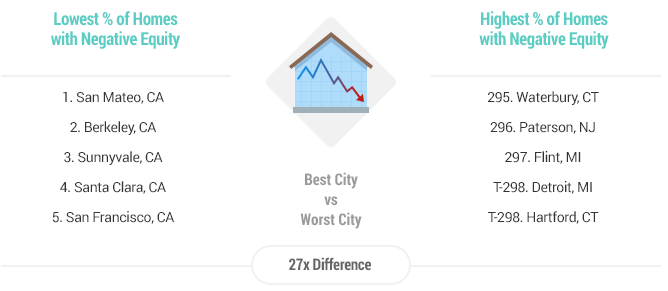
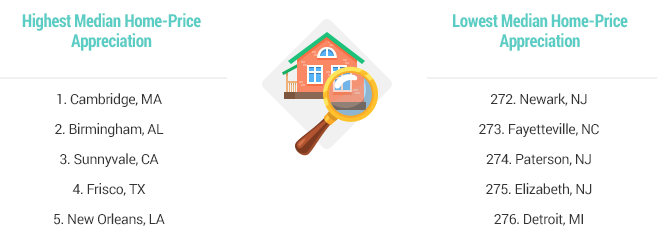
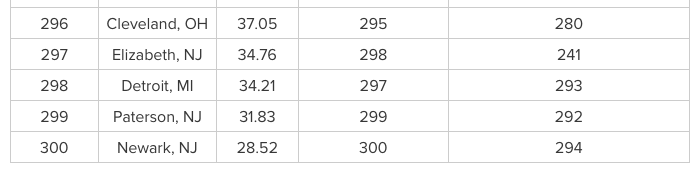
Worst Real Estate Markets

Way to go NJ! Taking 3 out of the bottom 5 spots! Special Kudos to Newark and Paterson – worse than Detroit.

From WalletHub:

2016’s Best Real-Estate Markets

Screen Shot 2016-09-02 at 8.02.54 AM

Screen Shot 2016-09-02 at 8.05.28 AM

Screen Shot 2016-09-02 at 8.05.04 AM 1

Posted in New Jersey Real Estate | 48 Comments

Otteau: NJ Pending Sales at 2005 Levels

From Otteau Group:

NJ Purchase Contracts On Par With 2005

The number of home sales this year in New Jersey has been about the same as 2005, which was the peak year heading into the Great Recession. In July, the number of contract purchases by homebuyers exceeded the same month in the prior year for the 23rd consecutive month, reflecting a 2% increase over July 2015. Considering the 21% increase (y-o-y) in July of 2015, home sales have increased by 23% over the past 2 years.

On a year-to-date basis (January-July) home purchase demand in New Jersey has increased by 13%. This increase has been largely concentrated in homes priced below $400,000, as first-time ‘Millennial’ buyers begin to transition from rentership to homeownership. By comparison, the number of luxury home sales priced at $2,500,000 and above, declined by 3% this year. Reasons for this trend include a greater number of younger-age first home buyers, trade-down purchases by older-age empty-nesters, and relaxed mortgage lending standards which have reduced minimum down-payment amounts.

Shifting to the supply side of the equation, the supply of homes being offered for sale remains tight, which is limiting choices for home buyers. The number of homes being offered for sale today in New Jersey has declined by nearly 6,000 (-10%) compared to one year ago. This is also about 22,000 (-30%) fewer homes on the market compared to the cyclical high in 2011. Today’s unsold inventory equates to 5.3 months of sales (non-seasonally adjusted), which is lower than one year ago when it was 5.9 months.

Currently, the majority (81%) of New Jersey’s 21 counties have less than 8.0 months of supply, which is a balance point for home prices. Hudson County is presently experiencing the strongest market conditions in the state with just 3.3 months of supply, followed by Union, Essex and Somerset Counties, which all have fewer than 4 months of supply. None of the counties have an unsold inventory level equivalent to a supply of 12 months or greater, however those with the largest amount of unsold inventory are concentrated in the southern portion of the state including Cumberland (9.4), Cape May (9.9), Atlantic (10.3) and Salem (10.8).

Posted in Demographics, Economics, New Jersey Real Estate | 40 Comments

National Home Prices up 5.1% YOY

From Bloomberg:

US home price gains ease in June: S&P/Case-Shiller

The pace of U.S. home price gains slowed in June from the previous month, but strong appreciation in the West and South kept growth above the two-year average, according to a monthly report.

The S&P CoreLogic Case-Shiller 20-City Composite index rose 5.1 percent year over year, versus expectations for an increase of 5.2 percent. That marked a sequential slowdown from May’s revised 5.3 percent increase.

The June gains were slightly above the 4.8 percent annual pace over the last two years.

“Overall, residential real estate and housing is in good shape. Sales of existing homes are at running at about 5.5 million units annually with inventory levels under five months, indicating a fairly tight market,” David M. Blitzer, managing director and chairman of the Index Committee at S&P Dow Jones Indices, said in a statement.

Portland, Oregon, led the gainers with price appreciation of 12.6 percent. Seattle followed with an 11 percent increase, and Denver came in third with a 9.2 percent gain.

“In the strongest region, the Pacific Northwest, prices are rising at more than 10 percent; in the slower Northeast, prices are climbing a bit faster than inflation,” Blitzer said.

Posted in Economics, National Real Estate | 70 Comments

West Coast the New East Coast?

From HousingWire:

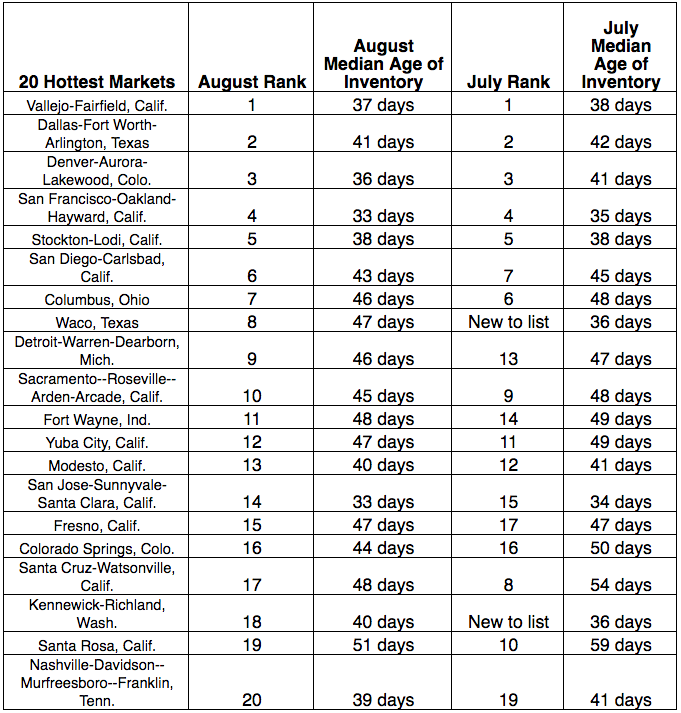
Here are the 10 hottest housing markets that fueled a record-breaking August

The hottest housing market in America right now might still be Vallejo-Fairfield, California [San Fran area] but this doesn’t mean the rest of the list stood still. Interestingly, one new market not only joined the list, but also jumped up to the eight spot. And to the city that was sitting comfortably as the eighth hottest market, well, it fell completely out of the top ten, barely even making the top twenty.

Needless to say, the summer housing season was on fire, recording the hottest August housing market in a decade, as Jonathan Smoke, chief economist for realtor.com, the creator of the hottest medium-sized to largest market list, explained.

“Summer 2017 was one of most competitive buying seasons that we have ever witnessed, fueled by historically low mortgage rates and inventory shortages that resulted in record-high prices,” said Smoke.

“With the school year starting now in most of the country, we’re seeing some drop-off in demand, which may provide some relief for buyers weary from battling it out against other buyers all summer,” he noted.

So what exactly is hot?

According to realtor.com, the hottest markets received from 1.4 to 4.5 times the number of views per listing compared to the national average, and in terms of supply, these markets saw inventory move from 21 to 39 days more quickly than the rest of the U.S.

On the positive side for home shoppers, the report stated that the hottest markets saw inventory movement slow down slightly, with the median age increased by two days on average from July.

top20

Posted in Economics, National Real Estate | 65 Comments

Affordable Suburbia

From the Record:

Garden apartments help shape the N.J. landscape

In North Jersey, garden apartment buildings are a little like pizzerias — there’s at least one in every town.

These two-story rectangles, usually faced with brick and set on grassy lawns, date to a post-World War II suburban building boom that also gave rise to strip malls and modest single-family subdivisions across the region.

And like other suburban building types, garden apartments aren’t on anybody’s list of design stars.

“They’re nondescript architecturally,” said architect Barry Poskanzer of Poskanzer Skott in Ridgewood. “I’ve never driven by one and thought, ‘That’s an interesting design.’ ”

“Monotonous,” said James Hughes, a Rutgers economist who has studied the history of New Jersey’s apartment markets.

Still, garden apartments have their place in the housing ecosystem. They’re a relatively affordable choice for many people just starting out, or those who can’t or don’t want to buy a home. And then there’s the green space that puts the “garden” in their name.

William Martin, a Westwood architect, said that the green space is one of the best features that garden apartments bring to the North Jersey landscape.

“If you look at complexes constructed in the ’50s and ’60s, they have mature trees, nice pathways, sometimes open space,” said Martin, co-chairman of the public awareness committee of the New Jersey chapter of the American Institute of Architects. “I think they’re a tremendous asset. They provide an alternative way to live in suburban New Jersey that isn’t a single-family home.”

Garden apartments, he said, help diversify a town’s demographics, allowing people to stay in the same town over their life cycles because they offer shelter for young people just starting out, as well as for older people looking to downsize. A garden apartment is often the first “adult” home for people in their twenties.

Over the years they’ve often been marketed as “luxury,” but compared to newer rentals, they’re fairly modest in terms of both size and amenities.

“You have a kind of community, you have a front door, you can drive up to your apartment. It doesn’t feel as urbanized,” said Ryan Sanzari, chief operating officer of Hackensack-based Alfred Sanzari Enterprises, which owns about 500 units in half a dozen garden complexes. Most were built by his grandfather, Alfred Sanzari, half a century ago.

Investors like them, too. Tom McConnell of Redwood Realty Advisors in Hasbrouck Heights has sold a number of North Jersey garden complexes. Investors who buy these buildings, he said, will pay roughly $125,000 to $225,000 per apartment in suburban towns, depending on the town.

“There’s a lot more demand than there is supply,” McConnell said. Investors like the steady income they can get out of the buildings, which have monthly rents that typically range from around $1,200 to $1,700 for a one-bedroom in North Jersey.

The heyday of garden apartment construction came in the 1950s and 1960s, part of the suburban building boom that followed World War II. Between the Depression and the war, there was a 15-year home-building drought, leaving an acute demand for housing that working people could afford.

“How do you economically meet that demand?” Martin asked.

Garden apartments were one answer, because they were relatively fast and easy to build, with wood frames and no need for concrete, steel or elevators. So a single-family builder without the expertise to construct a high-rise could easily diversify into garden apartments.

And they were a way to “create increased density in the suburbs,” according to Poskanzer, since more density generally means more profits for a builder.

Garden apartments make up a major part of the apartment market in New Jersey. About half the apartment units in the state were built from 1940 to 1979 — a period that includes the garden-apartment boom, according to a Rutgers report written by Hughes and a former colleague, Joseph Seneca.

Posted in Demographics, Economics, New Jersey Real Estate | 33 Comments