
Inventory yet? Nope.

From Berkshire Hathaway Fox & Roach:

Low inventory fuels real estate market

Buyers and sellers in the New Jersey-Pennsylvania region will enter a highly competitive housing market in 2016 as the economy continues to get stronger, according to a survey of Berkshire Hathaway HomeServices Fox & Roach Realtors agents.

Forty-one percent of agents reported that both buyers and sellers will have equal power in 2016, an increase from 37 percent last year, while buyers’ power decreased from 44 percent to 34 percent in the survey. The online survey of 347 BHHS Fox & Roach agents was conducted from Nov. 3 to 20, 2015.

Agents feel positive about current regional market conditions for both buyers and sellers, but the sellers position is strengthening, as 53 percent of agents feel it is a good time to sell (up from 48 percent in 2015), while the percentage of agents that feel it’s a good time to buy remained the same as last year (77 percent).

Data from the BHHS HomExpert First Nine Months report shows monthly average inventory has remained relatively stagnant since 2012. Limited housing options will continue to fuel competition, with 30 percent of agents reporting that limited supply/inventory will be the biggest hurdle homebuyers will face in 2016.

In spite of the competitive atmosphere, agents are still seeing 67 percent of buyers submitting an offer below asking price, hoping the seller sees they overpriced the home, and 11 percent are willing to walk away if they need to increase their offer that will increase their mortgage from their current home.
Posted in Demographics, Economics, Employment, Housing Recovery, New Jersey Real Estate | 6 Comments

“He said a lot of bad things and he walked away.” (He called AC pols “corrupt and stupid”)

From the Star Ledger:

Is gambling mogul Steve Wynn interested in north Jersey casino?

The leader of the state Assembly said Thursday that Steve Wynn, the famed casino mogul who owned one of the first gambling halls in Atlantic City before leaving town decades ago, has expressed interest in returning to the state — as the owner of one of the first casinos in north Jersey.

Assembly Speaker Vincent Prieto (D-Hudson) said attracting entrepreneurs like Wynn is one of the reasons he continues to stick by his plan to ask voters to amend the state constitution to expand casino gambling to the northern part of the state, rather than support a rival bill by state Senate President Stephen Sweeney (D-Gloucester).

“I have talked to many individuals that have expressed interest in coming into New Jersey,” Prieto said. “Mr. Wynn is one of those individuals that has shown interest in different sites in the area.”

“It’s just another excuse,” the Senate president said. “The ball keeps moving.”

“Steve Wynn left New Jersey,” he added. “He said a lot of bad things and he walked away.”

Top state lawmakers agree that casinos in north Jersey would bring thousands of new jobs and millions in new revenue to the state. They also say it help New Jersey stay afloat in the competitive northeastern gaming market now that Atlantic City — the only place in the state currently allowed to offer gambling — has suffered through years of financial struggles.

Both Prieto and Sweeney have introduced plans to place a question on November’s ballot asking voters to approve two new casinos in north Jersey. But for the question to make it to the ballot, the Senate and Assembly need to compromise on a single plan, and Prieto and Sweeney remain deadlocked.

One of their key disagreements is over who should be allowed to operate the new casinos. Sweeney’s resolution requires that each of the new casinos must be owned at least in part by an operator in Atlantic City, which has seen four casinos close and thousands of jobs lost amid increasing competition in neighboring state over the last few years.

Prieto’s measure requires that for only one of the casinos. The second would be open to outside operators.

South Jersey lawmakers have argued that any north Jersey casino would cripple Atlantic City. And Sweeney said by requiring an Atlantic City operator to run one of the new casinos, it would at least allow cross-promotion that could boost the struggling resort and keep it from fading.

Posted in New Development, New Jersey Real Estate, Politics | 75 Comments

The rise and fall of the office park

From CityLab:

The Sad State of Suburban Office Parks

A report from the real estate service firm NGKF released late last year provides new numbers on an ongoing phenomenon: the slow, agonizing death of the American office park. The report looks at five far-flung office tenancy submarkets—Santa Clara, in the San Francisco Bay Area; Denver; the O’Hare region in Chicago; Reston/Herndon outside of Washington, D.C.; and Parsippany, New Jersey—and finds a general aura of decline.

Between 14 and 22 percent of the suburban office inventory in these areas is “in some stage of obsolescence,” suggesting that between 600 million and 1 billion square feet of office space are far from ideal for the modern company and worker. That’s about 7.5 percent of the country’s entire office inventory.

What makes an office park “obsolete?” Arguably the most important amenity for the modern office is location, location, location. This aspect of an office park is difficult to change. So-called Class A office space is in transit-oriented areas that are at least close to highways. These offices don’t need to be in walkable, urban neighborhoods—though that’s ideal. At the very least, today’s workers want to get lunch or maybe even a workout without firing up an engine, NGKF finds. The newest figures from the commercial real estate service firm CBRE bear this out: 10.4 percent of downtown office spaces are currently unoccupied, compared to 15.0 percent of suburban ones.

The decline of the office park is part of a larger story, often told, about shifting American working and housing preferences, from sprawling, isolated, “safe,” and cubicled suburban campuses to more well-connected and increasingly well-funded urban open floor plans. (The office park itself was a rejection of the city: “The first office park opened in Mountain Brook, Alabama, an upper-class white suburb of Birmingham, in the early 1950s as commuters became uneasy with simmering racial tension in city centers,” a recent Washington Post piece notes.)

The growing freelance economy, which sees fewer people traveling to a desk each morning, has contributed to a larger, national decline in the amount of office space occupied by workers. Much of country doesn’t need the wide-open office campus anymore.

But as the world (mostly) marches on without them, what will existing office parks be when they grow up?

There are models that developers are using to transform older office parks throughout the country, to measured success. They mostly involve turning definitely-suburban office parks into urban-like, albeit still isolated, office “cities.” (It is worth noting that many of these projects involve extensive rezoning efforts.) A facility in the community of Edina, Minnesota, is in the midst of transforming from sprawling office center into what one local developer called “not your father’s or mother’s office park.” In practice, that means linking the park to 15 miles of bike trails, big box store-free retail, and green space. Other struggling office parks are talking farmers markets, hotels, and housing.

Sure, those are familiar buzzwords. But it appears that the office park is not going down without a fight.

Posted in Demographics, Economics, Employment, National Real Estate, New Development | 111 Comments

Jersey foreclosures finally turning the corner?

From the Record:

New N.J. foreclosure filings dip for first time in four years

New residential foreclosure filings fell last year in New Jersey for the first time since 2011, which experts say is another sign that the state’s economy and housing market are improving.

Lenders’ foreclosure filings — not including condominiums — fell 27 percent in 2015 to 35,733 with declines in each of the state’s 21 counties.

Bergen County, which had 3,173 filings in 2014, ranked fourth last year with 2,513 filings behind Essex, Ocean, and Camden counties, which had 3,265, 3,072 and 3,017 filings, respectively. Passaic County had 1,883 filings last year, down from 2,687 in 2014.

The turnaround came after increases of 15 percent in 2014, and 75 percent the year before, according to the data released Tuesday by the New Jersey Judiciary.

The figures affirm a trend highlighted in a quarterly Mortgage Bankers Association report in November, which said the percentage of New Jersey mortgages which had payments way overdue or that were in foreclosure represented 12.7 percent of the total mortgages in the state, down from 15 percent a year earlier.

The reversal of the foreclosure trend indicates that “the economy is stabilizing, and the major pressures are beginning to ease off of the housing market,” said Joel Naroff, president of Naroff Economic Advisors. Employment in the state also has picked up in recent months.

Economist Patrick J. O’Keefe agreed, while noting that 35,733 filings is still a fairly high number.

“Much of the progress that has been made in reducing the seriously delinquent inventory is being countered by foreclosures still being filed,” said O’Keefe, who is director of economic research for the Roseland accounting firm CohnReznick.

O’Keefe said he suspects that some of the reported foreclosure filings may actually be re-filings of old cases which had been set aside for any of a number of reasons, as lenders struggled to comply with court requirements, and as homeowners challenged debt collectors’ rights to foreclose on loans that may have changed hands several times.

“When you look at mortgages today it’s a bit like trying to describe a bowl of spaghetti,” O’Keefe said.

It is clear, however, that New Jersey which has been lagging the nation in its recovery from the foreclosure crisis, is now catching up.

Posted in Foreclosures, Housing Recovery, New Jersey Real Estate | 125 Comments

“This year will be a good year for housing”

From the Record:

Job growth lifts housing outlook for 2016

Buoyed by strong job growth, the housing market in the new year will continue to climb out of its worst downturn in generations.

As the unemployment rate has dropped to 5.3 percent in New Jersey and 5 percent nationwide, people are increasingly getting the confidence to move into their own places or trade up to more expensive homes. Mortgage rates will rise, but not precipitously, experts predict. And builders will ramp up activity to help meet the demand — though new home construction will continue to fall short of long-term averages.

“Given the continuing economic recovery, this year will be a good year for housing,” said Jeffrey Otteau, an East Brunswick appraiser who tracks the housing market statewide.

On the downside, many people will struggle to afford apartments or houses, as home prices and rents continue to grow faster than incomes.

Housing prices are expected to continue recovering from the 25 percent to 30 percent plunge they sustained in the housing crash. Most predictions for home price increases this year are in the neighborhood of 3 percent to 5 percent — not huge, but still ahead of inflation.

Along with higher mortgage rates, these price increases will make homes less affordable. That’s expected to create special challenges for first-time buyers, who have been missing from the housing market’s recovery.

As young households are priced out of cities, they will increasingly look to inner-ring suburbs, especially those with walkable neighborhoods and downtowns, said Svenja Gudell, chief economist for Zillow.

Even with the affordability issues, there’s a lot of pent-up demand for homes because many people delayed setting up their own households in the years when unemployment was high, analysts say.

“This hesitancy has begun to diminish as the economy has shown a more consistent improvement and jobs are being added,” Crowe said.

Millennial households are expected to move into homeownership in larger numbers, as they begin to marry and have children.

“There’s a heavy correlation between marriage and homeownership and an even stronger correlation between having children and homeownership,” Crowe said.

On the seller side, as values rise, more homeowners who have been underwater on their properties — that is, owing more on the mortgage than the home is worth — will be able to sell without suffering a loss. That is expected to loosen up some of the gridlock in housing sales activity, by bringing more inventory to the market.

Rents nationally are expected to rise by 4 percent to 5 percent this year, continuing recent trends. Demand for rentals is on the rise as more people become confident enough about their jobs to move into their own places, but either prefer the flexibility of renting or can’t afford to buy homes.

In North Jersey, a number of new apartment buildings have been constructed to meet the growing demand for rentals. But most are high-end properties with monthly rents that can start at $2,000 and up, offering little relief to low- and middle-income households in the region, which has always been a high-rent market.

Nationwide, the worst of the foreclosure tsunami has passed, but New Jersey is still dealing with a backlog of distressed properties that built up while the mortgage industry answered accusations of abusing borrowers’ rights.

That overhang of distressed properties put downward pressure on prices, because foreclosed properties tend to sell at a discount, O’Keefe said.

As the state continues to resolve more foreclosure cases this year, distressed properties will be less of a weight on the market, O’Keefe predicted. That will allow home values to rise, which in turn will enable more homeowners to sell without taking a loss.

Posted in Demographics, Economics, Employment, Foreclosures, Housing Recovery, New Jersey Real Estate | 133 Comments

Rising incomes will have an “outsized” impact on NJ

From the Record:

Some optimism about the state economy, for a change

New Jersey’s economy has rarely failed to disappoint in recent years, but economist Joel Naroff thinks that may change in 2016.

He foresees a solid national performance, with economic growth of around 3 percent. And while New Jersey won’t match the nation, the state will enjoy a similar performance – unlike past years, when the state has clearly lagged, Naroff said.

“We are beginning to follow national trends again,” said Naroff, who is economic adviser to the Trenton-based New Jersey Business and Industry Association, adding that his comments reflect only his own views. “That’s good news.”

“I am positive about the direction the state’s economy is going in,” he said. “I am not saying it’s going to be strong. We are not going to have a great economy. But we had improvement in the second half of 2015, and that will carry through to 2016.”

The upbeat forecast from the economist, who heads his own consulting company, contrasts with his past laments about the state’s lackluster economic recovery.

He has worried that no industry appears to be strong enough, or with enough potential, to lift the state out of the doldrums created by the decline of such past powerhouse sectors as manufacturing and telecommunications, the downsized casino industry, the weakened financial sector and the diminished pharmaceutical industry.

Yet the state is coming into its own as a distribution, logistics and warehouse hub, and that will help, Naroff said. The rise of online shopping requires logistical excellence to get goods purchased online quickly to consumers, and the state’s ports, infrastructure and proximity to the vast metropolitan market make it well placed to benefit from the shift, he said.

Outside of that, Naroff said the economy will be helped by a rise in incomes, which will have an “outsized” impact on New Jersey, because of its dense population.

“I think the state economy accelerates in 2016, in no small part because we will finally start seeing better income gains,” he said. “And that feeds back. Income gains means greater demand. Greater demand means more hiring. More hiring means more income. And you set off this positive impact.”

Posted in Economics, Employment, Housing Recovery, New Jersey Real Estate | 51 Comments

Predictions 2016!

This is becoming a tradition around here, so here we go again! You know how this works, break out the crystal balls and prognosticate.

Ground Rules

Predictions provided should either be for June 30th, 2016 or December 31st, 2016, please specify.

Provide justification for your forecast, where applicable (unless you are just making it up, if so, state that).

You may provide any caveats and/or assumptions that your forecast is based on.

You need not provide a forecast for all categories below.

Where applicable, forecasts are judged against the surveys/reports listed.

Real Estate
National
Existing Home Sales – NAR
Existing Home Price – S&P Case Shiller HPI
Existing Home Price – Other
National New Home Sales – NAHB
Median New Home Price – NAHB

New Jersey
Existing Home Sales – NAR/NJAR
Existing Home Price – S&P Case Shiller HPI
Existing Home Price – Other

Commodities
Energy (Oil, NatGas)
Metals (Gold, Silver, Copper)

Equities
United States
International Developed Markets
Emerging Markets

Mortgage Financing
30-Year Fixed – Freddie Mac PMMS
15-Year Fixed – Freddie Mac PMMS

Foreclosures
Delinquency Rate
Foreclosure Rate

Macroeconomic
10y Treasury
Fed Funds Rate
National Unemployment Rate
New Jersey Unemployment Rate

Oddball
Anything else you’d like to make a prediction about.

Posted in General | 57 Comments

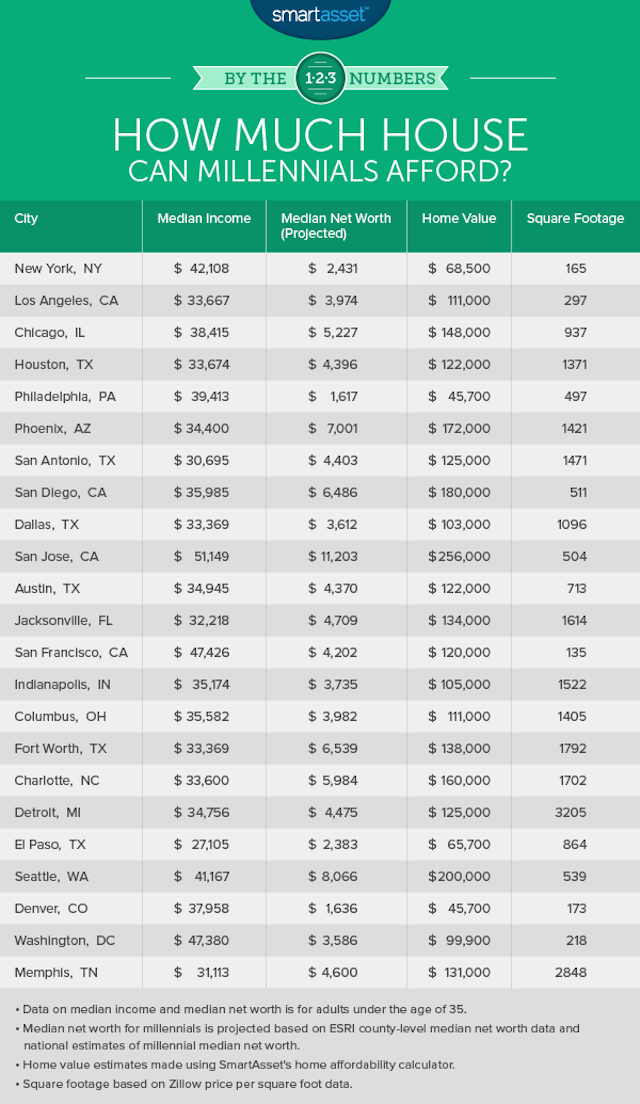
Millennials can barely afford their own bedroom

Posted in Demographics, Economics, Employment, National Real Estate | 46 Comments

Despite our arrogance, we’re not in the top 20.

From HousingWire:

Here are the 20 hottest housing markets to close out the year

Discuss:

Here are the 20 hottest housing markets in December

20. Midland, Texas

19. Fort Wayne, Indiana

18. Tampa-St. Petersburg-Clearwater, Florida

17. Boulder, Colorado

16. Detroit-Warren-Dearborn, Michigan

15. Modesto, California

14. Palm Bay-Melbourne-Titusville, Florida

13. Nashville-Davidson-Murfreesboro-Franklin, Tennessee

12. Oxnard-Thousand Oaks-Ventura, California

11. Los Angeles-Long Beach-Anaheim, California

10. Stockton-Lodi, California

9. Yuba City, California

8. Santa Rosa, California

7. Denver-Aurora-Lakewood, Colorado

6. San Diego-Carlsbad, California

5. Sacramento-Roseville-Arden-Arcade, California

4. Dallas-Fort Worth-Arlington, Texas

3. Vallejo-Fairfield, California

2. San Jose-Sunnyvale-Santa Clara, California

1. San Francisco-Oakland-Hayward, California

Posted in Housing Recovery, National Real Estate, New Jersey Real Estate | 46 Comments

#FOMO

From the WSJ:

Housing Rebound: Time for Millennials to Leave the Nest

Millennials appear to be in no rush to ditch their parents’ homes. Perhaps they should be.

More adults between ages 18 and 34 are now living with mommy and daddy than ever before, according to the Pew Research Center. And the millennials who have fled the nest have increasingly become renters rather than buyers, a major reason the U.S. homeownership rate hit a 48-year low earlier this year.

But times are changing. Job prospects are improving and wages are showing signs of breaking out. Those factors alone suggest conditions are favorable for home buyers. Yet record levels of student debt are weighing on millennials and that could prompt them to miss out on a ripe opportunity to buy.

Consider the coming S&P/Case-Shiller Home Price Index, due Tuesday. Economists polled by The Wall Street Journal estimate home prices across the nation rose 5.2% in the 12 months ended in October, up from a 4.9% increase in the comparable period a month earlier.

Of course, that is good news for current homeowners. They reap the benefits of seeing home values appreciate by more than twice the rate of inflation. But that doesn’t help a millennial skittish about becoming a first-time home buyer. Rising home values make it even more difficult to muster 20% for a down payment.

Furthermore, the benefit of ultralow mortgage rates won’t last forever. The average 30-year fixed-rate mortgage was still under 4% in December, according to Freddie Mac. With the Federal Reserve expected to keep raising interest rates at a measured pace in 2016, they should move higher as well.

Rising prices and interest rates may please the older generation, but not the one that hasn’t yet begun climbing the property ladder.

The fear of missing out—or FOMO, as the kids say these days—should prompt millennials to act now.

Posted in Demographics, Housing Recovery, National Real Estate | 87 Comments

$1m to buy the average condo/coop in NYC

From the WSJ:

New York City Housing Prices Set Record

Manhattan apartment prices reached new highs in 2015, with the typical price of a co-op or condominium topping $1 million for the first time as the year drew to a close.

The new benchmark, in the fourth quarter, was a milestone in the rising cost, and for many the unaffordability, of homeownership in New York City.

Many brokers and analysts attributed the marker to a surge in closings at expensive new buildings that have been under construction for years, including many deals signed months or even years ago. The rest of the market showed more modest prices gains and slower sales growth.

Instead of celebrating the new benchmark, brokers described an alternative real estate universe in the second half of 2015: There were signs of a slowdown beginning in the summer, with a modest uptick late in the year.

The number of foreign buyers dropped, they said, while New York buyers became extremely price sensitive.

“There is more supply and more headwinds in the market,” with supply pressures varying from neighborhood to neighborhood, said Dolly Lenz, a broker in the luxury market. “Buyers have a whole lot of choices and they are voting with their dollars.”

The median price of a Manhattan apartment rose to nearly $1.1 million, an increase of 13.5% from $965,000 from both the previous quarter and the fourth quarter of 2014, according to an analysis of city Department of Finance data by The Wall Street Journal. The average price also increased to a record of $1.9 million in the fourth quarter from $1.67 million in the third quarter.

For all of 2015, the median price also set a record: $980,000, up 6.5% from $920,000 in 2014. Sales were up slightly too, by 2.1%, but below the sales pace in 2013. There were 12,872 sales in 2015, compared with 12,608 in 2014, based on sales filed with the city through Dec. 21 of each year.

Posted in Economics, Housing Recovery, NYC | 97 Comments

2015 Economic Snapshot

From the Record:

2015 was the year of the long good-bye, but jobs rebounded

New Jersey’s job market swung from optimism to despair and back in 2015, ending the year on a high note, with the largest annual employment increase in 15 years.

Yet the encouraging performance will have to show continued strength if it is going to dispel the notion that the state’s economy lags the national expansion.

New Jersey added 37,800 jobs in the first five months of the year, only to lose 60 percent of them in June and July. Since then, state employment has grown by about 12,000 jobs a month, bringing the figure to 55,000 through November, the most since the 78,400 jobs created in 2000.

The state’s employment increase, by 1.38 percent, is smaller than the national employment increase of 1.64 percent so far this year. New Jersey’s jobless rate of 5.3 percent remains above the national level of 5 percent. And the state has recovered only about 78 percent of the jobs lost in the recession; the U.S. regained them more than a year ago.

Construction provided the state’s largest proportional employment increase, adding 9,800 jobs for a 7 percent increase in 2015 that reflected the strength in the housing market. The next biggest gains were in education and health services — a reliable growth sector that saw employment rise 2.4 percent — and leisure and hospitality, which expanded by 2.2 percent, shrugging off the weakness of 2014 from the casino meltdown in Atlantic City.

The most striking improvement was in the manufacturing sector, long a declining area, which increased by 1.57 percent, or 3,800 jobs, this year, prompting economists to wonder whether the drop had bottomed out.

That did little to diminish concern at the weakness in the professional and business services group, home to many of the state’s high-paying occupations. The sector shed 900 jobs in 2015.

North Jersey’s housing market continued to recover in 2015 from a deep downturn, with multifamily construction and the number of home sales up significantly.

But the pain is not over. Price increases were muted, and the state led the nation in foreclosures.

Home construction in the state has rebounded strongly from the depths of the housing crash, when only about 13,000 housing units were started each year from 2009 to 2011 — the lowest numbers since World War II. In 2015, the state’s builders are on track to start more than 30,000 units — the highest number since 2006, and close to the longtime averages in the 37,000 range.

The growth this year was entirely in multifamily construction, especially along the Hudson River waterfront in Hudson and Bergen counties. Single-family building permits were actually down by 8.2 percent through November, reflecting the high price of land and the fact many households are renting, either by choice or because they can’t qualify for a mortgage.

Still, the number of single-family home sales through November was up 11 percent in Bergen and 14 percent in Passaic County over the same period last year, according to the New Jersey Realtors. Despite the increased demand for homes, prices didn’t budge much, up 2.2 percent in Bergen and 3.5 percent in Passaic.

During the year, New Jersey led the nation in foreclosure activity. Lenders continued to clear up a backlog of distressed properties that built up after the mortgage industry was forced to slow down foreclosures after being accused of abusing the rights of homeowners in trouble.

Posted in Economics, Employment, Housing Recovery, New Jersey Real Estate | 20 Comments

Something’s fishy about the New Home Sales numbers

Housingwire cites Zerohedge? I like it.

Is there more trouble hidden in November’s new home sales data?

But a deeper dive into the new home sales data shows that November’s increase over October isn’t quite as promising as it appears.

The folks over at Zero Hedge spotted a potentially troubling trend of the new home sales data being continually revised down, making each month’s figures look not nearly as positive as first reported.

For example, the initial estimate for October’s new home sales data was a seasonally adjusted annual rate of 495,000, so the revised data released Wednesday showed a downward revision of 25,000.

With November’s new home sales data printing at a seasonally adjusted annual rate of 490,000, November’s new home sales are actually lower than October’s initial total.

But comparing the November’s initial estimate to October’s revised total is not an apples-to-apples comparison, but a further look at the year’s data shows why November’s data could look a whole lot different in about a month when December’s data is released.

As Zero Hedge noted, the last five months have each been revised downward from the initial projections.

September’s initial report showed a seasonally adjusted annual rate of 468,000, but the current data from the Census and HUD shows that the revised total for September is actually 442,000, a decrease of 26,000 over the initial total.

The difference between August’s initially reported totals and the revised figures are even more significant.

When September’s initial report came out, the initial estimates had new home sales collapsing 11.5% from what was then August’s revised total of 529,000. But since then, August’s total has been revised even further.

August’s initial report showed at a seasonally adjusted annual rate of 552,000, but the current revised total is 507,000, a decrease of 45,000 from the initial report and a decrease of 22,000 from what was reported in October.

So the actual decrease from August to September was 84,000, not 65,000 as it was initially thought to be.

October, September and August were not the only months where the new home sale data has been revised down.

July’s initial report showed at a seasonally adjusted annual rate of 507,000, but the current revised total is 500,000, a decrease of 7,000.

June’s total was revised down from 482,000 to 469,000, a decrease of 13,000.

May’s total was revised down from 546,000 to 513,000, a decrease of 33,000.

And April’s total was revised down from 517,000 to 508,000, a decrease of 9,000.

So, for the last seven months, the average reduction from the initially reported new home sales data is approximately 22,570.

Subtract that average reduction of 22,570 from November’s total of 490,000 and November’s new home sales print at an estimated 467,430, which would represent a decrease of approximately 3,000 from October’s revised total, not an increase as was initially reported.

So, will next month’s report showed that new home sales actually fell in November?

The math certainly seems to show that that is exactly what happened.

Posted in Economics, National Real Estate, Politics | 38 Comments

Did TRID cause the November dip?

From HousingWire:

The TRID effect is real: Existing-home sales fall sharply in November

First there was anecdotal evidence that the implementation of the Consumer Financial Protection Bureau’s TILA-RESPA Integrated Disclosures rule in October had caused issues with the housing industry, but now, concrete data is beginning to show just how much the impact of TRID is being felt – and the news isn’t great.

Last week, the latest Origination Insight Report by Ellie Mae showed the average time to close a loan increased by 3 days during the month of November to 49 total days, making it the longest time needed to close a loan since Feb. 2013.

And according to the latest report from the National Association of Realtors, those closing delays helped considerably slow down existing-home sales in the month of November.

According to NAR’s latest report, the total existing-home sales, which are completed transactions that include single-family homes, townhomes, condominiums and co-ops, fell 10.5% to a seasonally adjusted annual rate of 4.76 million in November.

Existing-home sales cooled to the slowest pace in 19 months during November, NAR’s report showed, to the lowest seasonally adjusted annual rate since April 2014 when it was 4.75 million.

This it the second month in a row that existing-home sales have fallen. In October, total existing-home sales decreased 3.4% to a seasonally adjusted annual rate of 5.36 million.

After last month’s decline, which NAR said was the largest since July 2010 at 22.5%, existing-home sales are now 3.8% below a year ago, which is the first year-over-year decrease since Sept. 2014.

According to NAR Chief Economist Lawrence Yun, the decline is not entirely due to TRID, but TRID certainly isn’t helping.

NAR’s report also showed extended closing times, which Yun said may be pushing sales out into December, with the hope being that closings are just being delayed, not disappearing entirely.

Posted in Housing Recovery, Mortgages, National Real Estate | 121 Comments

November Existing Home Sales

From the WSJ:

U.S. Existing Home Sales Plunge in November

Sales of previously owned homes plummeted in November as delays caused by new mortgage red-tape and a dwindling supply of residences on the market pushed down sales to a level not seen since April 2014.

Existing-home sales fell 10.5% last month to a seasonally adjusted annualized rate of 4.76 million, the National Association of Realtors said Tuesday, well below the 5.32 million economists expected. The double-digit decline was the sharpest since July 2010, when sales took a hit from the expiration of a home-buyer tax credit.

The NAR blamed the lion’s share of the November decline on closing delays caused by new federal rules implemented by the Consumer Financial Protection Bureau in October, although it said rising home prices and tight inventory continued to challenge potential buyers.

Several realtors said pressure on housing inventories is also driving the sales slump. The number of existing homes for sale fell more than 3% on the month in November and was down nearly 2% on the year.

“I think we’re still seeing a fair amount of tightness in active selling markets,” said Zillow Chief Economist Svenja Gudell, adding first-time buyers trying to enter the market at a lower price point are facing particular scarcity. Housing prices have also climbed faster than wages in many markets, making it more difficult for first-time buyers to save for a down payment.

In November, the national median home price rose to $220,300, the 45th consecutive month of gains year over year, and 6.3% higher than the same month last year.

Despite November’s decline, NAR said home sales are on track for their best year since the current economic expansion began. Economists said the underlying sales rate appears steady, despite the rule changes causing turbulence last month.

Posted in Economics, Housing Recovery, National Real Estate | 44 Comments