
Just let Atlantic City fall into the sea

From the Record:

Legislators advance competing measures to put approval of North Jersey casinos on ballot

State Senate and Assembly committees each passed resolutions on Thursday designed to have voters statewide determine next fall whether to amend the state constitution to allow two casinos to operate in North Jersey.

But the two measures differ on how much tax revenue from the North Jersey casinos should go to support Atlantic City — a discrepancy that could jeopardize efforts to pass the resolution before the end of the lame-duck session next month in Trenton.

The version that the Assembly Judiciary Committee approved Thursday would send 35 percent of tax revenues from the North Jersey casinos to a new state entity that would use those resources to bring more diverse entertainment and leisure options to the struggling, casino-dependent city. The revised measure that emerged from the Senate Budget and Appropriations Committee would send 49 percent of the first $150 million in North Jersey casino tax revenues to Atlantic City, then 40 percent, 30 percent, and 20 percent of each subsequent $150 million that the casinos generate.

Additionally, the Assembly resolution would allow for one of the two winning casino bids to have no affiliation with a company that operates an Atlantic City casino. But Stephen Sweeney, the state Senate president who represents a South Jersey district, said it was critical that any North Jersey casino operator have an Atlantic City-based partner — a provision of the Senate measure.

“I want the industry in the north part of the state to be tied to Atlantic City,” Sweeney said Thursday, adding that a patron at a casino in the Meadowlands or in Jersey City should be able, for example, to earn a free room or meal at an Atlantic City counterpart.

Sweeney also said of the higher subsidy for Atlantic City in the Senate measure: “I’m not just going to let Atlantic City fall into the sea after it has provided billions and billions of dollars to the state. It would be easy for me to curry favor with my friends in other parts of the state and say, ‘The hell with them.’ But we are not going to let that happen.”

The referendum would ask voters whether to amend the state constitution, which currently restricts casino gambling to Atlantic City, allowing two casinos to be established in separate counties at least 75 miles from the struggling seaside resort city. Neither version of the resolution spells out where the casinos would be built, but all locations would have to be north of Monmouth and Mercer counties. The most likely locations appear to be the Meadowlands and Jersey City.

Assemblyman Ralph Caputo, D-Essex, who sponsored the Assembly resolution, has said that the Senate version, with its more generous Atlantic City subsidy, is more likely to be rejected by taxpayers who are aware of the city’s longstanding budget woes and recurring corruption scandals there over the years.
Posted in New Development, North Jersey Real Estate, Politics | 78 Comments

Atlantic City in the Top 10 … worst performing markets

From HousingWire:

These are the top and bottom 10 housing markets right now

As the year comes to a close, Pro Teck Valuation Services’ latest home value forecast of the top 10 best and 10 worst performing metros ended the year on the same note, fluctuating little over the year.

The rankings are based on a number of leading real estate market indicators, including: Sales/listing activity and prices, months of remaining inventory, days on market, sold-to-list price ratio and foreclosure and REO activity.

Pro Teck measures Core Based Statistical Areas which consist of the county or counties with a substantial population, along with adjacent commuter communities. It refers collectively to metropolitan statistical areas and micropolitan statistical areas.

This month’s Bottom 10 CBSAs include:

Fort Lauderdale-Pompano Beach-Deerfield Beach, Florida
Huntington-Ashland, West Virginia-Kentucky-Ohio
Joplin, Missouri
Lake County-Kenosha County, Illinois-Wisconsin
Lake Havasu City-Kingman, Arizona
McAllen-Edinburg-Mission, Texas
Milwaukee-Waukesha-West Allis, Wisconsin
Midland, Texas
Atlantic City-Hammonton, New Jersey
Jacksonville, North Carolina.

Posted in Demographics, Economics, Employment, Housing Recovery, Shore Real Estate | 39 Comments

Not the lenders responsibility, except in NJ…

Again, NJ legislators lack awareness of their own unintended consequences. From the Star Ledger:

3-year foreclosure ban for Sandy victims headed to Christie’s desk

A bill aimed at keeping thousands of Hurricane Sandy victims from entering into foreclosure for three years passed both houses of the state Legislature on Thursday.

The bill (S2577) would prevent lenders from foreclosing on homeowners waiting for funds through rebuilding grant programs run by the state.

It would also allow homeowners waiting for grant money to qualify for a three-year forbearance period, during which time they would not have to make mortgage payments.

State Assemblyman Gary Schaer (D-Passaic), one of the bill’s sponsors, said state “has not adequately or appropriately addressed the needs” of Sandy victims.

But a representative from the New Jersey Bankers Association told lawmakers at a hearing on the bill earlier this year that lenders “are getting forced to carry the burden the government has failed to do themselves.”

Posted in Foreclosures, Mortgages, Politics, Shore Real Estate | 81 Comments

Fannie: 3 more rate hikes next year, little impact to mortgage rates

From HousingWire:

Fannie Mae: Expect 3 more Fed rate hikes in 2016

December 16, 2015, will forever be known as the day that the Federal Open Market Committee increased the federal funds rate for the first time since June 2006, but one housing industry insider expects that this rate hike won’t be the last one — far from it, in fact.

In a note published shortly after the Federal Reserve’s announcement, Doug Duncan, Fannie Mae’s chief economist, said that Wednesday’s announcement is just the first step in a longer journey for the Fed and that he expects to see several more rate hikes in 2016.

“This is one small step on an overdue journey for the Fed,” Duncan said.

Duncan said that Fannie Mae now expects three more hikes in the federal funds target in the next year.

Duncan also said that Fannie Mae expects the 30-year fixed mortgage rate to rise from 3.9% in the fourth quarter of this year to 4.1% by this time next year.

Posted in Economics, Housing Recovery, Mortgages | 82 Comments

Fewer underwater borrowers, NY Metro among the highest positive equity

From CoreLogic:

CoreLogic Reports 256,000 US Properties Regained Equity in the Third Quarter of 2015

CoreLogic … today released a new analysis showing 256,000 properties regained equity in the third quarter of 2015, bringing the total number of mortgaged residential properties with equity at the end of Q3 2015 to approximately 46.3 million, or 92.0 percent of all homes with an outstanding mortgage. Nationwide, borrower equity increased year over year by $741 billion in Q3 2015.

The total number of mortgaged residential properties with negative equity stood at 4.1 million, or 8.1 percent, in Q3 2015. That was down 4.7 percent quarter over quarter from 4.3 million homes, or 8.7 percent, compared with Q2 2015* and down 20.7 percent year over year from 5.2 million homes, or 10.4 percent, compared with Q3 2014.

For the homes in negative equity status, the national aggregate value of negative equity was $301 billion at the end of Q3 2015, declining approximately $8.1 billion from $309.1 billion in Q2 2015, a decrease of 2.6 percent. On a year-over-year basis, the value of negative equity declined overall from $341 billion in Q3 2014, representing a decrease of 11.8 percent in 12 months.

“Home price growth continued to lift borrower equity positions and increase the number of borrowers with sufficient equity to participate in the mortgage market,” said Frank Nothaft, chief economist for CoreLogic. “In Q3 2015 there were 37.5 million borrowers with at least 20 percent equity, up 7 percent from 35 million in Q3 2014. In the last three years, borrowers with at least 20 percent equity have increased by 11 million, a substantial uptick that is driving rapid growth in home equity originations.”

Highlights

Of the 10 largest metropolitan areas based on mortgage count, Phoenix-Mesa-Scottsdale, Ariz. had the highest percentage of mortgaged residential properties in negative equity at 14.2 percent, followed by Chicago-Naperville-Arlington Heights, Ill. (13.8 percent), Riverside- San Bernardino-Ontario, Calif. (11.4 percent), Washington-Arlington-Alexandria, DC-Va.- Md.-W.Va. (10.8 percent) and Atlanta-Sandy Springs-Roswell, Ga. (9.7 percent).

Of the same 10 metropolitan areas, Houston-The Woodlands-Sugar Land, Texas had the highest percentage of mortgaged residential properties with positive equity at 98.2 percent, followed by Dallas-Plano-Irving, Texas (97.9 percent), Los Angeles-Long Beach-Glendale, Calif. (95.4 percent), Minneapolis-St. Paul-Bloomington, Minn.-Wis. (94.4 percent) and New York-Jersey City-White Plains, N.Y.-N.J. (94.3 percent).

Posted in Demographics, Economics, Housing Recovery, National Real Estate, New Jersey Real Estate | 134 Comments

Don’t blame millennials for rental prices, blame the boomers.

Best headline in a long while, from US News:

Old People, Not Millennials, Are Taking All the Apartments

Though millennials often get a bad rap for clinging to rental housing and stubbornly refusing to jump into homeownership, a study released Wednesday by Harvard University’s Joint Center for Housing Studies suggests more than half of renters are actually in their 40s or older.

The study – which extensively details the rental and homeownership trends that have played out in America over more than a decade – challenges the notion that young people are mostly to blame for staggeringly high rental occupancy and historically low homeownership rates across the country. It also casts doubt on whether the housing market has truly recovered from its collapse in the mid-2000s, with so many atypical renters staying away from traditional homeownership.

“In mid-2015, 43 million families and individuals lived in rental housing, up nearly 9 million from 2005 – the largest gain in any 10-year period on record,” the report said. “While households in their 20s make up the single largest share [of renters], households aged 40 and over now account for a majority of all renters.”

Those younger than 30 account for nearly 26 percent of America’s rental market, according to the study. That’s far larger than any other age demographic’s share. But the number of households rented to people younger than 30 has only expanded by about 1 million units over the last 10 years.

For comparison’s sake, the number of units rented to people in their 50s ballooned by more than 2.3 million over the same window, while those occupied by people in their 60s climbed by more than 2 million. Those older than 50 years old accounted for 55 percent of the growth in America’s rental population between 2005 and 2015, compared with those under 30, who accounted for just 11 percent of the gains.

“This growth reflects the aging baby boomer renters (born 1946-1964), as well as declines in homeownership rates among this generation,” the report said. “While the conventional image of renters is groups of young, unrelated adults living together, these types of non-family households make up a relatively small share of all renters, and their numbers have grown only modestly in the past 10 years.”

Overall, the more than 22 million units rented to people at least 40 years of age now account for 51 percent of the country’s rental market, according to the study. Back in 1995, that share was less than 43 percent.

And that demographic shift is taking a bite out of the housing market. The seasonally adjusted national homeownership rate in July, August and September sat at just 63.5 percent, which tied the second quarter of this year for the lowest rate on record dating back to 1980, according to the Census Bureau. Rental vacancy rates, meanwhile, are now “at their lowest point since 1985,” according to the Harvard study.

Posted in Demographics, Economics, Housing Recovery, National Real Estate | 82 Comments

Of course the short-sale tax forgiveness will pass…

From the WSJ:

Tax Break for Home Short Sellers at Risk

Last-minute negotiations in Washington have left real-estate agents and sellers nervous about the possibility that distressed homeowners could receive an unwelcome tax hit.

Congress has yet to reach an agreement to extend a tax break that forgives taxes on owners who sell their home for less the remaining mortgage balance in what is known as a short sale. The provision, which was passed in 2007 under President George W. Bush, would forgive an estimated $5.1 billion of taxes for homeowners who have been battered by the foreclosure crisis if it is extended for two years.

Otherwise distressed owners would have to pay taxes on the difference between what they owe on the mortgage and the amount raised in the short sale. They also would have to pay taxes on the difference if the lender agrees to reduce the principal amount that the borrower owes.

For example, if someone sells their home for $250,000 and owes $300,000 on their mortgage, they would owe taxes on $50,000—roughly equal to the country’s median household income.

Technically, the tax break expired at the end of 2014, leaving homeowners in limbo for 2015. Although it is widely expected to pass, if it weren’t renewed, homeowners who received some relief this year could now take a hit when they file their taxes next year.

“Particularly as the job market has improved since the recession, lenders are trying to work with borrowers who are distressed to keep them in their homes. Borrowers need the certainty that they will not be faced with a large, unexpected tax bill,” said Bill Killmer, senior vice president for legislative and political affairs at the Mortgage Bankers Association.

Although eight years have passed since the housing crisis began, some 13.4% of homeowners remain underwater, meaning they owe more than their homes are worth, according to Zillow, a real-estate information company.

Posted in Foreclosures, National Real Estate, Politics | 59 Comments

Mounties, Hockey, Maple Syrup, Housing Bubble, eh?

Can the Canucks engineer a soft landing? Probably not. From Reuters:

Tighter Canada mortgage rules could boost condos, hurt consumers

Dec 11 Canada’s move to tighten mortgage rules and raise some fees on lenders will likely make it more expensive for consumers to borrow, but could boost one of the most vulnerable segments of the market – Toronto’s big supply of condominiums.

Realtors, mortgage brokers and economists said the move to raise the minimum down payment on expensive properties and boost fees for mortgage insurance may have little impact on Canada’s housing market as a whole, but puts cash-strapped consumers in Toronto and Vancouver in the cross-hairs.

The new measures will require buyers who need government-insured mortgages to make down payments of up to 7.5 percent on homes worth C$500,000 ($365,000) to C$1 million, up from the current 5 percent – a price point that targets entry-level homes in Canada’s two largest housing markets.

“Cash-poor buyers will be funneled into less expensive properties which, in Toronto, means the more affordable condominium market,” said Toronto real estate agent Steve Fudge.

“This isn’t necessarily a bad thing, as it creates a larger pool of buyers to support the exponentially larger supply of condominiums in Toronto. In fact … it may help mitigate the potential oversupply of condominiums we collectively fear may be happening,” said Fudge.

But while condos in Vancouver and Toronto may become increasingly the default option for the lower end of the housing market, the higher costs are expected to push some would-be buyers out of the market altogether, economists said.

In addition to the higher minimum down payment, the Canada Mortgage and Housing Corp, a federal agency that provides insurance on mortgages, said Friday it is raising fees it charges banks and other lenders to provide guarantees under the government’s mortgage-securitization program.

“Lenders, when they incur higher costs, they typically pass them on to consumers because it’s a very tight margin business these days,” said Robert McLister, mortgage expert and founder of RateSpy.com.

Posted in Economics, Housing Bubble | 11 Comments

Trenton and AC lead national foreclosures

From Reuters:

Two New Jersey cities top November U.S. metro foreclosure rates

Two New Jersey metropolitan areas, Atlantic City and Trenton, had the highest U.S. metro foreclosure rates in November, RealtyTrac data showed on Thursday.

It was the fifth straight month for Atlantic City and the surrounding area as U.S. poster child for foreclosures. One in every 307 homes in or near Atlantic City had a foreclosure filing in November, compared to one in 1,268 nationally.

It held that position even as its rate dropped by 16 percent from the previous month and nearly 6 percent from November 2014.

In Trenton, the state capital, foreclosure activity in November rose 32 percent from a year ago and posted the second highest national rate at one in every 346 housing units.

New Jersey itself had the second highest foreclosure rate among all U.S. states in November, behind Maryland. Florida, Nevada and Illinois rounded out the top five states.

Overall national foreclosure activity was down 10 percent in November from the previous month and 7 percent lower than the same month last year.

The monthly drop was caused mostly by a 10-year low in foreclosure starts, with just 41,208 properties starting the process for the first time in November.

“Banks are continuing to work through the backlog of lingering foreclosures, pushing bank repossession numbers higher in the short term even as foreclosure starts drop to new lows,” RealtyTrac Vice President Daren Blomquist said in a statement.

Posted in Foreclosures, New Jersey Real Estate, Risky Lending | 106 Comments

Recovery by next year?

From HousingWire:

TransUnion: Mortgage market will completely recover next year

The long, steady recovery from the housing crisis and the recession that followed is nearly over, with the consumer lending market, including mortgages, expected to recover completely in 2016, according to a new report from Transunion.

Transunion published its 2016 forecast for the mortgage market this week, and the report states that the mortgage market will return to its pre-crisis state by the end of 2016.

According to Transunion’s analysis, the national mortgage loan serious delinquency rate, which is the ratio of borrowers 60 or more days past due, will decline from 2.5% at the end of 2015 to 2.06% at the conclusion of 2016.

Consumer level mortgage delinquency rates peaked at 6.94% during the first quarter of 2010 and have been declining nearly every quarter since, Transunion’s report showed.

And the delinquency rate is expected to drop to 2.5% by the end of this year.

Transunion’s 2016 projection is that the year-end delinquency rate will sit at 2.06%, much more in line with the pre-crisis delinquency rate.

“We have observed that a ‘normal’ delinquency rate falls between 1.5% and 2% in the past, and our forecast puts the nation back at this level,” said Steve Chaouki, executive vice president and head of TransUnion’s financial services business unit.

“Newer vintage mortgage loans have been performing at this level for the last few years, but a combination of factors such as the funneling of bad mortgage loans through the foreclosure process, an improvement in the employment picture and an uptick in housing prices were needed to get back to normal,” Chaounki continued.

Transunion’s forecast also projects continued growth in the average mortgage debt per borrower, which has slowly gained in recent years, due in part to a rebound in housing prices.

Debt levels are expected to experience a $9,000+ gain by the end of next year from the year-end low observed in 2012, Transunion’s report shows.

Posted in Foreclosures, Housing Recovery, Mortgages, National Real Estate | 142 Comments

New Jersey and NY Metro Making Progress

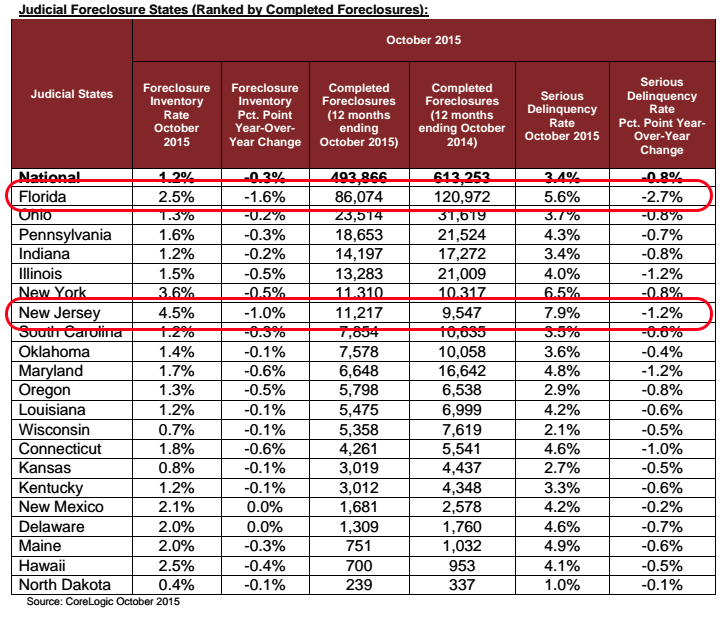
This is probably the strongest showing yet, and finally good indication that NJ is making forward progress on reducing the number of foreclosures and outstanding mortgage delinquencies.

For state foreclosure performance, you can see that NJ ranked second best in terms of foreclosure inventory reduction, dropping a full percentage point in comparison to Florida with their very strong 1.6% (Florida is very quick to foreclose, and has the ability to support a significantly larger pipeline than NJ). Serious delinquencies down a strong 1.2% year over year.

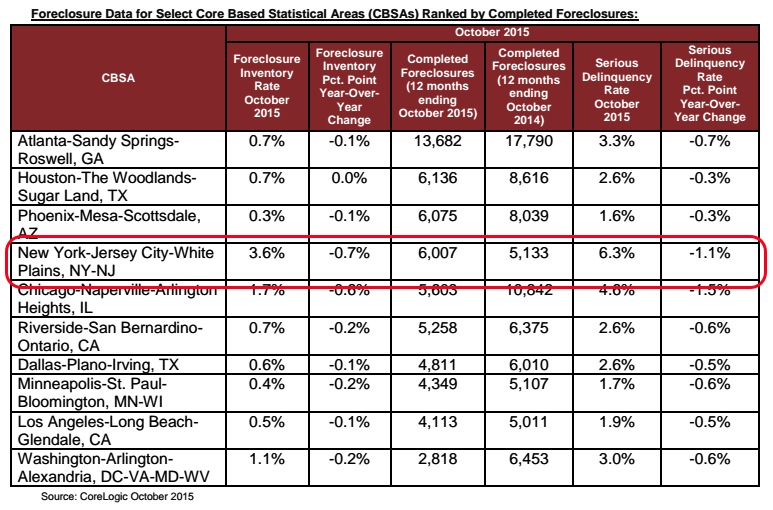
Metro area performance for the broader NY metro area are also making strong progress with a large 0.7% year over year reduction in foreclosure inventory, and second highest drop in serious delinquencies, 1.1% compared to a 1.7% in Chicago.

NJ will continue to remain on top for at least another year, however we’re finally starting to see solid progress being made on reducing inventory and delinquencies, dare I say an end seems to be in sight. I’m not calling all clear, not by a long shot. It won’t be until we pass terminal foreclosure velocity and start to see the YOY numbers drop can we say that. A good number of states have already made it over that hurdle and are coasting back down to what would be considered a longer-run average.

Posted in Foreclosures, New Jersey Real Estate | 82 Comments

NJ floats bill to tax non-profit hospitals

From the Record:

Proposed N.J. bill would mandate that some hospitals make payments to host communities

Non-profit acute-care hospitals that have money-making facilities would start making payments to offset the cost of services provided by host municipalities, according to a bill introduced Monday.

Currently, under tax laws that date back to 1913, such hospitals have blanket property tax exemptions on all their property, regardless of how much they profit from money-making ventures.

The proposed legislation, introduced by Senate President Steve Sweeney, Senator Robert Singer and Senator Joe Vitale, was worked out in agreement with the hospitals themselves. It would not change their tax-exempt status, but would require them to make defined payments to the municipalities to help pay for emergency services like police and fire protection.

The bill, called the Hospital Community Service Contribution Bill, would have non-profit hospitals that have for-profit operations make community service contributions directly to their municipalities. The payment formula would be $2.50 a day for each hospital bed and $750 a day for each facility providing satellite emergency care.

“The health care industry has changed substantially over the years, with hospitals engaged in a broad range of activities and services,” said Sweeney, a Democrat representing the counties of Salem and Gloucester.

“There is also a dramatic increase in competition among other hospitals and with other health care providers. The business has changed, but the tax laws have not. This legislation will have the hospitals pay their fair share while at the same time preserving their tax-exempt status,” Sweeney added.

Five percent of the payments under the measure would be sent to the county where the hospital is located. Any voluntary contributions by the hospitals would be deducted from the community service payments, and any hospital that is losing money could apply for an exemption from the payments.

Posted in New Jersey Real Estate, Politics, Property Taxes | 73 Comments

GSE High-LTV Mortgages Vaporware?

From HousingWire:

Black Knight: Consumers aren’t getting Fannie, Freddie 3% down mortgages

For all the uproar that surrounded Fannie Mae and Freddie Mac introducing loan programs that allowed buyers to put down as little as 3% around this time last year, not many buyers are actually taking advantage of the low down payment loans, according to a new report from Black Knight Financial Services (BKFS).

In Dec. 2014, Fannie and Freddie officially rolled out 97% loan-to-value products. At the time, officials from the Federal Housing Finance Agency said that they expected the low down payment loans to represent a small portion of the government-sponsored enterprises’ business moving forward.

Black Knight’s latest Mortgage Monitor report, released Monday, shows just how small that portion actually is.

According to Black Knight’s report, high-LTV loans (loans with LTV’s above 95%) from the GSEs have accounted for less than 3% of the total number of high-LTV loans originated in 2015.

According to Black Knight’s report, loans insured by the FHA or the VA still account for more than 90% of the total number of high-LTV loan originations – a figure that has held steady above 90% since 2009.

And high-LTV loans account for 77% of the total number of FHA or VA loan originations as well.

According to Black Knight Data & Analytics Senior Vice President Ben Graboske, those figures were far different before the housing crisis.

“Back in 2007, the GSEs made up over 45% of high-LTV purchase originations, while FHA/VA lending made up roughly one-third,” Graboske said.

Posted in Mortgages, National Real Estate, Risky Lending | 59 Comments

2016 predictions start early

From Trulia:

Housing in 2016: Hesitant Households, Costly Coasts, and the Bargain Belt

As part of our annual look at the year ahead in housing, we commissioned Harris Poll to conduct a survey online in November among more than 2,000 Americans about their housing hopes and fears. We noticed some striking trends. Among them:

The American Dream of homeownership is not only alive and well, but continues its resurgence. The share of Americans who dream of owning a home is again up since last year: 1 percentage-point to 75%, and up 2 points among millennials to 80%.

More than one in five (22%), Americans think it will be harder to get a mortgage in 2016 than it was in 2015, perhaps because of looming interest rate increases.

Among millennials telling us that they plan to buy a home, nearly a third (31%) tell us they want to buy within two years, so by 2018. However, jobs and down payments are keys to turning these renters into homeowners within the next 12 months.

In addition to the survey, we at Trulia put together a short list of predictions for 2016:

Housing markets in the West and Northeast that we’ve defined as the Costly Coasts will continue to cool, but will boom in the Southern and Midwestern markets we call the Bargain Belt.

Renters may get some relief in costly metros, where multifamily construction is booming.

Buying will remain a better deal than renting nationally, even if mortgage rates increase. But in several California markets, renting might become cheaper than buying.

We expect housing markets along the Costly Coasts – namely, expensive metros in the West and Northeast– to continue slowing. In many of these coastal metros, affordability has decreased, homes are staying on the market slightly longer, and saving for a down payment can take decades.

Consumers are also starting to feel pessimistic about homes along the costly coasts. Those in the combined regions of the West and Northeast say getting a mortgage to buy or refinance a home will be worse in 2016 than better (10 percentage-points more said it would be worse than better to get a mortgage to buy a home, 7 points for refinance). Likewise, more Americans in these combined regions also said 2016 will be worse for renting a home than better (by a margin of 8 percentage-points).

Taken together, these factors lead us to believe household formation will wane in these metros 2016, which should help moderate price and rent growth. But due to a limited supply of new single-family homes in these metros, we don’t anticipate prices to fall anytime soon.

Posted in Demographics, Economics, Housing Recovery, National Real Estate | 19 Comments

Jobs Day!

From Bloomberg:

The Jobs Report Probably Won’t Change the Fed’s Mind on Liftoff

For once, the upcoming jobs report may not be the most critical of all time.

Federal Reserve officials have signaled that an interest-rate increase is in play for their December meeting, with both markets and economists now anticipating that normalization will begin less than two weeks from now. That means the payrolls data will probably offer more information about the pace of tightening in the months ahead than on the timing of the first hike.

“It would have to be a very large surprise — both in November and potentially a downward revision to October — to really change the outlook enough for the Fed to stop and reconsider the hike in December,” said Laura Rosner, a U.S. economist at BNP Paribas in New York.

Payrolls probably climbed by about 200,000 last month following a 271,000 surge in October that was the biggest this year, according to the median forecast of a Bloomberg survey of economists. The unemployment rate is expected to hold at a seven-year low of 5 percent,.

While some slowdown from October is to be expected, economists are looking for confirmation that hiring remains solid after payroll gains decelerated sharply in August and September. Friday’s data will do a lot to clarify which trend prevails.

Payrolls growth would have to be severely disappointing — closer to 100,000 or less — for it to prevent the Fed from hiking, said Mark Vitner, a senior economist at Wells Fargo Securities LLC in Charlotte, North Carolina.

The signal from policy makers regarding an increase this month has been so clear that “to not do it would risk adding uncertainty to financial markets right at year-end,” he said. “That might do more harm to the economy than raising interest rates would.”

Posted in Economics, Housing Recovery, National Real Estate | 157 Comments