Will it work?

From Bloomberg:

New Jersey Senate Passes Charitable Tax Workaround

New Jersey residents might be able to avoid federal deduction limits on property taxes by converting them to a charitable contribution under a proposal the state Senate approved Feb. 26.

S.B. 1893 would permit municipalities, counties, or school districts to establish charitable funds and allow donors to receive property tax credits in exchange for donations. The proposal is similar to proposals in other states, such as California and New York, that aim to use charitable contributions as a way around the state and local tax deduction cap included in the new federal tax law.

Under the new law, taxpayers who itemize deductions on their federal return may deduct up to $10,000 in state and local sales, individual income, and property taxes (SALT deduction). Previously the SALT deduction was unlimited.

Sponsored by Senate President Stephen Sweeney (D) and Deputy Majority Leader Sen. Paul Sarlo (D), the measure passed the Senate by a vote of 28-9.

The proposal is one of many legislative fixes that New Jersey is considering to counteract heavy tax burdens resulting from the 2017 federal tax act ( Pub. L. No. 115-97). New Jersey residents pay high state and local taxes as well as some of the highest property taxes in the country.

The charitable deduction proposal has support from Gov. Phil Murphy (D), who earlier this month told a gathering of mayors that shifting property tax payments to a charitable contribution system “provides residents with significant deductibility from their federal income taxes.”

Under the proposal, the local government unit would need to pass an ordinance or resolution to establish the fund, set an annual donation cap, and set an annual limit on tax credit funding that could be made available. The limit on tax credit funding would equal 90 percent of the annual donation cap, according to a Feb. 15 statement accompanying the bill.

However, Treasury Secretary Steven Mnuchin has cast doubt on such workarounds and has threatened to audit taxpayers who use them. IRS Publication 526 says that taxpayers can’t deduct as a charitable contribution any payment for which they receive a benefit in return.

Several Republican Senators who voted against the bill expressed concerns that the IRS wouldn’t accept the workaround.

“This deduction is worth a hundred million dollars in tax revenue. There’s no way the federal government is going to look away,” said Sen. Joseph Pennacchio (R). “I don’t want to put my taxpayers at risk.”

Sen. Steven V. Oroho (R) worried that “we’re going to give our residents a false sense of security.”

Sarlo said there are 33 other states that have similar programs. “If the IRS rules that we cannot proceed, then I would love to be at the table when we challenge them in court,” he said during debate on the bill.
Posted in New Jersey Real Estate, Politics, Property Taxes | 146 Comments

Top? Anywhere? Anyone see a top?

From CNBC:

Home prices surge 6.3% in December amid critical housing shortage

Sky-high demand and record-low supply continued to push home prices higher in December, far faster than income growth.

U.S. home prices increased 6.3 percent compared with December 2016, according to the much-watched S&P CoreLogic Case-Shiller national home prices index. That is an increase from 6.1 percent annual growth in the previous month.

The index measuring the nation’s 20 largest metropolitan markets rose 6.3 percent year over year, a slight decline from the 6.4 percent annual gain in November.

“The rise in home prices should be causing the same nervous wonder aimed at the stock market after its recent bout of volatility,” David M. Blitzer, managing director and chairman of the Index Committee at S&P Dow Jones Indices, said in a release. “Across the 20 cities covered by S&P Corelogic Case Shiller Home Price Indices, the average increase from the financial crisis low is 62 percent; over the same period, inflation was 12.4 percent. Even considering the recovery from the financial crisis, we are experiencing a boom in home prices.”

The boom is strongest in Seattle, Las Vegas and San Francisco, which reported the highest gains. Chicago, Cleveland and Washington, D.C., saw the smallest gains. None of the top 20 markets saw an annual price decline.

Posted in Housing Bubble, Housing Recovery, National Real Estate | 103 Comments

NY jumps to the front?

From Inman:

Home prices reach new peak, NY makes biggest gains

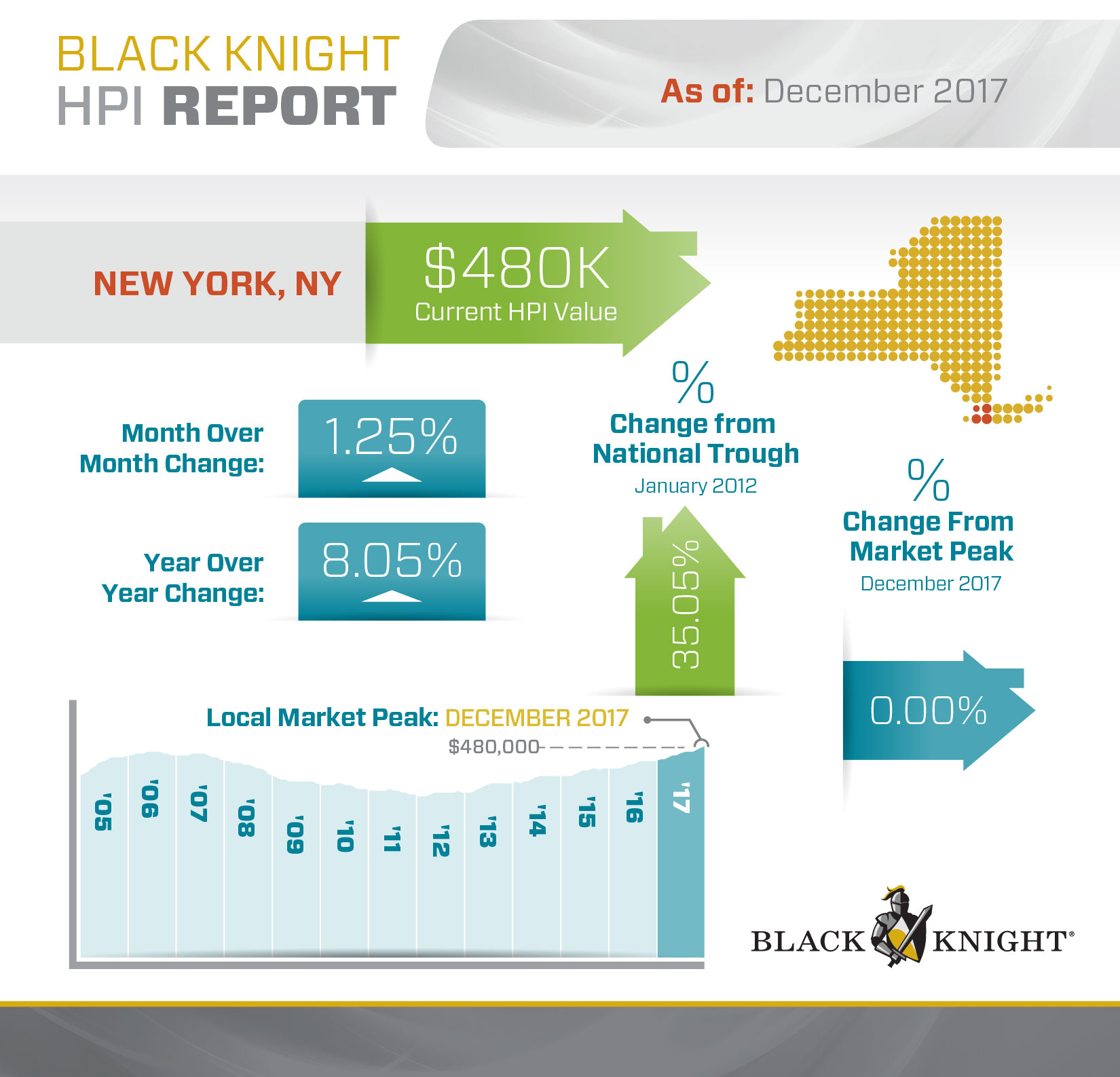
According to the most recent Home Price Index (HPI) report from Black Knight, Inc., home prices in December increased .10 percent month-over-month and 6.6 percent year-over-year to $283,000 — the 68th consecutive month of annual home price appreciation, and a new peak for six of the nation’s 20 largest states and 11 of the 40 largest metros.

On the state level, New York led the way with a 1.71 percent month-over-month home price increase followed by Georgia (+0.69 percent), North Carolina (+0.48 percent), Illinois (+0.37 percent) and Texas (+0.15 percent).

Meanwhile, Ohio had the lowest month with a 1.13 percent month-over-month decrease in home prices, and the state had seven of the nation’s 10 worst-performing metros of the month.

On the metro level, 11 of the 40 largest metros hit new home price peaks in December, while prices fell in another 20 metros. New York City came out on top with a 1.25 percent increase from November 2017, and Atlanta (+0.76 percent), Chicago (+0.44 percent), Miami (+0.21 percent), and Dallas (+0.20 percent) rounded out the top five.

Boston, Massachusetts, performed the worst out of the 40 largest metros, with a 0.21 percent month-over-month decrease in home prices.

Posted in National Real Estate, NYC | 105 Comments

Keep Manhattan, just give me that countryside

From the Real Deal:

Why increasing numbers of New Yorkers are calling it quits on city life

According to realtors, there’s a great exodus from New York City that can be measured in New Jersey commuters.

Over the past 25 years, people commuting across the Hudson have increased by 28 percent forcing, in turn, bus trips to grow by more than 80 percent and railway trips to triple, according to The New York Times.

“We can see that in the massive migration in the last three or four years of city dwellers,” said Jonathan J. Miller of Miller Samuel Real Estate Appraisers and Consultants to the Times.

To Miller, the cause of people decamping to the ‘burbs is a result of the climbing cost of living.

“City costs have risen more than the cost of a home,” he told the Times.

Posted in Demographics, Economics, New Jersey Real Estate, NYC | 85 Comments

Fulop – From Darling to Demon

From the Jersey Journal:

Jersey City residents protest tax reval: ‘You’re taking our homes away from us’

Dozens of Downtown residents protested outside City Hall today to call attention to exorbitant tax increases they could see as a result of the citywide property revaluation.

Carrying signs and protesting the new assessments that were released last month on their homes, the residents said their tax bills could double or even triple.

“You’re taking our homes away from us. People who have lived here for 80 years are going to lose their homes,” said Christina Szpala, 55. “The people standing around me are not millionaires. It’s not our fault you’ve built up this city the way you have and given abatements to all these developers. We’re the people you’re supposed to protect and you’re throwing us out.”

This process, the first citywide reval since 1988, is intended to match every property’s assessment — its value on city tax rolls — with its true market value.

The 30-year delay between revals is leading to skyrocketing projected tax hikes, especially Downtown, where property values since 1988 have risen dramatically. In other parts of the city, like Society Hill and Country Village, homeowners have been told to expect dramatic tax cuts.

One man said today his annual tax bill could jump from $7,000 to $16,000, another’s from $10,000 to $30,000.

“This reval is an insult,” said Alexander Caldron. “This is middle class gentrification.”

Szpala and others said local residents could get pushed out as a result. She proposed phasing in the tax increases, adding that “it shouldn’t happen all at one time, say over a 5-year period.”

“We’re all working class people, we don’t have million-dollar incomes,” she said.

Mayor Steve Fulop has said a phase-in is not possible, noting to a group of homeowners at a neighborhood meeting earlier this month that phasing in tax hikes would mean asking other property owners to wait for their full tax cut.

“This is obviously a very, very imperfect situation,” Fulop said then.

Posted in Economics, Gold Coast, Politics, Property Taxes | 25 Comments

If we learned anything during the last bubble, it’s that this is a sign of a bubble

From Builder Magazine:

HOMES NEAR ENVIRONMENTAL HAZARDS SHOW STRONG PRICE APPRECIATION

ATTOM Data Solutions today released its 2017 Environmental Hazards Housing Risk Index, which shows that median home prices in U.S. zip codes in the highest 20% for environmental hazard risk appreciated at a faster pace than the overall U.S housing market over the past year, past five years and past 10 years.

For the report, ATTOM Data Solutions analyzed 8,665 U.S. zip codes with sufficient housing trend data for risk related to four environmental hazards: superfund sites, brownfields, polluters and poor air quality.

Median home prices in zip codes in the top environmental hazard risk quintile increased 7.4% from a year ago on average (compared to 7.1% increase nationwide); increased 57.1% from 2012 (compared to 51.1% increase nationwide); and increased 22.2% from 2007 (compared to 12.3% increase nationwide).

“With housing inventory in short supply, even homes in higher-risk zip codes for environmental hazards are in high demand from buyers looking for lower-priced properties and investors looking for the next up-and-coming neighborhood,” said Daren Blomquist, senior vice president with ATTOM Data Solutions. “Buyer demand does seem to have a bit of a limit when it comes to environmental hazards, however. Homes in zip codes with superfunds on the EPA’s national priority list have seen weaker home price appreciation and have higher foreclosure rates than the overall housing market.”

Posted in Housing Bubble, National Real Estate | 133 Comments

No homes left to sell?

From CNBC:

Tight supply, rising prices weigh on US home sales

U.S. home sales unexpectedly fell in January, leading to the biggest year-on-year decline in more than three years, as a persistent shortage of houses pushed up prices and kept first-time buyers out of the market.

The National Association of Realtors said on Wednesday that existing home sales dropped 3.2 percent to a seasonally adjusted annual rate of 5.38 million units last month. It was the second straight monthly decline and reflected decreases in all four regions.

Economists polled by Reuters had forecast existing home sales rising 0.9 percent to a rate of 5.60 million units in January.

Existing home sales, which account for about 90 percent of U.S. home sales, declined 4.8 percent on a year-on-year basis in January. That was the biggest year-on-year drop since August 2014. The weakness in home sales is largely a function of supply constraints rather than a lack of demand.

House price increases have outstripped wage growth, which has remained stuck below 3 percent on an annual basis despite the unemployment rate being at a 17-year low of 4.1 percent.

While the number of previously-owned homes on the market rose 4.1 percent to 1.52 million units in January, housing inventory was down 9.5 percent from a year ago. That was the lowest inventory for January on record. Supply has declined for 32 straight months on a year-on-year basis.

At January’s sales pace, it would take 3.4 months to exhaust the current inventory, up from 3.2 months in December. A six-to-seven-month supply is viewed as a healthy balance between supply and demand.

The median house price increased 5.8 percent from a year ago to $240,500 in January. That was the 71st consecutive month of year-on-year price gains.

Posted in Demographics, Economics, Employment, National Real Estate | 163 Comments

Governor who?

From NJ Spotlight:

SWEENEY FORGES AHEAD WITH STATE TAX POLICY REVIEW, NO INPUT FROM MURPHY TEAM

Major changes to the federal tax code recently enacted in Washington, D.C. may have significant and unexpected impact on the state economy, according to state lawmakers — particularly in a high-cost place like New Jersey. That’s why Senate President Steve Sweeney has ordered a broad review of the state’s entire tax and fiscal policy landscape, and he’s named well-known outside policy experts to participate.

Sweeney (D-Gloucester) yesterday named two dozen members of a special working group, made up of both lawmakers and these experts; they’ve been charged with coming up with ways to help New Jersey deal with any economic challenges the federal tax-code overhaul poses.

But that’s not all. Other areas will be subject to the group’s discussions, which will primarily only be held in private, according to Sweeney’s announcement. The group will look at everything from how New Jersey funds local schools and other government services, to what can be done to control high property taxes and stop residents from leaving the state for cheaper alternatives.

The effort will be led by state Sens. Paul Sarlo (D-Bergen) and Steve Oroho (R-Sussex), and Assemblyman Lou Greenwald (D-Camden). In addition to several other lawmakers from both parties, the working group also will include more than a dozen outside policy experts, including economist Mark Zandi of Moody’s Analytics and former state Treasurer Feather O’Connor Houstoun.

The formation of the working group comes just weeks before Gov. Phil Murphy is expected to put forward his first state budget message to a joint session of the Legislature. It also comes as Murphy and Sweeney have publicly disagreed about whether the new governor should go forward immediately with his plan to hike New Jersey’s top-end income tax rate on earnings over $1 million to bring in more revenue to fund core priorities like K-12 education and public-employee pensions.

In fact, such working groups are usually organized by governors, and noticeably absent from the panel assembled by Sweeney — who once considered running for governor himself — is a member of Murphy’s administration. It remains to be seen exactly how receptive the governor will be to any of the group’s findings once they are released; Murphy’s press secretary did not respond to requests for comment yesterday.

Sarlo stressed that this new effort is putting “everything on the table,” and Greenwald promised it would not be just an “academic exercise.” Oroho suggested the group’s eventual policy proposals would help the state deal with a potential crisis.

“We are facing a crisis — a crisis of competitiveness, a crisis in housing values, and a crisis that undermines our prospects for future economic growth,” Oroho said.

In addition to Zandi and Houstoun, the experts from outside the Legislature are Dr. Joel Naroff, Naroff Economic Advisers Inc.; Dr. Michael Lahr, Rutgers Economic Advisory Service; Dr. Ray Caprio and Marc Pfeiffer, Rutgers Local Government Research Center; Richard Keevey, Rutgers University Bloustein School of Planning & Public Policy, and Princeton University’s Woodrow Wilson School; Dr. Henry Coleman, Rutgers University Bloustein School of Planning & Public Policy; Dr. Donald Moliver and Peter Reinhart, Monmouth University’s Kislak Real Estate Institute; Dr. Spencer Levy, CBRE Group Inc.; Ralph Thomas, New Jersey Society of Certified Public Accountants; Frank Chin and Ray Kljajic, American Public Infrastructure Inc.; Kurt Stroemel, H&RHS Financial Services; and Jerry Maginnis, accounting executive in residence at Rowan University.

“Blowing up the system, and putting it back together in a way that makes it work better, requires total discussion amongst people that can speak freely, and not be concerned that they’re going to be criticized until we get a product done,” Sweeney said.

Posted in New Jersey Real Estate, Politics, Property Taxes | 67 Comments

NJ’s tax scheme … will fail

From the Star Ledger:

Here’s how N.J. lawmakers propose to save your property tax break

The state Senate began its work Thursday devising a way to prevent New Jersey taxpayers from losing a popular property tax break as a result of federal income tax reform.

Following the mold of other high-tax states looking to skirt the new $10,000 cap on state and local tax deductions taxpayers can claim, the state Senate Budget and Appropriations Committee advanced a bill allowing municipalities to set up charitable funds to substitute donations for property tax payments.

Under the scheme, taxpayers would make donations to the charitable fund and receive a credit against their property tax bill. They could in turn claim the payment as a charitable contribution, which is not subject to a cap.

It’s a maneuver championed by Gov. Phil Murphy, a Democrat who urged the Democratic-controlled state Legislature to act.

While local officials don’t have to wait for the state to pass a law before establishing charitable support funds, Murphy said he believed they would be on stronger footing with it.

The bill would give property owners a 90 percent tax credit — ostensibly to stand up to IRS scrutiny — for their contribution to the town, county or school district’s charitable support fund. And if an owner’s tax credits exceed their net property taxes owed, the fund would roll the credits forward for up to five years.

State Sen. Steve Oroho, R-Sussex, warned state lawmakers may be sending taxpayers down a risky path, as it’s unclear whether the Internal Revenue Service will bless these moves, which resemble a quid pro quo.

“The way the charitable contributions work is you’ve got to give something and get nothing in return,” Oroho said. “I’m not really sure how we can argue that you’re not getting anything in return.”

In fact, U.S. Treasury Secretary Steven Mnuchin last month called the idea, also considered by California, “ridiculous.”

Posted in New Jersey Real Estate, Politics, Property Taxes | 167 Comments

At what point do we say “recovered” and at what point do we say “bubble”?

From CNBC:

Home Prices Hit Records in Almost Two-Thirds of U.S. Cities

Home prices jumped to all-time highs in almost two-thirds of U.S. cities in the fourth quarter as buyers battled for a record-low supply of listings.

Prices for single-family homes, which climbed 5.3 percent from a year earlier nationally, reached a peak in 64 percent of metropolitan areas measured, the National Association of Realtors said Tuesday. Of the 177 regions in the group’s survey, 15 percent had double-digit price growth, up from 11 percent in the third quarter.

Home values have grown steadily as the improving job market drives demand for a scarcity of properties on the market. While prices jumped 48 percent since 2011, incomes have climbed only 15 percent, putting purchases out of reach for many would-be buyers.

Sales of previously owned homes, including single-family houses and condos, increased 4.3 percent to a seasonally adjusted rate of 5.62 million in the fourth quarter, the Realtors said. At the end of December, only 1.48 million existing homes were available for sale, 10.3 percent less than a year earlier.

Posted in Economics, National Real Estate | 121 Comments

Comp Killer – Saddle River Edition

From Variety:

Mary J. Blige Faces Huge Loss on New Jersey Estate

Mary J. Blige is riding a well-deserved professional crest with two Oscar nominations — one for supporting actress and one for original song, both for the acclaimed Netflix period drama “Mudbound” — but the R&B/hip-hop icon is also looking at a heart-stopping financial loss on a lavish, gated estate in Saddle River, N.J., that she bought in 2008 for $12.3 million and now has for sale at just under $7 million. Even if Blige manages to land a full-price buyer, she’s still faced with a pocketbook-punishing loss of more than $5.3 million, not including carrying costs, improvement expenses and real estate fees.

The ersatz French Renaissance chateau, about 25 miles outside Midtown Manhattan, measures in at more than 13,000 square feet, according to tax records, with a total of eight bedrooms and nine full and three half bathrooms. Four principal bedrooms, all en suite, include a sprawling owners’ complex replete with sitting room, fireplace, two walk-in closets and two bathrooms. The three-story, elevator-equipped mansion additionally provides an en suite staff bedroom just off the kitchen, a one-bedroom, one-bath guest apartment over the four-car garage and a two-bedroom, one-bath staff suite with full kitchen and living room in the basement.

The nine-time Grammy winner, who owes millions to the IRS in unpaid taxes and forks over $30,000 per month in spousal support to her estranged husband, Martin “Kendu” Isaacs, has long owned a substantially smaller, 6,200-square-foot contemporary residence in Cresskill, N.J., that she scooped up in 2001 for $1.95 million.

Posted in Comp Killer, New Jersey Real Estate | 61 Comments

Finally the end of cheap mortgages?

From CNBC:

Here’s how a 5% mortgage rate would roil the US housing market

Mortgage rates are now at their highest level in four years and poised to move even higher. The timing couldn’t be worse, as the usually busy spring housing market kicked into gear early this year amid higher home prices and strong competition for a record low supply of homes for sale.

Add it all up, and affordability is starting to hurt.

The average rate on the popular 30-year fixed is now right around 4.50 percent, still low when looking historically, but buyers over the past six years have gotten more used to rates in the 3 percent range. Mortgage rates have not been at 5 percent since 2011.

A 5 percent rate would cause more than a quarter of today’s homebuyers to slow their plans, according to a Redfin survey of 4,000 consumers at the end of last year. Just 6 percent said they would drop their plans to buy altogether. About one-fifth of consumers said 5 percent rates would cause them to move with more urgency to purchase a home, fearing rates would rise even further. Another fifth said they would consider more affordable areas or just buy a smaller home.

Despite rate concerns, the bigger issue for buyers is changes to tax laws that had lowered the cost of homeownership. Specifically, the deduction on property taxes is now limited to $10,000. While that does not affect homeowners in the majority of the country, it does hit those in high-cost states like New York, New Jersey and Illinois, and those in higher-priced housing markets like California.

Posted in Economics, Mortgages, National Real Estate | 137 Comments

Looking good, Billy Ray! Feeling good, Louis!

From HousingWire:

Americans gain confidence in housing as home prices rise

Americans continue to gain confidence in the housing market, not just despite, but even because of rising home prices, according to the latest Home Purchase Sentiment Index from Fannie Mae.

Over the past year, home prices have continued to rise, threatening affordability, and housing inventory is falling dangerously low. However, despite these setbacks, Americans continue to hold a positive view of the housing economy.

Fannie Mae’s HPSI rose 3.7 points in January to 89.5, reversing the decrease seen the month before and an all-time survey high. This rise is due to increases in five of the six HPSI components.

The share of those who said now is a good time to buy a home increased three percentage points to 27% in January, reversing some of last month’s decline. The share of those who say now is a good time to sell a home also increased, rising four percentage points to 38%.

“Over the past year, continued home price growth has helped spur a sizable increase in the net share of consumers who say it’s a good time to sell a home but also a modest weakening in the net share who say it is a good time to buy,” said Doug Duncan, Fannie Mae senior vice president and chief economist.

Americans are increasingly expecting home prices to rise as those who said they expect home prices to go up over the next 12 months increased eight percentage points in January to 52%, a new survey high. But even as they expect home prices to rise, the share of Americans who say mortgage rates will fall in the next 12 months increased two percentage points to -50%.

When it comes to personal finances, the share of Americans who say they are not concerned about losing their job increased five percentage points to 73% and the share who say their household income is significantly higher than it was 12 months ago remained flat at 16%.

Posted in Demographics, Economics, Employment, National Real Estate | 61 Comments

Net net … nothing?

From the Washington Post:

Predictions of a crash in housing prices have not come true

Were fears overblown that changes to the federal tax law would trigger plunging home values?

You might recall the scary predictions that began coming last fall from the realty industry and some independent economists: Cutting tax benefits for homeowners would inevitably lead to declines of 4 to 10 percent in home prices, and maybe even more for upper-bracket properties in high-tax areas.

So how are those dire warnings holding up? It’s still early in the game for hard statistical answers. But it’s not too early to gather anecdotal evidence on whether buyers — citing higher tax burdens — are pushing asking prices downward and whether sellers are caving or resisting.

To get answers, I contacted realty agents and economists who keep a close eye on consumer behavior in markets around the country. The consensus was summed up best by Ralph McLaughlin, chief economist of Trulia, a San Francisco company that tracks prices and local market trends in hundreds of communities.

Price declines are nowhere in sight yet and cannot be totally ruled out, he said, but “we think the potential negative impacts [of the tax bill] will be muted by the likely fact that most households will actually have more money in their bank accounts at the end of the year because of the tax plan.”

That, plus the ongoing shortage of homes for sale, strong buyer demand, low unemployment and growth in wages, may offset any whatever tax-deduction concerns. Cheryl Young, senior economist at Trulia, cited the latest Standard & Poor’s Case Shiller index, which documented steadily rising prices in most markets.

Noah Goldberg, an agent with Redfin in Jersey City, says clients “were waiting on the sidelines at the end of the year due to the uncertainty around tax reform.” But “now that [they’ve] had a chance to calculate the monthly costs, income taxes and deductions,” they’re streaming back. Some buyers have told Goldberg that the lower federal income taxes they’re likely to owe will offset the real estate deductions they’re likely to lose. So the net effect could be a wash.

Chicago real estate broker Alexis Eldorrado says some sellers of upper-bracket properties have become more flexible on their initial asking prices, knowing that buyers may come in with Excel spreadsheets detailing how their tax bills are going up. Jill Eber, a broker in Miami, told me that tax law may actually be driving some owners from high-tax states to tax-friendlier Florida.

“We’re hearing from more people from New York, the Northeast and California than usual,” she told me in an interview, and some are specifically citing the tax bill as a reason for considering switching domiciles. What impact that might have on pricing isn’t yet clear, however.

Posted in Demographics, Economics, Employment, Housing Recovery, Politics | 213 Comments

Downtown JC going to pay up

From the Jersey Journal:

10 homes socked with huge tax hikes thanks to Jersey City reval

Jersey City is conducting its first complete property revaluation since 1988 and the new assessments have started rolling in.

Appraisal Systems, the company hired to oversee the process, has been uploading the new assessment information online, thousands of properties at a time. The company expects to release a new wave of assessments each week for the next month.

Revals are intended to square each property’s assessment — the value on city tax rolls — with its true value. Because many properties have not been assessed since 1988, the average city property is assessed at less than 24 percent of its true value.

As expected, the city’s Downtown, where property values have soared since the last reval, is home to many of the large assessment hikes — and tax increases. Excluding tax abated properties, the 500 properties with the highest tax hikes have Downtown addresses.

Property owners are still able to make informal appeals to Appraisal Systems and then formal appeals to the Hudson County Board of Taxation, so the new assessments are still only proposed. And there is no 2018 budget yet for the city, county or school district, so the tax hikes are tentative as well.

The city is predicting a new tax rate of 1.62 per $100 of assessed value.

$36,066 tax hike: 203 Washington St. (middle), 5,972 square feet
Current assessment: $175,000
New assessment: $3,068,900
Current taxes: $13,650
New taxes: $49,716

$29,480 tax hike: 104 Morris St. (right), 4,488 square feet
Current assessment: $125,000
New assessment: $2,421,600
Current taxes: $9,750
New taxes: $39,230

$29,115 tax hike: 69 Sussex St., 4,696 square feet
Current assessment: $135,000
New assessment: $2,447,200
Current taxes: $10,530
New taxes: $39,645

Posted in New Jersey Real Estate, Property Taxes | 75 Comments