Just how low can inventory go?

From the WSJ:

This Problem Is Shutting the Door on Many Would-Be Home Buyers

The U.S. housing market has a supply issue.

Between low interest rates, a steady job market and rising rents, economic fundamentals suggest lots of houses should be selling. Simultaneously, though, tight inventory levels are playing a role in driving prices higher, making the market less appealing for buyers and potentially making it tougher for sales to keep growing at a rapid clip.

As the all-important spring selling season ramps into high gear, Monday’s report on existing-home sales should offer clues of whether higher prices are keeping potential buyers on the sidelines.

Economists polled by The Wall Street Journal estimate February sales of previously owned homes fell 2.6% from a month earlier. On a year-over-year basis, sales are expected to have risen by about 7%. Existing homes account for about 90% of the housing market.

In 2015, existing-home sales had their best year since 2006. But falling inventory could make it difficult for last year’s strength to continue.

For instance, there were about 1.8 million existing homes available for sale at the end of January, according to the National Association of Realtors. That was down 2.2% from a year earlier. It also represented about a four-month level of supply at the current sales pace, near the lowest levels since 2005. A level of six months is considered typical.

Of course, the existing-home market isn’t completely dried up. As the Journal reported earlier this month, housing has become a tale of two markets, as lower-priced homes have been selling rapidly while inventory of more expensive ones is piling up. In other words, the cheaper the price, the smaller the growth in the number of homes available on the market.

Posted in Economics, Housing Recovery, National Real Estate | 52 Comments

Oh boy…

From News 12:

Toms River ordinance bans aggressive real estate solicitation

Door-to-door real estate solicitation is now forbidden in areas of Toms River. The “cease and desist” ordinance went into effect Friday.

The ordinance comes after many complaints by Toms River residents of real estate agents “aggressively” inquiring about the sale of homes that have not been put on the market. The residents say that typically these agents represent members of the Orthodox Jewish community from neighboring towns like Lakewood.

Toms River has previously had a “no knock” registry to keep away unwanted solicitation, and residents were able to put green stickers on their door to mark their homes as such. However, township officials have expanded the law after more complaints came in from residents.

Toms River police will now enforce the law, although there won’t be any special task force assigned to the task.

“The police department will enforce whatever the state, federal or local government puts on the books and we’re going to enforce it. But we’re not aggressively seeking to catch anybody doing this. It’s going to be as a result of citizen complaints as it always has been,” says Toms River police spokesman Ralph Stocco.

The ordinance will ban the solicitation for the next five years. Nonprofit organizations such as the Boy Scouts or Girl Scouts are exempt.

The new ordinance comes after Lakewood’s mayor criticized Toms River Mayor Tom Kelaher for calling the aggressive real estate inquiries “an invasion” or Orthodox Jews. Kehaher later apologized for the comments.

Posted in New Jersey Real Estate, Politics, Unrest | 59 Comments

Living near crime doesn’t pay

From RealtyTrac:

RealtyTrac® (www.realtytrac.com), the nation’s leading source for comprehensive housing data, today released its first-ever Registered Criminal Offender Risk Index, which shows that average home values and home equity were lower — while average foreclosure rates were higher — in zip codes with a higher offender index than in zip codes with a lower offender index.

The report also shows that average home price appreciation has been slightly stronger over the past year and five years in zip codes with a higher offender index than in zip codes with a lower offender index, but only zip codes with an offender index in the bottom 20th percentile have seen home prices rebound above levels from 10 years ago.

“This new index provides concrete evidence that registered criminal offenders pose not only a potential safety risk for homeowners and their families, but also a potential financial risk for what is likely a homeowner’s biggest asset,” said Daren Blomquist, senior vice president at RealtyTrac. “This is clearly evident in the significantly lower home values and significantly higher foreclosure rates in zip codes with a higher offender index, but it may not be as evident in the home price appreciation numbers, which are actually slightly stronger over the past year and five years in zip codes with a higher offender index. However, the 10-year appreciation numbers demonstrate home values in the lowest-risk zip codes for offenders were not hit as hard during the housing downturn and have rebounded more quickly back to their previous highs – even exceeding those previous highs.”

The index is based on the number of registered criminal offenders (including sex offenders, child predators, kidnappers and violent offenders) as a percentage of total population in 10,358 U.S. zip codes. The offender data is collected from each state’s criminal offender registry online and is available on RealtyTrac subsidiary www.homedisclosure.com, where offenders living within a half-mile radius of a home can be identified.

The higher the offender index, the lower the home value and home equity

Average home values as of the first quarter of 2016 in zip codes with a Very Low offender index ($512,841) were more than three times higher than home values in zip codes with a Very High offender index ($157,844).

Furthermore, the average 2015 median sales price for homes in zip codes with a Very Low offender index ($450,925) was more than three times higher than the average 2015 median sales price in zip codes with a Very High offender index ($126,205). The median price per square foot on average for homes in zip codes with a Very Low offender index was $243, three times higher than in zip codes with a Very High offender index ($81).

Homeowners living in zip codes with a Very Low offender index on average had 29 percent equity (71 Combined Loan-to-Value) as of the first quarter of 2016, nearly three times the average 10 percent equity (90 CLTV) for homeowners living in zip codes with a Very High offender index.

Home prices rebound above 10-year-ago levels only in zips with Very Low offender index

Among homes that sold in 2015, the average one-year home price appreciation in zip codes with a Very High offender index (up 7 percent) was slightly higher than the average one-year HPA in zip codes with a Very Low offender index (up 5 percent).

Home prices also rose slightly faster over the past five years in zip codes with a Very High offender index (up 24 percent on average) than in zip codes with a Very Low offender index (up 20 percent on average).

Median home sales prices in zip codes with a Very Low offender index in 2015 were 7 percent higher than median sales prices 10 years ago, in 2005, but home prices in all other offender index categories were flat or lower than 10 years.

Posted in Demographics, Economics, Housing Recovery | 55 Comments

NJ’s Wealthiest Resident Leaves for Florida

From Bloomberg:

Tepper’s Most Profitable 2015 Trade May Be Moving to Miami

New Jersey lost its richest resident late last year when billionaire David Tepper decamped to the tax friendly climes of Florida.

Tepper registered to vote in Florida last October, listing his residence as a Miami Beach condominium, and followed up in December by filing a court document declaring that he is now a resident of the state. He also carried out a business reorganization on Jan. 1 that relocated his Appaloosa Management from New Jersey to Florida, which is free of personal income and estate taxes.

The move could save Tepper hundreds of millions of dollars in state taxes several years from now. Florida has been pitching itself as a warm-weather tax haven to hedge fund managers in the Northeast, some of whom face a 2017 deadline to pay taxes on billions of dollars in performance fees that they had kept offshore for years. A Florida residence could offer partial relief to New York and New Jersey money managers who face the prospect of surrendering at least half of the deferred money to federal, state and local taxes.

“Anyone who has a large deferral coming due in 2017” is thinking about ways of reducing the tax hit, said Anthony Tuths, a tax attorney in the New York office of Withum who advises alternative investment funds. “What is easier than packing up your house in New York City and moving down to Miami?”

Tepper, 58, lived in New Jersey for more than two decades, initially as an executive at Goldman Sachs Group Inc., where he helped run junk-bond trading during the late 1980s and early 1990s. He founded Appaloosa in 1993 and now has an estimated fortune of $10.6 billion, according to the Bloomberg Billionaires Index. That ranks him as the wealthiest person in New Jersey.

When Tepper personally relocated to Florida, part of his firm came along. Under a Jan. 1 reorganization, the firm moved what was formerly its main investment advisory unit to Miami from Short Hills, according to a filing with the SEC. Because the previously deferred offshore fees would normally be paid out to this unit, the move could be key to saving money on state taxes in 2017.

As a New Jersey resident, Tepper would have to pay the 9 percent state tax upon reporting his deferred compensation in 2017 on top of a federal tax rate of 39.6 percent. Moving to Florida could at least eliminate the 9 percent tax.

Because Appaloosa Management is now in Miami, the deferred fees that it receives in 2017 from the offshore funds will qualify as Florida-sourced income for tax purposes, Tuths said. So will the future performance fees that Appaloosa Management receives as the general partner for Tepper’s primary onshore vehicle, Thoroughbred Fund LP. As a Florida resident, Tepper won’t have to pay any state income taxes on such fees when they’re passed along by Appaloosa Management.

Posted in Economics, New Jersey Real Estate, Politics, Property Taxes | 96 Comments

Swallowed by the sea

From the Star Ledger:

Rising seas could drive 837K N.J. residents from their homes, study says

Rising seas could force hundreds of thousands of New Jersey residents from their homes by the end of the century, a new report found.

The report, published in Nature Climate Change, analyzed the impact that sea-level rise will have on 22 states and Washington D.C. by 2100.

It paints a grim picture, projecting incessant flooding in coastal counties affecting up to 13.1 million people in the United States.

According to the study, up to 827,449 people in the Garden State would have to relocate due to sea-level rise, most notably on barrier islands, but also in low-lying urban areas, such as Hoboken and Newark.

While New Jersey’s counties appear to fare significantly better against rising seas than some of the other 319 coastal counties in the study — 94 percent of residents in Tyrell County, North Carolina, would be affected for example — even under the low projections, more than 300,000 people could be forced from their homes.

Three counties in the Tampa and Miami area would account for a quarter of the projected 13.1 million affected by sea-level across the country, according the report.

In Cape May County, 38.9 percent of projected residents in 2100, or 79,345 people, would experience the result of climate change. The highest concentration of residents with homes inundated by rising seas would be in Ocean County, with 176,360 people affected.

William Sweet, a NOAA oceanographer with the Center for Oceanographic Products and Services, told NJ Advance Media “it was important to note” that this report only focuses on high tide levels and does not take into account the impact on these areas from “recurrent tidal flooding or larger storm surges.”

“Such tipping points will occur much before high tide itself becomes problematic and much before the year 2100 as presented in this paper,” Sweet said.

In a 2014 report, NOAA said it expects most of the U.S. coastal areas to see 30 days of flooding or more each year by 2050.

Under the three-foot sea-level rise scenario, a projected population of 308,662 people in New Jersey may have to relocate by 2100.

“If the sea level is three feet higher, Atlantic City is basically not viable,” said Strauss, who is also the vice president for sea level and climate impacts at the research group Climate Central. “And the same is probably true for Cape May.

“All of the barrier islands are too low and too developed to handle three-foot sea-level rise.”

Hauer noted that the study doesn’t take into account for any future strategies to manage rising seas, such as barriers, levees, seawalls, elevated developments or coastal wetland restoration.

According to the report, the infrastructure need to protect the coastal areas from rising seas would cost roughly $421 billion by 2100.

Posted in New Jersey Real Estate, Shore Real Estate | 74 Comments

NJ 2015 Jobs Revision Surprise

From the Record:

NJ’s 2015 job creation was better than first reported, but state lost 14,100 jobs in January

New Jersey employers created 81,500 jobs last year, even more than the 65,200 originally reported, to make 2015’s employment gains the most robust since 1999, state labor officials reported Monday.

“The numbers show that the labor market and economy are much stronger than we had thought,” said James Hughes, a Rutgers University economist.

In contrast to that upbeat report, the state Department of Labor and Workforce Development also announced that New Jersey lost 14,100 jobs in January, led by 10,100 jobs sliced from the generally well-paid professional and business services sector.

Even with January’s job losses, the state’s unemployment rate fell to 4.5 percent for the month, down from 4.8 percent in December and below the U.S. rate of 4.9 percent. This was a sharp reversal of the pattern over the past five years, when New Jersey’s jobless rate clocked in above the national rate almost every month.

Charles Steindel, a Ramapo College economist and former chief economist in the Christie administration, called the 2015 job gains “a very encouraging number,” reflecting 2 percent job growth in a state of about 4 million workers.

“It says the state’s economy is actually growing at a reasonable clip,” he said.

“We actually outpaced the nation in 2015; New Jersey’s private-sector employment rose 2.5 percent, while the nation’s rose 2.2 percent,” said Hughes. “That’s the first time since the 1990s that New Jersey grew faster than the nation.”

Steindel said the January job losses may reflect weather patterns — especially mild weather in December that allowed more people to continue working outdoors, only to be sidelined by more wintry conditions in January, when a blizzard hit.

Hughes suggested the January job losses may be a statistical anomaly; revised January numbers are expected next week.

“We can’t take any one month to predict either a boom or a bust,” he said.

Posted in Economics, Employment, New Jersey Real Estate | 78 Comments

In 5 years, remember this one

From the NY Post (Hat tip Chi):

Obama is setting us up for another housing crash

We learned nothing from the last financial crisis. The housing market is set to collapse, again, and a key culprit, again, is artificial demand created by government policies.

For starters, mortgage-software firm Ellie Mae reports that the average FICO credit score of an approved home loan plunged to 719 in January (the latest month for which data is available) from 731 a year earlier, and well below 2011’s peak of 750.

It’s a dangerous sign lenders are loosening underwriting standards. Lower FICO scores correlate with higher risk of loan default.

The Federal Housing Administration is a big reason for falling credit scores. So are Fannie Mae and Freddie Mac. The government housing agencies have slashed credit requirements under pressure from the Obama administration — like the Clinton administration before it — to qualify more immigrants and minorities with low incomes and “less-than-perfect credit.”

Meanwhile, home lenders are approving more debt-strapped borrowers. According to Ellie Mae, applicants approved for mortgages in January had an average household debt-to-income ratio of 39%, up from 2012’s annual average of 34%. Borrower debt loads have been creeping higher each year since 2012, when Ellie Mae first started tracking such data.

A recent report by the Office of the Comptroller of the Currency, a federal agency that regulates the nation’s banks, warns that declines in mortgage underwriting standards are mirroring pre-crisis trends.

“Underwriting standards eased at a significant number of banks for the three-year period from 2013 through 2015,” the report said. “This trend reflects broad trends similar to those experienced from 2005 through 2007, before the most recent financial crisis.”

Not since 2006, it noted, have lenders taken on so much credit risk, and it says the hazard will continue to grow this year: “Examiners expect the level of credit risk to increase over the next 12 months.”

Today’s relaxation in mortgage-underwriting standards is largely a function of government housing-policy changes at FHA, Fannie Mae and Freddie Mac, which dominate the nation’s mortgage activity.

All three agencies have slashed down-payment and other requirements under pressure from Obama regulators, who include, most significantly, former Congressional Black Caucus leader and Obama appointee Mel Watt, head of the new Federal Housing Finance Agency, which now controls Fannie Mae and Freddie Mac.

Last year, Fannie Mae launched a new subprime-mortgage product called HomeReady that caters to recent immigrants with weak credit and limited income.

The new loan program, which offers “income flexibility,” allows borrowers for the first time to bundle income from roommates and relatives to meet qualifications for income. They only have to put 3% down, and can use gifts from nonprofit groups to subsidize their down payments.

“There is no limit on the number of non-borrower household members who can be present on a single transaction,” Fannie advises originators. And even then there is “documentation flexibility,” a frightening echo of last decade’s “no-doc loans.”

Under HomeReady, you can even qualify for a “cash-out refinance” of your mortgage, a type of loan that led to over-leveraging and a wave of defaults during the mortgage crisis.

Why would Fannie offer the same kinds of poorly underwritten loans that forced it into bankruptcy? Because HomeReady aligns “with our housing goals” set by Watt, it says in its Home­Ready literature. These are the same government affordable-housing quotas that plunged Fannie and Freddie into the subprime market under the Clinton administration.

It’s all part of a government campaign to ease access to home loans for recent Hispanic immigrants — including those living here illegally. In fact, HomeReady caters to illegal immigrants by allowing borrowers to waive Social Security documentation.

Home-loan approvals hinge on FICO credit scores, which have a strong track record of predicting risk, says Pinto, who formerly worked as chief credit officer at Fannie Mae. They are the bedrock of the modern financial system.

But the Obama regime views FICO scoring as too strict, “unfairly locking” millions of low-income minorities and immigrants out of homes. So it’s pressuring Fannie and Freddie, which control 57% of primary-home-purchase loans and set the underwriting standards for the entire mortgage industry, to abandon reliance on FICO for a more accommodating standard for evaluating credit risk.

Posted in Economics, Mortgages, National Real Estate, Politics, Risky Lending | 95 Comments

What cap?

From the Record:

Property tax cap growing weaker across North Jersey; more towns than ever exceed 2% limit

Reforms enacted in 2011 to keep the nation’s highest property taxes in check are showing signs of weakening as a growing number of New Jersey towns fail to stay within the 2 percent cap on increases that formed the cornerstone of the effort.

Recently released tax data show that, four years after Governor Christie and the Legislature reached the landmark bipartisan deal imposing the cap, 60 percent of the state’s municipalities exceeded it in 2015, an analysis by The Record has found. The actual number — 334 of the state’s 565 municipalities — is higher than it has been at any point since the reforms were passed, as communities use exemptions in the law to surpass the limit, the analysis found.

While most tax increases across the state are nowhere near those seen in the years before the accord, last year’s count of towns surpassing the cap was up from 225 in 2012 and marked the third year in a row that the number grew, a sign of the mounting struggles localities face in containing rising costs.

Municipalities managing to stay within the limit last year included only 21 of the 70 in Bergen and four of the 16 in Passaic. Those numbers also are at or tied for their lowest points since the ceiling was imposed, according to the analysis.

To be sure, from a long-term perspective, there is little indication that towns are reverting in large numbers to the time before the cap was set, when tax levies commonly rose 5 percent or more. But the total amount of tax levied to pay for town and county services, as well as public schools, rose by at least 3 percent in a third of the municipalities across North Jersey and statewide in 2015.

Topping last year’s tax increase list in Bergen and Passaic, with hikes of more than 5 percent, were Edgewater, Englewood Cliffs, Rochelle Park, Haledon, Prospect Park, Totowa and Woodland Park. The broader trend boosted the average residential property tax above $10,000 in 49 municipalities in Bergen and Passaic counties, up from 33 in 2010.

Among the exemptions are increases from rising employee health insurance premiums, borrowing for major construction projects, increased school enrollments and emergencies such as hurricanes or major snowstorms. A town also can exceed the cap in a given year if it stayed under the cap in the prior three years, according to the Community Affairs Department.

Representatives of local governments say the need to use the exemptions to boost taxes will continue as costs subject to the cap — mainly salaries and maintenance of public buildings — keep rising, giving officials less and less wiggle room to keep levy increases to 2 percent.

“I would say it’s likely to continue. Absent favorable events elsewhere, more towns will be forced to use the exceptions and go over the 2 percent cap,” said Jon Moran, senior legislative analyst of the New Jersey League of Municipalities. “I wouldn’t guess at a percent, but I think it will increase.”

Adding further to the fiscal pressure are changes in the way annual health-insurance premium increases — which often top 5 percent — are shared between local governments and their employees. After a period in which higher employee contributions were phased in, upcoming increases are likely to be borne more by towns, counties and school systems.

Posted in New Jersey Real Estate, Politics, Property Taxes, Unrest | 7 Comments

Underwater borrowers continue to decline

From Corelogic:

From MarketWatch:

Another 1 million homes regained positive equity in 2015, CoreLogic says

An additional million homeowners regained equity in 2015, bringing the number of mortgaged properties with equity to 91.5% or 46.3 million, CoreLogic said.

There were still 4.3 million properties with negative equity in the fourth quarter, representing an increase of 2.9% compared to the third quarter. But that was 19.1% lower than in the fourth quarter of 2014.

The 8.5% share of underwater mortgages at the end of 2015 compares to a peak of 26% in the fourth quarter of 2009.

The five states with the highest percentage of negative equity properties accounted for 30.8% of the negative equity across the county, but only 16.5% of outstanding mortgages.

Borrower equity rose by $682 billion in the fourth quarter compared to the final quarter of 2014, about an 11.5% increase. That was the 13th-straight quarter of double-digit equity growth, CoreLogic said.

The increase in equity reflects rising home prices, but also “continued deleveraging,” CoreLogic said. Homeowners are paying more toward their mortgages and taking out less equity than they have in the past.

Posted in Economics, Housing Recovery, National Real Estate | 64 Comments

This? Again? 4th time is a charm.

From the NY Post:

Get your summer on in this new Jersey Shore condo

On the hunt for a nifty summer pad? Perhaps head south — to the Jersey Shore, that is.

Asbury Park — an edgy-cool seaside town about 60 miles from midtown Manhattan — is in the midst of an urban renewal led by artists and real estate development.

And in the latest chapter of the enclave’s renaissance, the 34-unit Monroe condominium — a luxe four-story structure located minutes from the boardwalk, as well as the city’s downtown — launches sales on Friday, March 11, The Post has exclusively learned.

The property, which will be completed in September, will house one- through three-bedroom apartments, whose interior measurements span 700 to 1,600 square feet. Prices will range from $445,000 to $1.2 million, and each pad will come with private outdoor space, open floorplans and laundry machines.

“I think it’s clearly a value play when you consider the area against almost everything in the marketplace,” says Douglas Elliman’s Neal Sroka, whose team is handling Monroe’s sales and marketing, of Asbury Park’s pricey surroundings (think: Deal, N.J., a ritzy neighboring town).

Monroe will make its launch at an event in Miami, and there’s a special nod to buyers in the market for their second or third homes. Why not invest in an up-and-coming area?

“Real estate in New York City has gotten very expensive, real estate in Long Island is incredibly expensive, and I think people see the Jersey Shore as an alternative because … their money can go further,” says architect Chad Oppenheim, who not only handled the building’s design but also grew up 25 minutes from Asbury Park.

Posted in New Development, Shore Real Estate | 62 Comments

Homeowners again think their home is worth more than it is … shocker

From HousingWire:

Homeowner expectations and appraisal values divided as gap widens

The gap between appraisal and owner estimates widened for first time in six months, Quicken Loans said in its latest monthly Home Price Perception Index and Home Value Index for February.

However, the rise is still small, and the HPPI is still at a healthy level.

“While it is always disappointing for homeowners to learn they don’t have quite the home equity they expected, the national HPPI is still within a normal range,” said Quicken Loans Chief Economist Bob Walters. “In an ever-changing real estate market, home values fluctuate and these changes are most quickly realized by appraisers who are evaluating local sales every single day.”

Homeowners’ estimates of their homes’ value exceeded appraiser estimates by an average of 1.99% in February, according the national HPPI.

“Home prices continue their long march back from the big price drops experienced in the financial crash. As more and more Americans gain equity, this increases the number of homeowners who are financially able to sell their home and buy another one. We’re seeing the benefits of this virtuous cycle in rising home prices, which is also being greatly aided by historically low mortgage rates,” he added.

Posted in Economics, Housing Recovery, National Real Estate | 97 Comments

Pessimistic in NJ

From the Press of Atlantic City:

Few in NJ upbeat on state’s economy, Stockton researchers find

The vast majority of New Jersey residents believe that they’re either falling behind economically or barely keeping up, a Stockton University study reported Monday.

Fifty-five percent of people in the state told researchers from Stockton’s William J. Hughes Center for Public Policy that they believe their income is “falling behind the cost of living.” Another 37 percent said their income is “just keeping pace” with increasing costs.

Only 14 percent now see the New Jersey economy as good and 6 percent rate the state’s economy “excellent,” says Kelly Sloane, a Hughes Center public policy researcher who released the study, “Views on Economic Inequality in the State of New Jersey.”

About 70 percent told Stockton pollsters that they believe the U.S. economy is still in a recession.

While most of the 802 respondents were personally pessimistic in the polling, large majorities also said that neither they nor anyone in their households had any major economic misfortunes over the previous year.

Still, when asked about their own status, about 55 percent of New Jersey residents said they think they’re personally doing better economically than other Americans, and 27 percent said they’re doing about the same as others in the country. Just 15 percent said they believe they’re personally worse off than the rest of the country.

Posted in Demographics, Economics, New Jersey Real Estate | 68 Comments

NJ foreclosures facing statute of limitations

From DS News:

Delinquent Loans May Still Face Foreclosure After Exceeding Statutes of Limitations

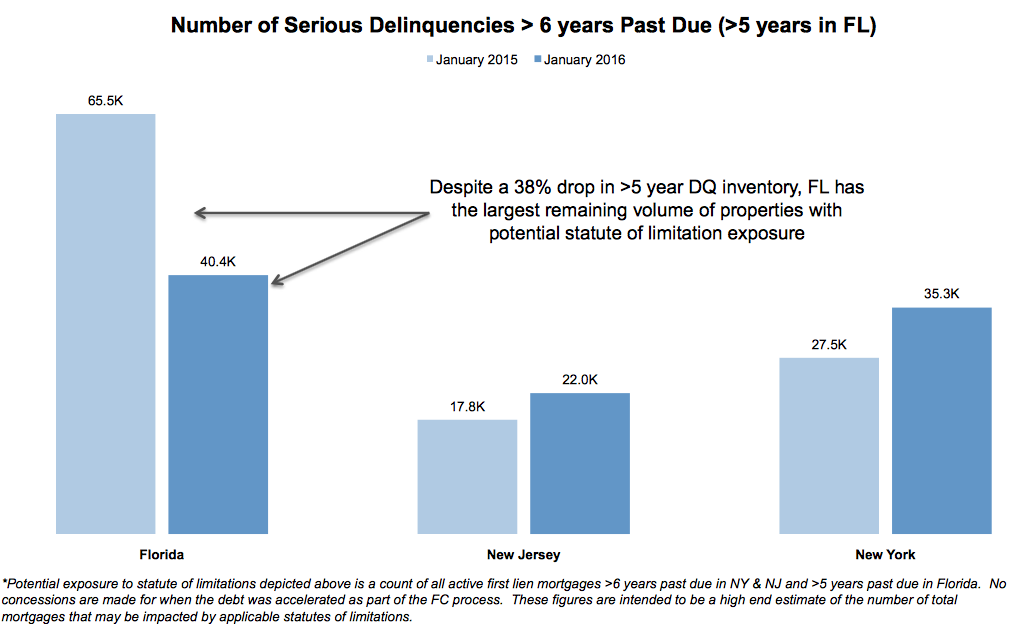
High-end estimates of loan-level delinquency timelines show that approximately 98,000 seriously delinquent mortgage loans may be facing some degree of exposure to foreclosure statutes of limitations in Florida, New Jersey, and New York—three of the states that were hit hardest by the foreclosure crisis, according to Black Knight Financial Services’ January 2016 Mortgage Monitor released Monday.

The courts are currently deliberating in those three states discussing the specifics of how the statues of limitations laws apply to foreclosures. In Florida, the foreclosure statute of limitations applies to mortgages that are five years or more overdue, while in New York and New Jersey, it applies to mortgages that are six or more years past due.

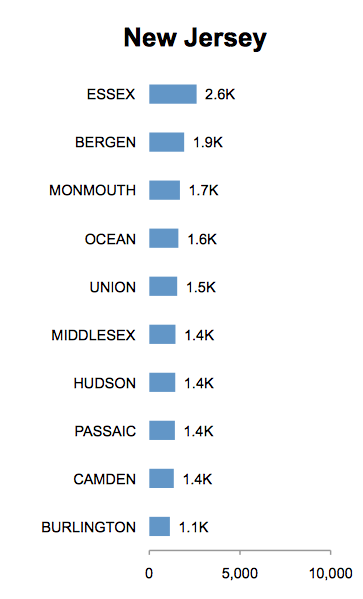
According to Black Knight, Florida has the largest volume of loans facing possible exposure to statutes of limitations with roughly 40,000, despite experiencing a 38 percent reduction over the past 12 months. For New York and New Jersey, the number of such loans is currently 35,000 and 22,000, respectively, after both experienced increases over the previous 12 months due to “limited resolution in severely delinquent loan populations” in both states, Black Knight reported.

“Without taking into account additional carrying costs and/or fees incurred by mortgage servicers, Black Knight estimates the current potential unpaid principal balance (UPB) risk exposure in these three states at approximately $30 billion, concentrated primarily in private-label securities,” Black Knight stated in the report. “As it stands today, roughly $1 out of every $10 of principal in private-label securitizations in these three states is tied to a mortgage that is more than five years delinquent in Florida or more than six years delinquent in New York and New Jersey.”

According to Black Knight, 37 percent of the loans that are more than five years delinquent in Florida are not actively involved in foreclosure, which depending on court rulings, potentially presents additional risk. For New York and New Jersey, the share of loans more than six year delinquent but not actively in foreclosure are 22 percent and 21 percent, respectively.

Posted in Foreclosures, New Jersey Real Estate | 89 Comments

LA cracks down on tiny houses illegal housing

From NPR:

LA Officials Bring The Hammer Down On Tiny Houses For Homeless

Elvis Summers is not part of any nonprofit or government agency. He’s just a 38-year-old guy with a Mohawk and tattooed arms who started a GoFundMe campaign last spring so he could build tiny houses for homeless people to live in. He got the idea after befriending a homeless woman in his neighborhood.

“It just got to me, you know, I’m just like, you know, everybody in this neighborhood knows you, they like you,” he says. “Why does nobody give a crap that you’re sleeping in the dirt? Literally.”

So far Summer has given out 37 tiny 6- by 8-foot houses, which cost $1,200 each to build. They resemble sheds, painted in bright, solid colors, with solar panels on the roof, wheels to make them mobile and a portable camping toilet.

But recently, city sanitation workers confiscated three of the houses from a sidewalk in South Los Angeles and tagged others for removal.

“Unfortunately, these structures are a safety hazard,” says Connie Llanos, a spokeswoman for LA Mayor Eric Garcetti. “These structures, some of the materials that were found in some of them, just the thought of folks having some of these things in a space so small, so confined, without the proper insulation, it really does put their lives in danger.”

Llanos says they’d be better off taking advantage of official resources like shelters or housing vouchers.

According to the latest count, 44,000 people live on the streets in and around LA. The city’s sweep put some people back on the sidewalks and since then Summers has been handing out tents instead.

Posted in Economics, Politics, Unrest | 41 Comments

Is flipping a good or bad sign?

From the Record:

Home flippers ramped up activity in 2015

One in 25 home sales in New Jersey last year were investors’ flips — in which properties are bought, renovated and quickly resold — according to a company that tracks real estate deals.

Nationally, about one in 20 home sales were flips, according to RealtyTrac, a California-based real estate information company. A total of about 180,000 homes were flipped in 2015 nationwide, including about 3,800 in the Garden State.

Home-flipping activity rose slightly in 2015, but remains well below the levels seen during the housing boom about a decade ago, said RealtyTrac, which counts sales as flips if a home is sold twice within a 12-month period.

Last year, about 5.5 percent of sales were flips, up from 5.3 percent the previous year, but significantly below the peak of 8.2 percent in 2005, as the housing bubble inflated.

Last year, about 110,000 investors completed at least one home flip, the highest number since 2007, but less than half the 259,000 who flipped properties in 2005.

Home flippers made a gross profit averaging $89,000 in New Jersey and $55,000 nationwide, according to RealtyTrac. The gross profit doesn’t include the cost of renovations and transaction expenses, which can be substantial.

Posted in Housing Recovery, New Jersey Real Estate | 89 Comments