March Beige Book

From the Federal Reserve:

Beige Book – March 2, 2016 – Second District–New York

Economic activity in the Second District has remained generally flat since the last report, while labor markets continue to tighten. Selling prices were little changed, while service-sector firms report continued upward pressure on wages and other input prices. Manufacturers report further weakening in activity, and service-sector firms also note some recent contraction. Consumer spending has been steady to up slightly in early 2016, while tourism activity has remained sluggish. Residential real estate markets showed scattered signs of softening, while commercial real estate markets were little changed. Multi-family residential construction has held steady at a high level, while commercial construction has weakened. Finally, banks report a pickup in loan demand from the commercial sector but further weakening in household loan demand, and little change in delinquency rates.

Construction and Real Estate

The District’s housing markets were stable to slightly softer in early 2016. In western New York, housing activity has reportedly slowed somewhat, in line with normal seasonal patterns, while contacts are optimistic about the outlook for the upcoming spring season. Statewide, sales activity was steady at an elevated level, while selling prices remained flat and little changed from a year earlier. Similarly, home resale prices are reported to be essentially flat in northern New Jersey, while both sales activity and inventory levels are characterized as low. One building industry contact notes that home renovation activity has been increasing, and that sub-contracting business seems to be robust.

New York City’s co-op and condo sales market has slowed somewhat since the beginning of the year, with both prices and activity down modestly from late-2015 levels. The city’s residential rental markets have also been somewhat softer. Rents on Manhattan apartments have been steady to somewhat lower so far this year, while rents in Brooklyn and Queens have increased at a slower pace than in 2015. A major New York City appraisal firms also notes that the high end of both the purchase and rental markets has been particularly sluggish, reflecting excess supply; a similar pattern prevails for high-end rental markets across the District more broadly.

Office markets have been stable across the District, with both availability rates and asking rents little changed since the beginning of the year. New office construction has weakened further; a good deal of new office space is under construction in Manhattan but little is in the works across the rest of the District. Single-family construction has generally remained sluggish, while multi-family development has been robust. In northern New Jersey, most of the recent apartment construction has been rental buildings, whereas in New York City, it has been largely condos.
Posted in Demographics, Economics, Housing Recovery, New Jersey Real Estate, NYC | 110 Comments

Pending home sales flatten YOY

From the WSJ:

U.S. Pending Home Sales Tumbled 2.5% in January

The number of existing homes tentatively sold across the U.S. fell in January, as swiftly rising prices and lower inventory muted buyer demand after the strongest year in nearly a decade.

An index measuring pending home sales—a gauge of purchases before they become final—fell 2.5% to a seasonally adjusted reading of 106.0 in January, the National Association of Realtors said Monday. An index of 100 is equal to the average level of contract activity during 2001, which the NAR considers a “normal,” or balanced, market for the current U.S. population. In 2015, the index averaged 108.9, a rise of 8.0% over 2014 and its highest level since 2006.

The drop surprised analysts. Economists surveyed by The Wall Street Journal had predicted a 0.5% increase in January’s sales. December’s reading was revised up to 108.7 from an initial reading of 106.8.

“While pending home sales have been weak lately, some other housing indicators—including the mortgage purchase application data reported through most of February—have looked strong, giving us hope that the housing market is continuing to recover,” Daniel Silver, an economist at J.P. Morgan Chase, wrote in an analyst note.

Pending home sales rose 1.4% in January from a year earlier, the 17th straight month the index has increased year over year, but that was its second-smallest annual gain over that period.

Several economists noted January’s blizzard may have dampened activity in the Northeast, but the index fell most in the Midwest and Northwest, declining by 4.9% and 4.5% respectively.

“It’s possible that the drop in the stock market beginning at the start of the year persuaded would-be home buyers to wait a while, but we have no way of knowing for sure,” said Ian Shepherdson, an economist at Pantheon Macroeconomics, in a note to clients. “Alternatively, the severe blizzard in late January might have depressed activity in the northeast, but sales reportedly fell even further in the West, so it’s hard to find a consistent story.”

Posted in Demographics, Economics, Employment, Housing Recovery, National Real Estate | 110 Comments

NJ eliminating a tax? Impossible

From the APP:

No more NJ estate tax? Bill passes first hurdle

A state Senate committee Monday approved a bill that would phase out New Jersey’s estate tax over five years.

The vote by the Senate Budget and Appropriations Committee was a win for business groups that have argued the tax drives Garden State residents out of state.

“The only individuals who are now paying the estate tax are those who due mostly to family or business reasons choose not to leave the state,” said Michele Siekerka, president of the New Jersey Business and Industry Association, a business lobby group. “Those who can leave New Jersey do.”

New Jersey taxes estates – cash, real estate, retirement accounts, life insurance benefits and other assets – worth more than $675,000. It is one of 14 states with an estate tax. And it has the nation’s lowest threshold. By comparison, the federal government for 2015 taxes estates worth more than $5.43 million.

New Jersey also taxes beneficiaries who receive inheritances, but grandparents, spouses, parents and children are exempt.

The bill was debated as lawmakers face pressure from two sides. They are searching for ways to lower the state’s notoriously high cost of living. And they are trying to generate enough revenue to pay for a checklist ranging from health benefits for state workers to transportation improvement projects.

The bill sponsored by Sen. Paul Sarlo, D-Bergen and Passaic, and Sen. Steven Oroho, R-Sussex, Warren, and Morris, would increase the threshold each year to $5 million in 2020 before eliminating it in 2021.

Posted in New Jersey Real Estate, Politics | 99 Comments

NJ Open For Business?

From the Record:

More New York businesses making move to North Jersey

Gross Printing had been doing business in a Sunset Park, Brooklyn, industrial park for several years when co-owner Samson Gross noticed that the company’s landlord was bringing in hipper tenants — breweries, artists and gourmet food companies.

Then, Gross said, the landlord told him his lease would not be renewed. The landlord wanted tenants that could pay $35 a square foot; Gross was paying about $7. So the company began looking for new space, finding its way last year to Clifton, where Gross Printing now leases a 32,000-square-foot building on Brighton Road. The place costs a little more than Gross Printing’s old quarters at the Industry City complex in Brooklyn, but much less than the company would have paid if it had stayed in the city. And Gross, who prints brochures, magazines and packaging, is happier with the location.

“It’s just a nicer place,” said Gross, who owns the company with his wife, Hindy. “The infrastructure in this part of New Jersey is by far better for my type of business than anything available in New York City. New York City is impossible. Customers can’t park their cars for a minute without getting a ticket. To drive five blocks can take half an hour. Frankly, I don’t know how I did it for so long.”

The path of corporate exodus from New York City to New Jersey is well-worn, but real estate brokers and others say that the pace has quickened recently. Companies that need industrial or warehouse space are getting priced out of New York City and its boroughs — especially Brooklyn — as developers scoop up industrial space for new uses.

“Buildings there are being redeveloped and repositioned, whether it’s for residential or retail,” said Tom Vetter, a broker specializing in the Meadowlands with NAI Hanson in Hackensack.

And the trendier Brooklyn and the other boroughs get, the harder it is for industrial users to afford to stay there.

“Companies aren’t just coming over here because of cost. You’ve got some other reasons: proximity to the port, proximity to New York City, transportation networks, real estate expenses,” said Blake Chroman, senior vice president of Sitex, which owns more than 2 million square feet of warehouse space in North Jersey.

The migration from New York has helped push New Jersey’s industrial vacancy rates to their lowest point in 15 years, according to Cushman & Wakefield. The real estate firm said the industrial vacancy rate was 6.4 percent statewide in the fourth quarter of last year, down from 8.2 percent a year earlier. In Bergen County, the vacancy rate was 7.5 percent, and in Passaic, 5.7 percent. By comparison, the office vacancy rare has long hovered in the 20 percent range.

Among the companies that have moved operations to New Jersey from the five boroughs are Goffa International of East Rutherford, a stuffed-animal importer formerly located in Brooklyn, and M&J Innovation of Norwood, a company that provides installation and other services for trade shows. M&J Innovation was previously in the Bronx.

In addition, the food company Blue Apron recently moved its distribution center from Williamsburg, Brooklyn, to Jersey City. And Streit’s Matzoh sold its 90-year-old building on the Lower East Side in Manhattan and moved some operations to a site it already owned in Moonachie last year. However, Streit’s plans to consolidate operations in the Rockland County, N.Y., town of Orangeburg, according to Alan Adler, director of operations.

Moving across the Hudson River carries some risks. Clients don’t always follow. And workers who are used to commuting by public transportation sometimes decide they can’t face the trip to a suburban workplace.

Posted in Demographics, Economics, Employment, New Jersey Real Estate | 55 Comments

Real estate porn goes conservative

From Bloomberg:

Home buyers in pricey markets are now scared to dream

Rising home prices in hot housing markets are robbing buyers of a favorite pleasure: looking at pictures of homes they can’t afford. Or at least, that’s one way to read a blog post published by real estate brokerage Redfin.

Traditionally, buyers browsing online listings have looked at homes that cost more than they are planning to spend, said Redfin. That dynamic has held true in such cities as Philadelphia and Chicago, where prices have remained stable in recent years. But in cities such as San Francisco and Boston, where inventory is scarce and prices have increased sharply, buyers are starting their searches at lower price points.

Denver is another good example. In 2014, the median price for listings viewed on Redfin was $359,000. That was 26 percent higher than the $285,000 median listing price for the city. So far this year, the difference between viewed listing prices ($379,000) and median listing prices ($337,000) is 13 percent.

There are a couple reasons buyers may start their search by aiming high. We all like to look at stainless steel appliances and killer views, whether or not we can afford them. More practically, it’s smart pricing strategy. If you want to spend $300,000 on a house, you might shop for homes that list for $330,000 and make a lower offer. The research looked at nine large U.S. cities to see whether real estate searchers were using that logic.

Why would buyers target their search below the local median listing price? Eric Scharnhorst, the Redfin data scientist who compiled the numbers, thinks it’s more likely that buyers are adapting their pricing strategies to hot markets where bidding contests have become the norm. “In a city where you need to compete, you start looking at homes for $280,000 with the exception that you’ll wind up spending $20,000 more,” he said. A simpler theory: In these markets, more people want to buy relatively cheap homes, even though few are available. Whatever the reason, homebuyers in the most competitive markets seem to be abandoning the urge even to peek at the high ceilings, Italian appliances and outdoor kitchens of their fantasies.

Posted in Demographics, Economics, Humor, National Real Estate | 14 Comments

Housing decline? Not likely.

From Forbes:

Why The U.S. Housing Market Will Remain Alive And Kicking in 2016

If you live in Coastal California, you don’t need national housing statistics to tell you that the housing market is in good shape – stick a “For Sale” sign in the yard and there are dozens of offers within a few days. If you are a seller or homeowner in the some of the less-than-hot spots, you can still take some comfort from the majority of indicators that suggest that the market is not only solid, but still improving. Worries about the state of the economy and the stock market justifiably create some jitters. However, the factors that positively influence real estate, such as employment, interest rates, and low inventory, are likely to trump the detractors looking ahead into 2016.

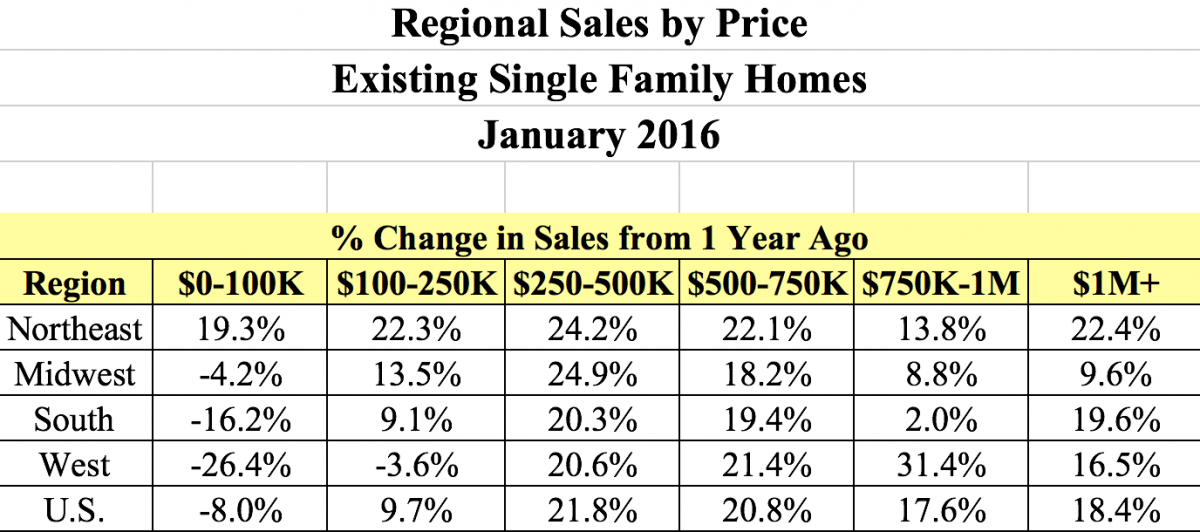
First, the data. Given recent poor economic figures, analysts were pessimistic heading into the release of January’s housing data. They were positively surprised to learn Tuesday that existing home sales climbed 0.4% from the last month, which translates into a healthy 11% increase since the same time last year. Despite January being a typical cold weather month, existing home sales were the second strongest month since 2007. Interestingly, the data produced by the National Association of Realtors dissects the data by home price, not just by region. This data indicates that most of the market has witnessed significant gains since last year – except for the cheapest priced homes (sub $100,000) which amount to about 16% of all existing sales.

New home sales data released Wednesday wasn’t so great, indicating a fall of 9.2% since December, led by a huge drop in the Western region of the U.S. As is the case with housing data and weather, the monthly information is highly volatile. Since December 2015 showed an outsized positive month for new sales, it is not shocking that January’s figure reveals an outsize negative.

Prices are performing well. The most closely watched index on home prices is the S&P/Case Shiller index, which showed home values improved by over 5% at the end of 2015 compared to a year earlier. The 20 large city index they track showed a higher climb in prices, closer to 6%. Inventories have been somewhat smaller than normal so buyers have been chasing fewer houses and driving prices up. More sellers are likely to emerge in the coming months to take advantage of these higher home prices.

That said, there are many positives underpinning the longer run housing story. The housing crisis that was the epicenter of the 2008 crisis has almost finished healing. The massive overhang of foreclosures has nearly cleared, and new foreclosures are back to a long run average. There is also less debt in the system, as distressed homeowners had to sell, and also since many have shifted to renting given tighter lending standards. With less leverage in the system, we can expect less turmoil induced by a cyclical slowdown in the economy.

The largest positives for the housing sector remain the ongoing gains in employment (and income) and very low mortgage rates. The unemployment rate is now below 5%, and thanks to decent wage gains and low energy prices, the consumer has more cash in the pocket and therefore can support mortgage payments, renovations, rents, and thus prices. Despite the overall recovery in the economy that has induced the Federal Reserve to hike interest rates, long term rates remain very low, dragging mortgage rates back down to historic lows. The chart above shows the steep decline in 30 year mortgage rates in the past month; the price of a mortgage will not be holding the buyers back.

Posted in Economics, Housing Recovery, National Real Estate | 100 Comments

Existing home sales show strong performance in January

From Bloomberg:

Sales of Existing U.S. Homes Rise to Second-Highest Since 2007

Sales of previously owned U.S. homes unexpectedly rose in January to the second-highest pace since early 2007, indicating the industry will keep prospering.

Closings, which usually take place a month or two after a contract is signed, advanced 0.4 percent to a 5.47 million annual rate, the National Association of Realtors reported Tuesday in Washington. Prices climbed from January 2015 as the number of dwellings on the market fell.

Near record-low mortgage rates, steady job gains and better wage growth are helping encourage prospective buyers, including first-time purchasers. Further strengthening in residential real estate will support the economy and make up for weakness in manufacturing tied to weaker global growth.

“Consumers are pretty keen to purchase a home,” said Gennadiy Goldberg, an economist at TD Securities in New York. “Slow and steady growth is what we want. It’s really positive for the U.S. economy in general.”

The January sales pace was the second-strongest since February 2007. The median forecast of economists surveyed by Bloomberg called for a 5.33 million annualized rate, with estimates ranging from 5.08 million to 5.55 million. December’s pace was revised to 5.45 million from an originally reported 5.46 million.

Compared with a year earlier, purchases increased 7.5 percent in January before adjusting for seasonal variations.

The median price of an existing home rose 8.2 percent from January 2015 to $213,800. The appreciation was led by an 8.7 percent year-to-year advance in the Midwest and an 8.5 percent gain in the South.

Posted in Economics, Housing Recovery, National Real Estate | 142 Comments

Leave and you lose your benefits?

From the Courier Post:

RABBLE ROUSER: Don’t reward workers who leave NJ

Stop rewarding people for moving out of New Jersey. This would be a good start in trying to be fiscally responsible.

Let me tell you a short story. Recently friends of mine sold their house and moved to Florida. One of them worked for a New Jersey government agency. Their family receives substantial medical benefits from New Jersey. They told me that their real estate taxes will be cut in half: $5,000 in Florida vs. $10,000 in New Jersey.

This is not surprising. This person wanted to thank me for helping to pay their pension and health care while they live in Florida.

I appreciate that they earned their pension. Yet why should residents left behind in New Jersey help subsidize health care for people who leave the state? Health care costs can easily exceed $5,000. My taxes keep going up to help pay for their health care even if they move out of New Jersey.

We know of three other couples who have New Jersey government benefits and are moving out of New Jersey to save money. One must question how many other former New Jersey government employees have left the state and still receive premium health care benefits from the state of New Jersey.

Maybe our state representatives should enact a new law that would subsidize New Jersey residents who were former government employees 95 percent of their health care and pay just 5 percent for former state employees who are not New Jersey residents.

Why are we rewarding people for moving out of the state? Is this too logical?

Posted in Unrest | 137 Comments

Welcome back our subprime overlords

From HousingWire:

Bank of America now offers 3% down mortgages without mortgage insurance

Bank of America unveiled a new affordable mortgage program that offers consumers the option of putting as little as 3% down and requires no mortgage insurance. The program does not involve the Federal Housing Administration, whose program has recently undergone a lot of scrutiny from big banks.

Bank of America announced a partnership on Monday with Self-Help Ventures Fund and Freddie Mac for its new “Affordable Loan Solution” mortgage, a conforming loan that provides low- and moderate-income homebuyers access to a responsible lending product with counseling at affordable entry prices.

To make the program function, the three companies will work together to help ensure the loan is properly originated and backed in case the loan goes delinquent, the companies said Monday.

For starters, Bank of America said the mortgage will be available through all of its mortgage sales channels.

Self-Help, which is based in Durham, North Carolina, will then buy the loans and servicing rights, along with providing post-closing counseling for any borrowers who might be experiencing payment difficulties.

Since Self-Help is taking the first-loss position, the loans require no mortgage insurance.

Freddie Mac will purchase all of the eligible affordable mortgages originated via the Self-Help and Bank of America partnership, having recently approving Self-Help as a seller/servicer to facilitate the rollout of this offering to borrowers.

The program allows down payments as low as 3% on the purchase of a primary, single-family residence, with no reserve funds required in most situations.

The loan also requires a minimum FICO score of 660, and first-time buyers will need to participate in homebuyer education.

Posted in Mortgages, National Real Estate, Risky Lending | 86 Comments

Fools and their money…

From the NYT:

When a Dream House Becomes a Money Pit

Any buyer knows that a dream home can become a nightmare. But most people don’t expect it to happen to them.

Steven and Michelle Hicks found what looked like the perfect home: a two-story, mid-1920s Dutch colonial on three-quarters of an acre in Millburn, N.J. But months after moving into the 1,856-square-foot house, they realized just how elusive a dream home can be.

When a broker urged them to look at 264 Glen Avenue in Millburn in 2012, their long search ended. “It was gorgeous,” Mr. Hicks said. Bay windows let in glorious light, and French doors graced the living room. The front yard had a stream running through it with a footbridge, and the house looked out into the thick woods of the South Mountain Reservation, whose southern tip began just across the street.

They offered the seller’s asking price of $650,000, and “she just took it,” Mr. Hicks recalled. In retrospect, he said, “That should have told us something.”

Once they moved in, problems quickly mounted. New windows had been installed in some rooms, but haphazardly, without insulation. A contractor told them that the previous owner had removed a load-bearing wall without putting a hefty beam across the ceiling to make up for the missing wall. “Nothing was shoring up the second floor,” Ms. Hicks said. An electrician told them the wiring was not grounded, and that a fire could break out at any time.

The basement had a tankless water heater, a selling point for the Hickses. But shortly after they moved in, it stopped working. It was supplying water to a Rube Goldberg series of pipes that traveled all the way to the attic and then into the rooms for the radiators, looping throughout the house and covering so much distance that the water cooled by the time it got to where it was needed. During last year’s often bitter winter, the radiators couldn’t get the second floor warmer than 48 degrees. Ms. Hicks said she was working from home, “but with a hat on” and a space heater glowing.

The previous owner, Carol Royal, said that when she left the house, “everything was fine, as far as I was concerned.” She said she has bought many homes in need of repair, and said, “first-time home buyers, they expect everything to be perfect. But it’s not.”

Ms. Hicks’s favorite feature of the house had been the hand-laid tile on the floor of the master bath, which gave the impression of a riverbed. But by the end of their first summer, the tiles were cracking. The plywood subfloor was inadequate and incomplete; the floor was sinking.

That winter, they lost access to one of the showers when the pipes froze; the pipes ran along an outside wall over the covered porch and had not been insulated.

Some things simply seemed slipshod. When Mr. Hicks leaned against the granite countertop on the kitchen island, it slid. It had never been attached.

The Hickses had paid for an inspection, but many of the problems were hidden behind the redone walls. Mr. Hicks said he wished that he had picked up on subtle signals the inspector may have been sending. “He was a little bit more apologetic than he should have been,” he said. In the basement, the inspector noticed that the beams supporting the kitchen had been notched to run wiring and pipes, reducing the load-bearing capacity. “You are not supposed to do that,” he told them, “but are you going to have 40 people in the kitchen?”

Posted in New Jersey Real Estate | 78 Comments

Christie’s property tax cap worked

From the Star Ledger:

Are N.J. property taxes actually going down in many towns?

Are many New Jersey residents actually paying less in property taxes than they were five years ago?

The state’s sky-high property taxes crossed the $8,300 threshold in 2015 as New Jersey residents continue to get smacked with the highest real estate rates in the nation.

However, a NJ Advance Media analysis of statewide property tax data has found that property taxes in 42 percent of municipalities increased at less than the rate of inflation from 2010 to 2015.

During that time, the average statewide property tax bill rose about 10 percent, from $7,576 to $8,353. When accounting for inflation, which rose about 9 percent, the property tax bills rose slightly more than 1 percent.

But 237 municipalities, that are home to nearly 46 percent of the state’s population, kept their tax increases below the rate of inflation.

NJ Advance Media analyzed municipal tax figures going back 15 years and found that, when adjusted for inflation, the impact of property tax relief relief measures enacted during Gov. Chris Christie’s first term — including strict caps on local spending and public worker arbitration rewards — is clear.

Property taxes rose 1 percent when adjusted for inflation from 2010 to 2015 after soaring 35 percent, after inflation was taken into account, from 2000 to 2010, the analysis found.

Data show only five municipalities — Teterboro, Pemberton, Woodbine, Lebanon and Union City — kept tax bills lower in 2015 than in 2000, after inflation.

Christie spokeswoman Joelle Farrell noted that during Christie’s first six years, property tax growth “has slowed to an annual average of 1.97 percent, dramatically lower than the 7 percent yearly average in the 10 years before the Christie administration.”

“You have to ask yourself, where would New Jersey’s property taxes be if not for the governor’s reforms,” Farrell said. “If annual average increases continued at a rate of 7 percent for the past six years?”

Michael Darcy, executive director of the New Jersey League of Municipalities said the 2 percent spending cap enacted by Christie helped, but reforms to public worker benefits and the arbitration cap made it possible for local officials to rein in some costs.

“I think it is safe to say that overall the escalation of property taxes has been significantly curtailed compared to historic trends,” said Darcy.

Posted in New Jersey Real Estate, Politics, Property Taxes | 37 Comments

The long grind

From the Record:

Foreclosures ease a bit in NJ, but remain higher than national rate

Housing distress is easing in New Jersey, but the state still has much higher rates of foreclosures and mortgage delinquencies than the nation as a whole, the Mortgage Bankers Association said Thursday.

About 12.1 percent of New Jersey mortgages – or one in eight – were either late on payments or in foreclosure in the fourth quarter of 2015. That’s down from 14.8 percent a year earlier, but is almost twice the national rate of about 6.5 percent, the lowest level since before the recession.

“As the job market has improved and national home prices have rebounded, fewer borrowers were becoming seriously delinquent, while borrowers previously behind on their payments were in a better position to … resolve delinquent loans,” Marina Walsh, MBA’s vice president of industry analysis, said in a statement.

New Jersey led the nation in the number of foreclosures started in the fourth quarter, according to the MBA. It was 12th in the rate of mortgages with late payments.

Posted in Foreclosures, Housing Recovery, New Jersey Real Estate | 123 Comments

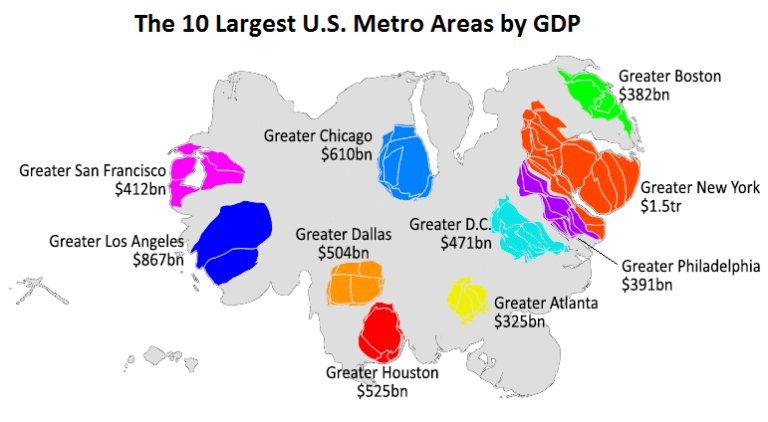
NYC/Philly – US Economic Powerhouse

I thought this was fitting, given the discussion about NYC/Philly GDP and US economic contribution:

Posted in Demographics, Economics, Employment, North Jersey Real Estate, NYC | 102 Comments

Clinton brings housing into the debate

From HousingWire:

Hillary Clinton unveils sweeping economic agenda, including major housing reforms

With the 2016 presidential election inching closer at a seemingly glacial pace, one issue that many of the main candidates have neglected to address is housing and its impact on the country’s economy.

Several now-former candidates for President spoke at last year’s New Hampshire Housing Summit hosted by the J. Ronald Terwilliger Foundation for Housing America’s Families and the Bipartisan Policy Center, but housing doesn’t often get mentioned in the stump speeches of Donald Trump, Ted Cruz, Marco Rubio, Bernie Sanders or Hillary Clinton.

But it appears that is about to change as Clinton, the Democratic hopeful and former Secretary of State, recently announced a sweeping economic agenda that includes some major housing reforms.

Part of Clinton’s $125 billion program is a $25 billion housing investment program that aims to “lift more families into sustainable homeownership,” by offering down payment assistance, increasing housing counseling programs, expanding beyond traditional credit scores, building more affordable rental housing, clarifying lending rules and other changes.

Clinton’s campaign states that the $25 billion housing investment program targets the blight that is still dragging down many communities, addresses “skyrocketing” rents that are impacting the country’s working families, and the “barriers” that prevent many families from becoming homeowners.

“Homeownership is about more than just owning a home. It is about putting roots down in a community with better schools, safer streets and good jobs,” Clinton’s campaign states.

“And it is about building wealth, as homeowners build equity in their home one mortgage payment at a time,” Clinton’s campaign continues. “But this opportunity is increasingly out of reach for too many families, particularly families of color.”

Clinton’s plan also addresses the “skyrocketing rise of rental costs in areas of opportunity.”

According to Clinton’s campaign, nearly half of all renters between age 25 and 34 pay 30% or more of their monthly income on rent, and one-fourth pay over half of their income on rent.

“High rents not only weigh heavily on the pocketbooks of these families but often displace entire communities in the face of local growth,” Clinton’s campaign states. “There is simply not enough affordable rental housing in many parts of the country to keep up with new demand, driving prices in these areas to a level that is unaffordable for large segments of the population.”

Clinton’s plan will tackle these issues by “increasing incentives for new affordable rental housing development and easing the local barriers to building affordable housing in areas of economic opportunity.”

Posted in Housing Recovery, Politics | 95 Comments

Valentines Day Massacre

From the Star Ledger:

Here’s what happened to those 100 lots Newark gave away last Valentine’s Day

This time last year, John Errico and Shannon Guy took what they believed would be the first step toward their shared dream.

Newly engaged, the two attorneys spotted news clippings detailing vacant lots in Newark being offered for just $1,000 each as part of a couples-only Valentine’s Day sale. They were among the first to arrive at City Hall that morning, and jumped at the chance to build on a small plot on Garside Street in the city’s North Ward.

“It was an emotional decision,” Errico said. “We wanted our forever home.”

A year later, the purchase that seemed too good to be true has been just that.

While construction for the three-family home they envisioned would have required a loan of at least $250,000, properties just up the road from their tract were selling in the high five figures.

“We didn’t really drill down into what are the actual financials of it (at first),” Errico said. “It was kind of hard to swallow spending $300,000 or even $350,000 to build a new home, when you can get an older home for $90,000.”

Errico and Guy’s story is not unique.

They are among 21 couples (or former couples) who have walked away from the Valentine’s Day properties. Dozens of others have found their own hopes delayed by difficulties securing construction loans.

As of Sunday, only five couples who forked over an initial $500 last Feb. 14 have officially closed, though city officials say another seven are in the pipeline. Eleven others have received approvals to begin construction, but are still pursuing loans.

Allowing for two other properties that had to be pulled back after city officials realized they were zoned for commercial use, that leaves 54 lots.

The owners of those 54 total lots have struggled, officials say, to navigate the financial and governmental channels needed to start building.

The city did not require proof of financing until home designs and site plans were approved, and despite the immediate equity gained through the cheap purchase, most buyers found themselves unable to secure financing to put shovels in the ground.

“We’re still in an economy that’s post-recession, and it’s really hard for the average Joe to get a construction loan,” said Baye Adofo-Wilson, Newark’s deputy mayor for housing and economic development.

On Sunday, officials announced a second phase of the sale, which will enlist the Newark Community Economic Development Corporation to guide many buyers as they look to obtain architectural renderings, construction documents and approvals from city boards.

In many cases, the lots will be sold to a handful of developers, who will build one and two-family homes for sale back to owners at $179,000-$249,000. The 21 lots already returned to the city will also be sold to a local developer for sale back to the public.

Initial agreements signed with buyers require construction to begin within 18 months of closing on the vacant lots, and owners must live in the property for a minimum of five years once the home is built. Adofo-Wilson said that while a handful of lots are on track to meet the requirements, the city has shifted its focus to encourage construction regardless of pace.

“Our goal is to sell all the city-owned lots that we can sell. We believe that’s true economic development. It doesn’t really make sense for the city to hold these lots,” he said. “We learned from the experience.”

Posted in Housing Recovery, New Development, New Jersey Real Estate, Politics | 91 Comments