
Time to consolidate NJ

From the Star Ledger:

I was the last mayor of Princeton Township: Consolidation works and we need to stop being afraid of it

Consolidation of New Jersey municipalities — especially as it relates to school districts – can result in significant long-term savings and at the same time it can lead to better planning and responsiveness in local government.

As the former and last mayor of Princeton Township and the lead architect of Princeton’s successful consolidation, I’d like to draw attention to some important considerations concerning consolidation and shared services that are often left out of the conversation.

For instance, one community of 1,500 residents could have an average cost-per-capita of $1,500 and a large community of 10,000 residents could have the same per capita cost. With no thorough analysis of actual services provided to residents, it does not prove that a town is equally efficient. If one community offers superior services, a police department and/or a library for the same cost, which one is more efficient?

The fact is that consolidation has worked and we need to stop being afraid of it. It is no longer a mythical unicorn in dealing with inefficient home rule.

Princeton blazed the trail with millions in annual budgetary savings and the lowest municipal tax growth rate post-consolidation than any neighboring municipality. Others have begun to realize some clear benefits of considering its application. The successful school merger in Hunterdon County is a prime example and others are in the works, including Mount Arlington and Roxbury which have great savings potential as the consolidation would include both school districts and municipal governments.

In the recent Star-Ledger article, “Merging 191 towns won’t fix crushing taxes, these experts say,” one of the experts is Marc Pfeiffer and his colleague Raphael Caprio, who wrote for Rutgers’ Bloustein School a white paper called “Size May Not Be The Issue: An Analysis of The Cost of Local Government and Municipal Size in New Jersey.”

While one can applaud the authors of the analysis in their attempt to make sense of New Jersey’s municipal madness, the unfortunate result of the white paper was misguided headlines about consolidation at a time when New Jersey municipalities and school districts should be considering all options to garner efficiencies in service delivery and control costs.

The reality is that without consolidation added to the “municipal toolkit”, large savings in shared services will continue to remain elusive. Shared services for small departments often have negligible savings while large departments with savings potential: police and public works – often are not considered by ‘home rule’ mayors for fear of losing control.

Consolidation brings some unique benefits above and beyond cost savings that cannot be achieved just by sharing services. A single, consolidated Princeton has a much improved level of responsiveness in times of crisis as it can better marshal its resources without the intervening power struggles of two separate governments.

In addition, it has avoided significant capital costs as it now shares real estate and avoided having to build or renovate a new facility for a non-profit that it houses.

New Jersey needs to stop the debate of whether or not consolidation or shared services works — they both do.
Posted in Economics, New Jersey Real Estate, Politics | 56 Comments

Haven’t yet returned to bubble pricing

From the Star Ledger, hat tip Yo:

Only these 2 N.J. towns have fully recovered since the housing crash

It’s been more than a decade since housing prices in New Jersey began a seven-year slide highlighted by the Great Recession.

As of today, only two have made it back to where they began: Hoboken and Weehawken.

That’s according to an NJ Advance Media analysis of Zillow market value data, which has tracked home prices for 500 of the state’s 565 municipalities dating to 2006.

Other than the two Hudson County neighbors mentioned above, all remain below the peak where they began. As a whole, New Jersey has seen housing prices rise over the past two years as housing inventories in many markets have tightened considerably.

But when historical prices are adjusted for inflation, the state median home value of $317,000 remains 30 percent lower than it was in 2006.

While other towns, like Millburn and Jersey City, have earned back most of the losses, Hoboken and Weehawken are the only two towns that have posted positive gains.

The median home value in Hoboken has risen by more than 11 percent since the market peak in 2006, while Weehawken has seen a more modest gain of 1.5 percent.

If you eliminate the massive rise and fall of the housing bubble leading to the Great Recession, the state’s home prices have risen at a sustainable rate over the past 20 years. The gains many towns have seen since 2013, when the state hit bottom, have been substantial.

Posted in Housing Bubble, Housing Recovery, New Jersey Real Estate | 23 Comments

All eyes on jobs today

From CNBC:

Hiring seen strong in June with plenty of jobs for grads

Employers may be having a hard time finding workers, but recent graduates and students may be helping fill the ranks this summer and that trend could have bumped up June’s job growth.

“Our forecast…embeds solid summer hiring of students and recent graduates, and we note that job growth tends to accelerate in June when the labor market is tight,” according to economists at Goldman Sach, who said they expect 200,000 jobs were created in June and that unemployment slipped to 3.7 percent from 3.8 percent.

The consensus of Wall Street’s economists’ is that 195,000 payrolls were added and that unemployment was unchanged at 3.8 percent, according to Reuters. May job growth totaled 223,000, but a softer than expected June ADP report, with 177,000 private payrolls in June, signaled a possibly softer number for June.

The ADP report, below 200,000 for a fourth month, could be signalling softness in job growth due to a lack of workers.

Markets will no doubt be most interested in wage growth, expected at a monthly gain of 0.3 percent, or an annual gain of 2.8 percent, a respectable pace. Economists expect that tightness in the job market to start pressuring wage growth at some point, but it’s been tame so far, signaling little inflationary pressure and therefore no reason for the Fed to increase its pace of interest rate hikes.

“I think we’ll have good numbers. I’m at 205,000,” said Ward McCarthy, chief financial economist at Jefferies. He expects unemployment at 3.7 percent but wage growth of only 0.2 percent.

“Consistently through this cycle, June has been a weak month for hourly average earnings…and part of the reason is you have all the college kids coming in,” said McCarthy.

Posted in Demographics, Economics, Employment | 136 Comments

It’s a great time to stay put

From CNBC:

Home prices make the biggest jump in four years

It is a seller’s market, undeniably. The supply of homes for sale is low, demand is high, and now prices are heating up even more. But sellers today see more reasons to stay put than to profit.

Home prices jumped 7.1 percent annually in May, according to a new report from CoreLogic. That’s the biggest jump in four years. Annual price gains had been shrinking slightly, as mortgage rates rose, but apparently higher rates are not hurting demand. They are, however, exacerbating the already critical supply shortage.

“During the first quarter, we found that about 50 percent of all existing homeowners had a mortgage rate of 3.75 percent or less,” said Frank Nothaft, chief economist for CoreLogic. “May’s mortgage rates averaged a seven-year high of 4.6 percent, with an increasing number of homeowners keeping the low-rate loans they currently have, rather than sell and buy another home that would carry a higher interest rate.”

If mortgage rates were to rise further, fewer homeowners would want to move. In fact, if today’s homeowners just considering a move were faced with a mortgage rate 1 percentage point higher than their current one, 24 percent would not move, according to a survey by John Burns Real Estate Consulting. Thirty-six percent said they “may not” move. The average rate on the 30-year fixed is now slightly more than 1 percentage point higher than the lows following the recession.

Posted in Demographics, Economics, Housing Recovery, Mortgages, National Real Estate | 95 Comments

New Jersey has a serious problem

From the Star Ledger:

Why paychecks in N.J. aren’t growing as fast as the rest of the U.S.

New Jersey hit near rock bottom in wage growth last year as compared to the rest of the country, according to new data released Saturday, raising fresh concerns about the strength of the state’s post-recession recovery, especially when it comes to workers.

The state’s average weekly paycheck grew 1.8 percent from 2016 to 2017, while wages grew 3.9 percent nationally, according to the Bureau of Labor Statistics. The slow growth placed the Garden State at 50th among all states and Washington, D.C., beating only Alaska.

“New Jersey’s been lagging over the post-recession period, but fiftieth is a little unexpected,” said James Hughes, professor of economics and former dean of the Edward J. Bloustein School at Rutgers University.

While the state’s wages remained relatively high — $1,262 on average, making it fifth in the nation — those wages are counterbalanced by its high cost of living. New Jersey has the fifth-highest rents and the fourth-highest home prices in the nation, according to Census data.

By comparison, New York was second in average wages and second in wage growth from 2016 to 2017. California, with the fourth-highest wages, had the fourth-highest wage growth as well, according to the Bureau of Labor Statistics.

Connecticut was most similar to New Jersey.

“New Jersey and Connecticut are both suburban economies, which are not the strongest nationally right now,” Hughes said. “Since the recession, the most favored places are the 24/7 work-play environments, while the weakest areas are dominated by suburban office buildings. … The places where wages are growing faster are where millennials want to live.”

Yet well-off, suburban Morris County in North Jersey actually matched the national average, with 3.9 percent wage growth. New, often cutting-edge industries have moved to that county in recent years, such as the re-opening of the Bell Labs complex.

Hudson, Monmouth, and Atlantic counties had the biggest increases after Morris. Mercer’s wages, in contrast, actually shrank slightly between 2016 and 2017 — the only county to do so.

Morris County also had the highest wages in the state, with Somerset County trailing close behind. Cape May and Ocean had the lowest wages, although the data included part-time and seasonal workers that may offset the wages of full-time residents.

New Jersey companies employed 4.1 million people in the last quarter of 2017, about half of the state’s population. But that number is likely an underestimation of New Jersey workers, since 14 percent of residents worked out of state in the 2012-2016 Census snapshot.

Passaic was last in employment growth, but every county tracked by the bureau had more workers in 2017 than in 2016. Yet with Baby Boomers retiring and being replaced by lower-wage millennials, the wage situation will probably remain well into the future, Hughes said.

“The administration in Trenton has a tough road ahead,” he said.

Posted in Demographics, Economics, Employment, New Jersey Real Estate | 43 Comments

So what’s this mean for Jersey?

From Bloomberg:

Manhattan Homebuyers Demand Bargains, Walk Away—Anything But Overpay

In his hunt for an apartment on Manhattan’s Upper West Side, Hal Walker found the perfect one-bedroom in an Art Deco building across from Central Park. It had languished on the market for almost six months.

Walker bid $30,000 below the $865,000 asking price, then refused the seller’s counteroffer. Yet he’s moving in next week.

“Would you lose sleep tonight if you lost this apartment?” Walker recalled his broker asking. “I said no.”

Manhattan homebuyers are getting bolder these days, demanding bargains or walking away from deals in a market where inventory is swelling. In the three months through June, purchases fell 17 percent from a year earlier to 2,629, according to a report Tuesday by appraiser Miller Samuel Inc. and brokerage Douglas Elliman Real Estate. That was the lowest tally for a second quarter since 2009, when the global recession chilled deals.

Of the sales that were completed in the quarter, 54 percent were for less than the asking price. Another 37 percent of transactions closed at the asking price, but often that figure had already been reduced. Combined, the share of purchases without a premium was the biggest since the end of 2012.

“It’s about perception — that the market went way up, and it went way up real fast, and it’s not happening anymore, and I am not going to be the fool who gets burned by overpaying,” said Steven James, Douglas Elliman’s chief executive officer for New York City. Buyers “do believe that over time, the market will go up, but it’s not going up right now.”

The median price for all homes that changed hands in the quarter dropped 7.5 percent to $1.1 million, the second consecutive year-over-year decline, the firms said. There were 6,985 homes listed for sale at the end of June, up 11 percent from a year earlier and the most for a second quarter since 2011 as properties came to the market faster than buyers closed deals.

“‘We are in a price correction, there’s no doubt about that,” said Hall Willkie, co-president of brokerage Brown Harris Stevens. “Buyers are very resistant to paying anything that isn’t justified.”

Price-sensitive shoppers are looking at recent sales within a building, not as a gauge for what to pay, but as a barometer for how much below that they should bid, Willkie said.

Posted in Comp Killer, Economics, New Jersey Real Estate, NYC | 78 Comments

Murphy concedes to Sweeney, budget passes

From the Star Ledger:

N.J. budget finally signed by Murphy after another really long day at the Statehouse

It took far longer than anyone imagined on Sunday, but New Jersey finally has a state budget.

The state Legislature put the finishing touches on a $37.4 billion state budget deal in the early evening — 24 hours after Gov. Phil Murphy and top lawmakers announced they had spared New Jersey a no-holds-barred political brawl and its second-straight state government shutdown.

Murphy then signed the spending blueprint several hours later, announcing it a few minutes before midnight Sunday.

Lawmakers had planned to vote at 8 a.m. Sunday on the budget agreement and related bills. But that was held up until the early evening as Murphy and his fellow Democrats who control the Legislature scrambled to nail down legislative language to close a corporate tax loophole.

Lawmakers would have preferred more time for the bill to come together, but state Senate President Stephen Sweeney said Murphy “insisted” they convene at 8 a.m. — fewer than 13 hours after striking a deal — to pass the budget bills.

“We came, we waited and we got it done,” Sweeney said early Sunday evening.

It won’t raise the sales tax, as Murphy had wanted, but will set hit really wealthy taxpayers with higher taxes on income above $5 million. That’s expected to raise about $280 million in new revenue.

It also includes higher corporate taxes and closes loopholes that are expected to generate more than $800 million.

While Democrats sped to get the bill passed in the Sunday evening, Republicans decried the budget as a blueprint to scare away businesses and jobs.

Assembly Minority Leader Jon Bramnick, R-Union, said that July 1, 2018, “should be declared Phil Murphy tax and spend day” in New jersey.

The budget bill passed Saturday will raise the state income tax deduction for property taxes to $15,000 creates a new child care and dependent tax credit and takes a small step toward tuition-free community college.

It will also pump an extra $402 million into public schools.

The budget does not include his plan to raise the sales tax from 6.625 percent to 7 percent, but will expand the tax to include such online rentals as Airbnb.

The state will also collect a 50-cent surcharge on rides through such ridesharing apps as Uber and Lyft and a 25-cent surcharge on shared rides.

The budget also anticipates collecting $200 million from a tax amnesty program that allows delinquent taxpayers to settle up at a discount.

Corporations with net income over $1 million will pay 11.5 percent this fiscal year and next, representing a 2.5 percent surtax. That will be cut to 1.5 percent in years three and four before phasing out entirely.

Sweeney fixed his sights on businesses after federal tax reform cut the corporate tax rate from 35 percent to 21 percent beginning this year.

Money fell from the sky, the Senate president said previously.

Posted in New Jersey Real Estate, Politics | 82 Comments

June MarketNews

From the Otteau Group:

June MarketNews

Home sales in New Jersey increased by 2% in the month of May compared to the same month last year, recording more than 12,200 purchase contracts in a single-month, setting an all-time record. As a result, the number of year-to-date purchase contracts (January-May) in New Jersey is up marginally by 1%, or roughly 600 contracts. Statewide, the amount of housing supply remains tight, which continues to stifle the amount of home sales occurring. This is especially true for entry-level homes priced below $400,000 where there is only 3 months of supply.

While the number of year-to-date home sales has increased by 1% overall, that is not the case for all price ranges. Due to the aforementioned supply shortage of entry-level priced homes (below $400,000), contract activity has declined by 0.4% in response to a 14% year-to-date drop in inventory. Also recording a 2.2% decline, are contract sales for homes priced between $1-Million to $2.5-Million for which unsold inventory has also experienced a 3% decline. At the opposite end of the spectrum, contract activity for luxury priced homes over $2.5-Million has increased by an impressive 22%, which is somewhat misleading, given the smaller sample size of sales within this price point.

Shifting to the supply side of the equation, inventory remains restricted, which is limiting choices for home buyers. The number of homes being offered for sale today in New Jersey has fallen to its lowest point since 2005, having declined by 2,500 (-6%) over the past year. This is also 42% less than the amount of homes (31,000 fewer) on the market compared to the cyclical high in 2011. Today’s unsold inventory equates to just 3.5 months of sales (non-seasonally adjusted), which is lower than one year ago, when it was 3.8 months.

Currently, all of New Jersey’s 21 counties have less than 8.0 months of supply, which is a balance point for home prices. Middlesex County has the strongest market conditions in the state with just 2.6 months of supply, followed by Essex, Union, Passaic, Monmouth, Somerset, Hudson, Camden, Burlington, Bergen & Warren Counties, which all have fewer than 3.3 months of supply. The counties with the largest amount of unsold inventory (5 months or greater) are concentrated in the southern portion of the state including Cape May (5.1), Atlantic (5.7), Cumberland (5.9) and Salem (6.8), however, these counties have shown vast improvement and are exhibiting strengthening conditions.

Posted in Demographics, Economics, Housing Bubble, Housing Recovery, New Jersey Real Estate | 71 Comments

Shut it down

From the WSJ:

New Jersey Faces Possible Government Shutdown

A government shutdown is still looming in New Jersey after several days of budget negotiations between Gov. Phil Murphy and state lawmakers.

The state government could close at midnight Sunday if Mr. Murphy, a Democrat, and the leaders of the state legislature are unable to reach an agreement. On Thursday, Mr. Murphy rejected a revenue-raising proposal floated by state Senate President Steve Sweeney, who had suggested taxing short-term property rentals, as “a straight shot to the gut of the middle class” that would target families vacationing at the New Jersey shore.

Still, Mr. Murphy said he was optimistic the two sides could strike a deal.

“I don’t want the state to shut down,” Mr. Murphy said. “But everything has to be on the table.”

Mr. Murphy and Mr. Sweeney both want to increase state spending in next fiscal year’s budget for public schools, public-employee pensions and NJ Transit but are in disagreement over how to raise the revenue to pay for it. Mr. Murphy wants to raise the state sales tax to 7% from 6.625% and increase income taxes on millionaires.

Mr. Sweeney, a Democrat, doesn’t support increasing those taxes. On Wednesday he said raising the sales tax would disproportionately burden the poor, while a millionaire’s tax could cause wealthy residents to leave the state.

“Honestly all these taxes really, really bother the hell out of me,” he said.

In lieu of Mr. Murphy’s tax proposals, Mr. Sweeney wants to raise the state’s business tax rate. On Wednesday he also suggested the tax on short-term rentals and increasing the state’s realty-transfer tax to 2% from 1% on homes valued at more than $1 million.

Posted in Economics, New Jersey Real Estate, Politics | 96 Comments

Dylan, Chelsea, and Austin buy homes

From the Huffington Post:

Millennial Buyers Face Tough Housing Market

Yvonne Jimenez Smith and her husband, Brandon Smith, spoke in whispers recently as they visited a white stucco house they planned to buy on a leafy street in San Jose, California.

Following six months of aggressive hunting, they were on their way to a small suburban home of their own after spending most of their 20s in noisy city centers.

“It was so quiet, it just seemed weird to speak out loud,” Jimenez Smith said. “We lived over a freeway entrance in San Francisco. It was always loud and we were always surrounded by people. It’s a big change.”

Like the couple from San Francisco, who are 28 and 30, other millennials are starting to follow in the footsteps of earlier generations and buy suburban houses after fueling a boom in city apartments. The share of 25- to 35-year-olds who own homes, which had been falling since 2005 as renting grew in popularity, ticked up slightly in 2017, according to a Stateline analysis of census microdata from IPUMS-Current Population Survey.

Last year 32.3 percent of young people were homeowners, a slight increase from 2016 when it was 32.2 percent.

That’s still well below the 45 percent in 2005 and the peak of 55 percent in 1980.

Millennials are hitting the market at a difficult time, though, with rising prices and few houses to buy as the housing industry has shifted to building more downtown rentals. Some people seeking to buy houses have been discouraged and have postponed the step, just as many have had to put off moving out of parents’ houses, forming couples and having children as they tried to build careers delayed by the recession.

Between 2011 and 2017, home prices grew 48 percent while income for all age groups rose only 15 percent, according to National Association of Realtors statistics.

Thirty-two is the median age for first-time homebuyers, according to a survey by the Realtors Association. That means many first-time buyers are squarely in the millennial generation, the oldest of whom reached their mid-30s in 2017.

There was an increase in new homebuyers named Dylan, Chelsea and Austin, according to ATTOM Data Solutions, which compiles real estate data such as deeds that don’t include buyers’ age. Such names were popular baby names in the early ’90s.

The apparent uptick in ownership in 2017, the first since 2005, is so tiny that it’s hard to say if the trend toward less buying and more renting is really over, said Chris Porter, chief demographer for California-based John Burns Real Estate Consulting.

Ownership is still “considerably lower than 10 years ago,” Porter said. “We may need another year or two of data to understand whether this is truly a reversal.”

Posted in Demographics, Economics, National Real Estate | 128 Comments

Reaching the tipping point?

From CNBC:

Home price gains ease in April: S&P Case-Shiller

The heat appears to be coming off home prices, albeit very slightly. Nationally, values rose 6.4 percent annually in April, down from a 6.5 percent gain the previous month, according to the S&P CoreLogic Case-Shiller National Home Price Index.

The nation’s 10 largest cities saw price gains of 6.2 percent in April, down from 6.4 percent in the previous month. The 20-City Composite posted a 6.6 percent year-over-year gain, down from 6.7 percent in the previous month.

“Home prices continued their climb,” said David M. Blitzer, managing director and chairman of the Index Committee at S&P Dow Jones Indices. “Cities west of the Rocky Mountains continue to lead price increases with Seattle, Las Vegas, and San Francisco ranking 1-2-3 based on price movements in the trailing 12 months. The favorable economy and moderate mortgage rates both support recent gains in housing.”

The biggest factor heating home prices is the pervasive shortage of homes for sale. Supply is increasing very slightly month-to-month, but is still considerably lower than one year ago.

Ten of the top 20 cities are currently higher than their peaks from 2006, not accounting for inflation. The national index is also above its last peak.

“However, if one adjusts the price movements for inflation since 2006, a very different picture emerges,” noted Blitzer. “Only three cities – Dallas, Denver, and Seattle – are ahead in real, or inflation-adjusted, terms. The National Index is 14 percent below its boom-time peak and Las Vegas, the city with the longest road to a new high, is 47 percent below its peak when inflation is factored in.”

Posted in Economics, Housing Bubble, Housing Recovery, National Real Estate | 161 Comments

AC back on track?

From the WSJ:

Atlantic City Places a New Bet on an Old Favorite: Casinos

Two years after plummeting gambling revenue nearly tipped this seaside resort into bankruptcy, two new casinos are opening on the boardwalk.

The casinos, which have hired more than 7,000 workers in total, are scheduled to open their doors on Thursday. Atlantic City officials and business leaders cheered the new jobs, while pointing to investments by a local university and gas company that they said show the gambling-dependent economy is finally starting to hedge its bets.

“The vibe is so positive,” said Debra DiLorenzo, chief executive of the Chamber of Commerce Southern New Jersey. “I don’t have a crystal ball, but I think that having nine casinos again, we’ll be just fine.”

At one end of Atlantic City’s boardwalk, Colorado developer Bruce Deifik is opening Ocean Resort Casino in the 6.4-million-square-foot complex formerly known as Revel Hotel and Casino, a $2.4 billion casino that opened in 2012 and entered bankruptcy twice before closing after two years. Nearby, Hard Rock International has spent $500 million renovating, “de-theming” and redecorating the closed Taj Mahal casino once owned by President Donald Trump, according to chairman Jim Allen.

The new casinos follow a turbulent period for Atlantic City’s economy. The city’s decadeslong monopoly on East Coast gambling crumbled after new casinos opened in neighboring states, and gambling revenue fell to $2.4 billion in 2015 compared with $5.2 billion in 2006, according to state records.

Four of the city’s 12 casinos closed in 2014, and a fifth shut its doors two years ago. In all, nearly 11,000 workers were laid off, according to a spokesman for the state Department of Labor and Workforce Development.

The decline in casino revenue and five closures decimated the city’s tax base and strained its budget. Atlantic City avoided municipal bankruptcy when the state seized control of the city’s finances and operations in 2016, a move that was unpopular with local officials and residents.

Today, the Atlantic City casino industry appears to be stabilizing, with gambling revenue increasing to about $2.7 billion last year, according to New Jersey Division of Gaming Enforcement records. Mr. Allen said he was particularly encouraged by the 23.7% increase in the remaining casinos’ gross operating profit last year, to $723 million.

Posted in Economics, Shore Real Estate, South Jersey Real Estate | 92 Comments

Showdown time

From the Star Ledger:

Gov. Phil Murphy’s rosy scenario for economic growth is full of thorns

Uh-oh. The governor’s got a new cliche.

It’s “rosy scenario,” and Phil Murphy repeated it several times last week as he fought with his fellow Democrats over the state budget that has to be enacted a week from now.

Murphy meant the term to apply to the scenario offered up by state Senate President Steve Sweeney and Assembly Speaker Craig Coughlin in their budget for Fiscal 2019. That passed both houses Thursday.

But I couldn’t help applying that to Murphy’s own plans for our fiscal future.

I am blessed – or perhaps I should say cursed – with a cash register in my head that rings up the cost of promises as a politician utters them.

In the case of Murphy, the sum is staggering for the programs he has promised to implement by the end of his first term. Universal pre-K education: More than $1 billion a year. Tuition-free community college: More than $600 million. Fully funding our K-12 state aid formula: Another billion.

And that’s on top of a pension contribution that grows by $700 million a year but is still drastically underfunded even at that rate. Retiree health benefits are also soaring.

Murphy proposes $1.7 billion in new taxes in his version of the budget for Fiscal 2019, which begins July 1. But that’s barely enough to pay current bills, never mind the tab for new programs.

At the governor’s press conference on Thursday, I asked him about that.

“We’re talking about $4 billion in new spending in the next four years,” I said. “Where are we gonna find the revenue for that in a non-rosy scenario?”

“We have a lot of opportunity to grow this economy,” he answered.

I persisted. “Can we get $4 billion in new revenue in four years?”

“With very reasonable growth assumptions, next year looks pretty darn good,” he said.

Posted in Economics, New Jersey Real Estate, Politics | 89 Comments

The good old days really were

From Curbed:

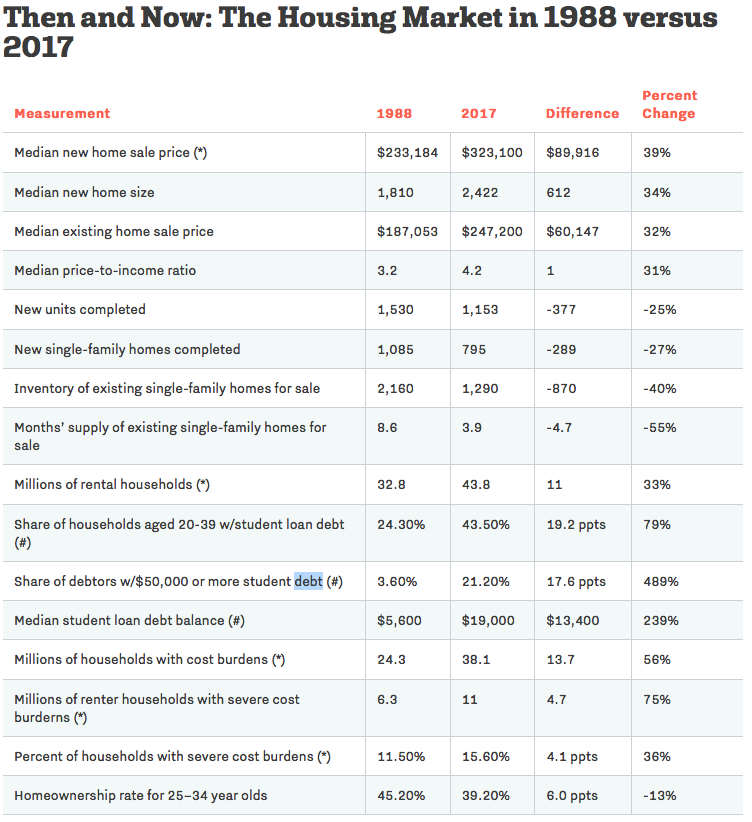
How the housing market has become harder since 1988

Millennials facing today’s difficult housing market, and the challenges of buying their first home, can wistfully imagine the ’50s and dream of a time when government policy and growth made buying a home easier for much of the population. But, as a new comparison between today’s market in the late ’80s suggests, they don’t need to look quite that far back to find a more promising housing market.

The Harvard Joint Center for Housing Studies’ annual State of the Nation’s Housing report has provided a measuring stick for changes in the home and rental market in the United States, tracking the vibrancy of the rental and homebuilding market, and whether the nation was making progress on the serious issue of affordability.

On the 30th anniversary of the report’s first release, the authors created a comparison showing how the housing market of 1988 measures up against the market today. The chart below demonstrated the significant shifts of just the past few decades, and shows how things have gotten harder for younger buyers. It wasn’t all easy—interest rates hovered around 10.5 percent, for one thing—but the overall decrease in young adult homeownership reflects how things have shifted.

Overall, homes were smaller, but easier for the average American to afford (based on the cost-to-median-income comparison), and supply was much healthier. The student loan burden was also significantly smaller. This time capsule underlines the serious supply and cost challenges we face today, especially single-family homes, as well as the rise in the rent-burdened population.

Posted in Demographics, Economics, National Real Estate | 60 Comments

About time…

From CNBC:

Millennials moving out of Mom and Dad’s place, study shows

If you have an adult child living at home, you could become an empty nester sooner than you thought.

The number of 18- to 34-year-olds living with parents last year edged down from 2016, according to new data from CoStar Group, a commercial real estate information company in New York.

Last year, 31.5 percent of that age cohort were living with Mom and Dad, down slightly from more than 32 percent in 2016. While still higher than the long-term average of under 28 percent, it’s a downward trend the firm expects to continue due to the strength of the job market and overall economy.

“There are more individuals in that age cohort who are employed,” said Michael Cohen, director of advisory services at CoStar. “We also should see some wage gains in that age range. … Both of those things help.”

Cohen said the tight labor market — overall unemployment is about 3.8 percent — has led to a higher rate of workforce participation among younger adults.

“That gives me some degree of confidence that we’ll see some more momentum … in [young adults] moving out of Mom’s place,” Cohen said.

Additionally, as young adults progress in their careers, their incomes should rise with those job advancements.

Millennials generally face financial challenges that their parents did not as young adults. On top of carrying most of the $1.5 trillion in student loan debt, their wages are lower than their parents’ earnings when they were in their 20s.

A 2017 study of Federal Reserve data by advocacy group Young Invincibles showed that millennials earned an average of $40,581 in 2013. That’s 20 percent less than the inflation-adjusted $50,910 earned by baby boomers in 1989.

As it stands, more than a third (35 percent) of U.S. workers are millennials (defined as those age 21 to 36 in 2017), making them the largest generation in the labor force, according to the Pew Research Center.

Posted in Demographics, Economics, Employment, National Real Estate | 137 Comments